

Avoid Audit Failures: Transcription Data Retention for HIPAA and GDPR
Most transcription platforms tie a transcript’s lifespan to the retention setting applied to its source recording, not to a fixed universal clock. Default windows commonly range from about one day for raw processing artifacts to several months for stored transcripts, with configurable extensions for regulated data. The immediate action for any compliance or engineering team: audit your vendor’s current retention dashboard, export anything you’re legally obligated to keep, and document the legal basis behind whatever window you choose.
TL;DR:
- Short-term retention for processing artifacts typically lasts 24 to 72 hours, with deletion often happening automatically soon after transcription completes.
- Vendor default retention periods generally range from a few months to multiple years, with options for longer or unlimited storage depending on the platform.
- Legal minimum retention guidelines for HIPAA-regulated data extend to at least six years, while GDPR requires retention to be proportionate to the purpose, with no fixed minimum.
- Data deletion involves a chain of mechanisms, including soft delete and eventual permanent purge, which can delay data unrecoverability beyond the vendor’s stated TTL.
- Establishing a retention policy should categorize data types, set legal and business-driven retention periods, and include procedures for audits, legal holds, and documented deletion confirmation.
Table of Contents
- Common Transcription Data Retention Timelines and Vendor Examples
- What Legal Rules Govern Transcription Data Retention?
- How Retention Actually Works Behind the Scenes
- Building a Transcription Data Retention Policy
- Proving Deletion and Passing an Audit
- Why Conservative Defaults Beat Convenient Ones
- Evaluate a Retention-Aware Transcription Provider
- Sources
- FAQ
Common Transcription Data Retention Timelines and Vendor Examples
Retention windows vary by processing stage, and conflating them is the most common mistake teams make when auditing a vendor. Ephemeral processing, where audio is transcribed and the working copy discarded, typically lasts minutes to a couple of days. Job outputs, the actual transcript text returned by an API, often sit in a separate, short-lived window before automatic deletion.
Vendor documentation shows a fairly consistent pattern across the industry:
- Ephemeral processing servers delete local audio copies immediately after a job completes, according to pyannote.ai’s retention documentation, which also recommends retrieving job results within 24 to 72 hours since that’s the default output retention window.
- Configurable retention settings commonly default to a few months, with the option to set a custom day count, schedule automatic deletion, or select unlimited retention, per ElevenLabs’ retention configuration guidance.
- Enterprise collaboration and contact center platforms frequently combine short admin visibility windows with much longer underlying storage. Genesys Cloud’s documentation on analytics and recording retention describes per-tenant configurable periods ranging from automatic post-processing purges to multi-year contractual retention.
- Some platforms limit standard admin access to a short period even when the underlying data persists longer in storage, as detailed in Dialpad’s data retention policy.
The takeaway: never assume a transcript outlives its source recording. Check both settings independently before relying on either.
What Legal Rules Govern Transcription Data Retention?
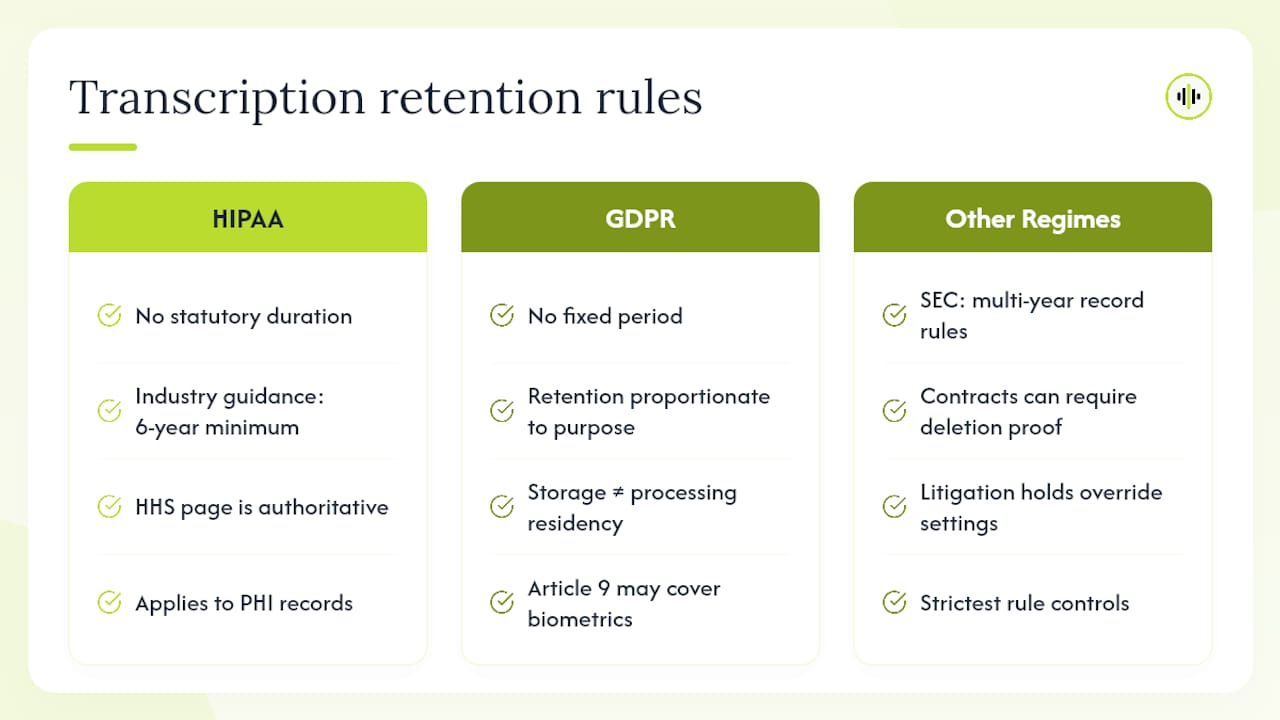
HIPAA, GDPR, and sector-specific recordkeeping laws each impose different retention logic, and the strictest applicable rule wins. HIPAA doesn’t set a single retention duration in the statute itself, but vendor guidance and industry practice commonly suggest multi-year minimums for records tied to protected health information, based on the HIPAA Privacy Rule’s documentation retention requirement. ElevenLabs’ retention guidance for conversational data cites this six-year benchmark for HIPAA-regulated audio and transcripts, and the HHS HIPAA laws and regulations page remains the authoritative reference for confirming exact obligations for a given covered entity.
GDPR complicates the picture differently. It doesn’t set a fixed retention period at all. It requires retention that’s proportionate to purpose, and it distinguishes storage residency from processing residency. A transcript stored in an EU data center can still trigger cross-border transfer obligations if the underlying speech model processes audio through infrastructure outside the EU, a distinction DEV Community’s guide to GDPR-compliant speech-to-text APIs covers in detail. Voice biometrics and certain AI-derived speaker identifiers can also qualify as special-category data under Article 9, which raises the bar for lawful processing and often triggers a Data Protection Impact Assessment requirement.
Statistic Callout: Vendor guidance commonly cites a six-year minimum for HIPAA-regulated audio and transcription records, one of the longest default retention benchmarks referenced across mainstream transcription vendor documentation.
Other regimes add contractual weight. SEC recordkeeping rules can mandate multi-year retention for communications tied to regulated financial activity, and enterprise contracts frequently specify deletion confirmation obligations that exceed what a vendor’s default settings provide. When a contract, regulator, or litigation hold conflicts with a vendor’s standard retention window, escalate to legal before changing any setting, and keep documentary evidence: the retention policy version in effect, the justification memo, and any signed data processing agreement addendum.
How Retention Actually Works Behind the Scenes
Retention isn’t one switch. It’s a chain of technical mechanisms, each with its own timing, and understanding the chain matters more than memorizing a single number.
- Ephemeral processing. Temporary media stores hold raw audio only long enough to complete transcription, typically 24 to 48 hours, then delete local copies automatically, as pyannote.ai’s documentation describes.
- Job result windows. Completed transcripts often sit in short-lived storage, commonly 24 to 72 hours by default, before deletion. Retrieve and store anything you need outside that window immediately rather than assuming the API will hold it.
- Soft delete, then hard purge. Most platforms mark a record as deleted first, which reverses accidental removals, then permanently purge it roughly 30 days later. This two-stage pattern protects against mistakes but also means a “deleted” record may still be technically recoverable for weeks.
- Access tiering. As data ages, some platforms restrict it to minimal metadata or read-only playback rather than full export, and standard admin dashboards may lose visibility into records after a set window even though the data persists in backend storage, per Dialpad’s tiered access documentation.
Deletion timing also depends on the underlying infrastructure. AssemblyAI’s documentation on deletion lifecycles notes that deletion events often begin at TTL expiration, sometimes as short as one hour, but the actual purge can lag by minutes to days depending on how the cloud provider processes the deletion queue.
Pro Tip: Never rely on a vendor’s stated TTL as the moment data becomes unrecoverable for legal purposes. Treat the soft-delete window as still discoverable, and build your legal-hold procedures around the hard purge date, not the deletion request date.
Building a Transcription Data Retention Policy
A usable policy starts by separating data types, since audio, transcripts, metadata, and analytics derivatives rarely need the same retention clock. Raw audio often carries the highest sensitivity and shortest justified retention; derived analytics (sentiment scores, keyword tags) can sometimes persist longer since they carry less identifiable detail. Decision criteria should weigh four factors: applicable legal minimums, litigation hold exposure, genuine business need for quality assurance or analytics, and the storage cost and breach risk of holding data longer than necessary.
A workable policy template covers these fields:
- Scope: which data types and systems the policy governs
- Retention periods: by data type, with legal basis noted for each
- Deletion procedure: soft delete trigger, hard purge timeline, and who executes it
- Exception handling: how litigation holds or active investigations pause deletion
- Review cadence: how often the policy is reassessed against new regulations or vendor changes
- Roles and responsibilities: who owns the policy, who approves exceptions, who audits compliance
| Data type | Typical retention driver | Review trigger |
|---|---|---|
| Raw audio | Processing necessity, HIPAA minimums if regulated | Vendor contract renewal |
| Transcripts | Business need plus legal minimum, whichever is longer | Annual policy review |
| Metadata/logs | Operational troubleshooting need | Storage cost audit |
| Analytics derivatives | Business analytics value | Data minimization review |
Proving Deletion and Passing an Audit
Auditors and regulators don’t accept “we deleted it” as evidence. They want documentation. A Data Processing Agreement should list every sub-processor touching the data, the physical processing locations, and an explicit deletion confirmation obligation, so you’re not left guessing whether a vendor actually purged records after contract termination.
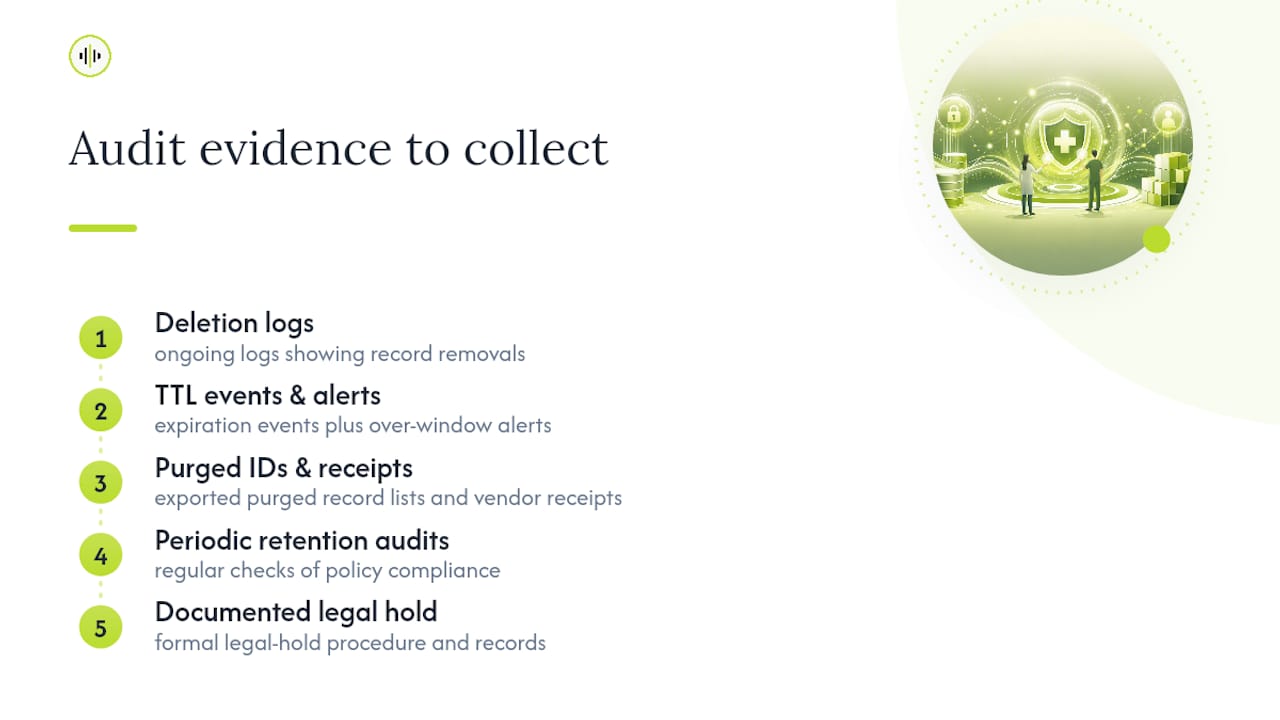
Voice and biometric data raise the stakes further: if your DPIA hasn’t specifically evaluated speaker identification or voice biometric features, it’s incomplete. Audit evidence worth collecting on an ongoing basis includes deletion logs, TTL expiration events, exported lists of purged record IDs, and deletion receipts issued by vendors after a request. Periodic retention audits, automated alerts when live data exceeds its policy window, and a documented legal-hold procedure round out the operational baseline most compliance teams end up needing anyway.
Why Conservative Defaults Beat Convenient Ones
The instinct to keep everything “just in case” analytics needs it later is the biggest liability I see in retention planning. Short default windows with documented exceptions cost less and expose less. Retention deserves the same rigor as any other engineering requirement: unit tests, telemetry, and alerts when a system drifts from policy. Teams that treat deletion as a compliance afterthought instead of a built system are the ones that fail audits, not the ones with strict clocks.
— Benjamin
Evaluate a Retention-Aware Transcription Provider
OpenTranscription is built for teams that need to see exactly what happens to audio and transcripts at every stage, not just trust a vendor’s marketing page. The platform’s billing model works alongside structured job outputs, so you retrieve transcripts, timestamps, and confidence scores on your own schedule instead of hoping a default window doesn’t expire before you export.
Because the platform benchmarks many transcription models side by side, compliance and engineering teams can compare how different providers handle processing location, output structure, and per-job retrieval before committing to one for regulated workloads. Review the model comparison catalog to see which models fit your accuracy and residency requirements, or check the realtime model rankings if streaming and ephemeral output handling matter most for your use case. Start a proof-of-concept on the OpenTranscription platform and test retrieval timing against your own retention policy before it goes into production.
Sources
Confirm current obligations directly: HHS HIPAA guidance, vendor retention docs from ElevenLabs and pyannote.ai, plus GDPR residency guidance. Healthcare teams should also review Live Caption AI’s HIPAA-compliant transcription overview for provider-specific compliance considerations.
This article is general information, not a substitute for advice from a qualified lawyer. Consult a qualified legal professional about your own circumstances before acting on anything here.
- HHS — HIPAA laws and regulations
- pyannote.ai — data retention and ephemeral processing notes
- Dialpad — data retention policy examples
FAQ
How Long Must HIPAA-Related Files Be Saved?
Vendor guidance and industry practice commonly point to a six-year minimum for HIPAA-regulated audio and transcription records, though the exact requirement depends on the covered entity’s own documentation policies under the HIPAA Privacy Rule.
What Is a 7-Year Retention Policy?
Some organizations adopt a seven-year retention window as an internal buffer beyond HIPAA’s six-year documentation minimum or to align with specific state recordkeeping laws or contractual terms, rather than because a single universal law mandates exactly seven years.
What Is a Best Practice for Transcription Data Retention?
Best practice combines short default windows, commonly 30 to 90 days for standard transcripts, with documented exceptions for legal holds, and a two-stage soft delete followed by hard purge process that leaves an auditable deletion trail.
Do Meeting Transcripts Expire?
Yes, most collaboration platforms apply configurable retention settings to meeting transcripts, often defaulting to a period like 90 days before automatic deletion unless an administrator sets a longer or unlimited window, similar to the configurable ranges described in vendor retention documentation.
Does OpenTranscription Retain Audio and Transcript Data?
OpenTranscription’s structured output model lets you retrieve transcripts, timestamps, and confidence scores per job, so retention behavior depends on the specific model and settings you choose; current details are available on the OpenTranscription platform.