

105+ Languages or Under 200ms? Rust Speech to Text for Developers
Building Rust speech-to-text today comes down to three practical routes: pure-Rust inference engines for low-latency local streaming, C++/ONNX-backed crates for broader model access, or a transcription API for teams that want accuracy benchmarking without operating GPU infrastructure. Pure-Rust crates like nspeech suit edge devices and real-time constraints; ONNX-backed options fit projects that need newer architectures fast; an API like OpenTranscription fits teams optimizing for coverage across 105+ languages and predictable per-second billing rather than infrastructure ownership.
TL;DR:
- Pure-Rust inference engines are ideal for edge devices and real-time applications due to their low latency and small binary size.
- ONNX-backed crates provide access to the latest models but come with a heavier, more platform-dependent build and longer cross-compilation times.
- Transcription APIs like OpenTranscription enable broad language support and predictable billing without managing GPU infrastructure, suitable for bursty or large-scale workflows.
- To build a minimal local pipeline, decode audio with symphonia, load quantized models via memory-mapping, and implement voice activity detection for better accuracy.
- Benchmark local Rust solutions against hosted models early to identify whether runs meet latency and accuracy needs before investing heavily in infrastructure.
Table of Contents
- The Rust Speech-to-Text Ecosystem, Mapped
- Notable Rust Libraries and Tools Worth Knowing
- How to Choose the Right Rust Approach for Your Project
- Getting a Minimal Rust Transcription Pipeline Running
- When an API Beats Local Rust Infrastructure
- A Rust Developer’s Honest Take on This Ecosystem
- Sources
- FAQ
The Rust Speech-to-Text Ecosystem, Mapped
Rust speech recognition splits into four project categories, each solving a different constraint. Unified wrapper crates expose one trait across multiple inference backends, letting you swap a Whisper model for an ONNX model without rewriting your pipeline. Pure-Rust inference engines skip C++ dependencies entirely and compile to a single binary. ONNX or libtorch-backed crates trade a heavier dependency tree for immediate access to whatever model architecture researchers publish next. CLI tools wrap any of the above into a command a developer can run without touching library code.
Underneath those categories, a handful of technical decisions determine whether a project actually ships:
- Quantization format (GGUF, INT8, INT4) controls model size and cold-start time, often more than hardware choice does.
- Hardware backend (Metal on macOS, WGPU for cross-platform GPU, CUDA for NVIDIA-only server deployments) dictates which platforms you can realistically target.
- Memory-mapped weights let a binary load a model without copying gigabytes into RAM first, which matters on constrained edge hardware.
- Voice activity detection and diarization turn raw inference into a usable pipeline instead of a model that only handles clean, pre-segmented audio.
Deployment target narrows the field further. A desktop or server GPU project can afford a 1.5B parameter Whisper variant and CUDA acceleration. An embedded or edge target needs INT4 quantization and a binary under a few hundred megabytes. A WASM/browser target adds a third constraint: no threads by default, no filesystem access, and a hard ceiling on model size that most large ASR architectures blow past without careful quantization.
Notable Rust Libraries and Tools Worth Knowing
Five projects cover most of what developers building speech recognition in Rust actually reach for, each solving a slightly different problem.
-
transcribe-rs exposes a unified
SpeechModeltrait that supports Whisper via whisper.cpp, OpenAI’s API, and ONNX-based models behind one interface. If you want to A/B test backends without rewriting your call sites, this is the crate that makes that swap a config change instead of a refactor. It ships word-level timestamps out of the box, which most raw inference wrappers do not. -
nspeech runs entirely in Rust with no Python runtime dependency, and it accelerates on Metal (macOS) and D3D12 (Windows) natively. Choose it when you need local GPU inference on a developer laptop without shipping a Python environment alongside your binary. It loads GGUF quantized models for faster cold starts, which matters if your tool spins up per-request rather than staying resident.
-
whisper.apr implements Whisper and Moonshine-style architectures in pure Rust, tuned specifically for streaming and WASM targets. Its INT4/INT8 quantization and direct GGUF loading make it the most credible option if your endpoint is a browser tab rather than a server.
-
WhisperForge, wforge, and voicet are GPU-accelerated, high-performance Whisper-style implementations built around memory-mapped weights and small binaries. They target realtime streaming specifically, with startup times low enough to matter for CLI tools that users expect to launch with low delay rather than warm up for several seconds.
-
yamabiko-asr and qwen3_asr_rs lean on ONNX or libtorch bindings instead of pure-Rust inference. That trade gives up some binary portability but buys immediate compatibility with newer model releases that haven’t been reimplemented natively yet.
How to Choose the Right Rust Approach for Your Project
Five axes decide which of the three approaches fits: latency requirements, accuracy needs, ongoing maintenance cost, how many languages or models you need access to, and whether you’re doing streaming or batch work.
Pure-Rust crates win on dependency footprint and cold-start speed, since pure-Rust inference with memory-mapped weights avoids importing large ML frameworks the way Python-based stacks typically do. The trade-off is model coverage: you’re limited to whatever architectures have a native Rust implementation. C++/ONNX-backed crates flip that trade. You get immediate access to the newest model releases, but you inherit a heavier build, slower cross-compilation, and more platform-specific quirks to debug. A transcription API removes the infrastructure question entirely, at the cost of network latency and per-second billing instead of compute you own.
- Need sub-200ms partial results in a desktop app? Pure-Rust streaming with a small quantized model.
- Need the newest research model the week it ships? An ONNX-backed crate.
- Need to support 20+ languages without maintaining model files yourself? An API.
Pro Tip: Prototype with a pure-Rust crate locally first, even if you plan to end up on an API. It exposes your real latency and accuracy requirements before you commit to a billing model.
Getting a Minimal Rust Transcription Pipeline Running
A working local pipeline needs four pieces wired together correctly, and most implementation pain comes from getting the order wrong rather than any single step being hard.
- Decode audio with symphonia rather than hand-rolling format parsing. It handles WAV, MP3, and FLAC consistently and saves you from sample-rate mismatches that silently degrade accuracy.
- Pick a pre-quantized model. GGUF or INT8 formats load faster and start faster than full-precision weights, which matters most for CLI tools invoked per-request rather than long-running services.
- Memory-map the weights when the crate supports it, so your binary doesn’t copy gigabytes into RAM on every launch.
- Add voice activity detection before inference, chunking audio into windows rather than feeding one continuous stream. Startup buffering of roughly 320 milliseconds, paired with 8 to 50 frame windows depending on model size, is a common starting point for balancing latency against accuracy.
- Wire in a KV cache if you’re streaming, since incremental decoding without one recomputes context on every chunk and destroys your latency budget.
- Run and collect output as JSON or SRT, structured enough to feed into a downstream captioning or search pipeline without a second parsing pass.
Skipping the VAD step is the most common mistake: feeding a model raw, unsegmented audio tends to produce worse transcripts than the same audio pre-chunked, even when the model itself hasn’t changed.
When an API Beats Local Rust Infrastructure
Local inference makes sense when latency is the constraint and you’re willing to own the GPU backend differences between Metal, WGPU, and CUDA. It stops making sense the moment your real bottleneck is model selection, language coverage, or the ops overhead of keeping quantized weights current across a fleet of edge devices.
That’s the gap OpenTranscription is built for. Instead of picking one crate and living with its model coverage, OpenTranscription’s API gives you access to 30+ transcription models behind a single integration, with realtime streaming, speaker identification, and support for 105+ languages. Every transcript can come back structured, with word-level timestamps and confidence scores, reducing the need for custom parsing logic on top of raw model output. Pricing models often bill per-second without subscription, which may benefit workflows that are bursty rather than constant.
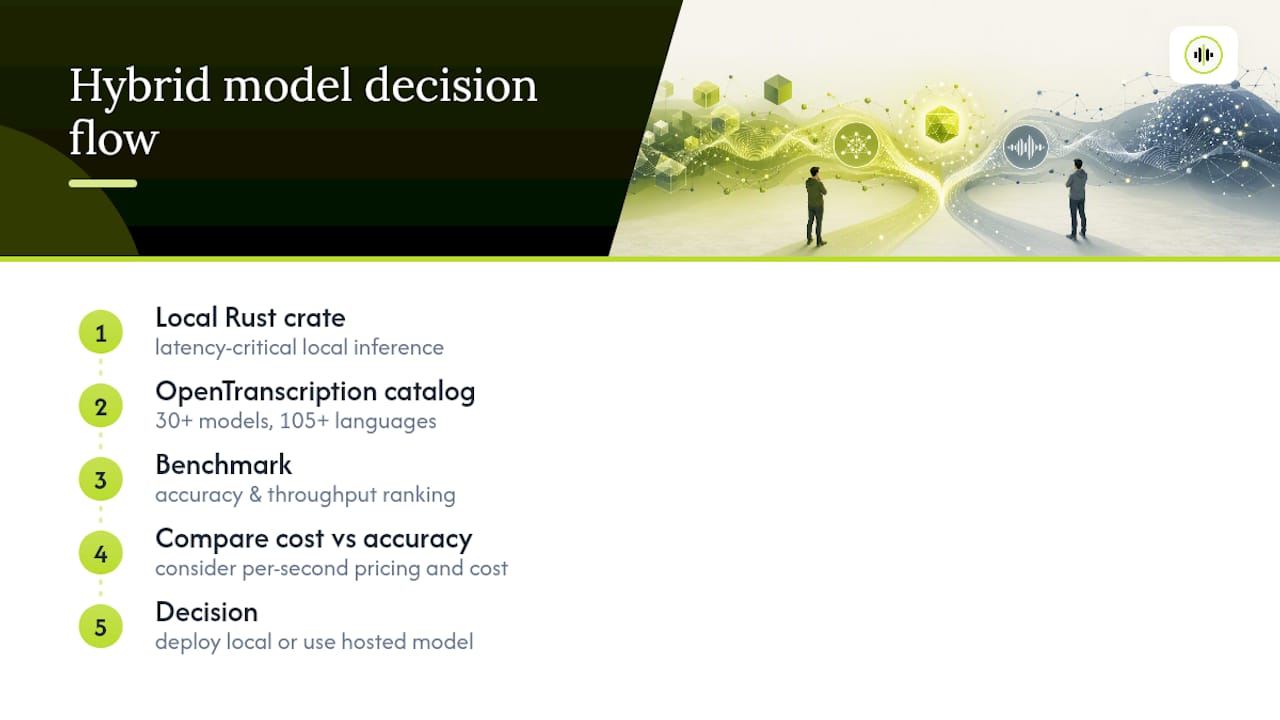
A practical hybrid: keep a pure-Rust crate for latency-critical local inference, and use OpenTranscription’s model catalog or realtime rankings to benchmark accuracy and throughput across models before deciding what your local pipeline should even try to match. If the numbers show a hosted model beating your local setup on both cost and accuracy, start comparing models rather than continuing to tune a Rust binary that’s already behind.
A Rust Developer’s Honest Take on This Ecosystem
The dependency tax surprises almost everyone who starts with an ONNX-backed crate expecting a clean cargo build. Pulling in libtorch or ONNX Runtime drags in platform-specific shared libraries that behave differently on macOS, Linux, and Windows, and cross-compilation stops being simple the moment you add one of these crates. Pure-Rust alternatives avoid that entirely, which is the real reason projects like nspeech and whisper.apr exist, not because pure Rust is philosophically superior.
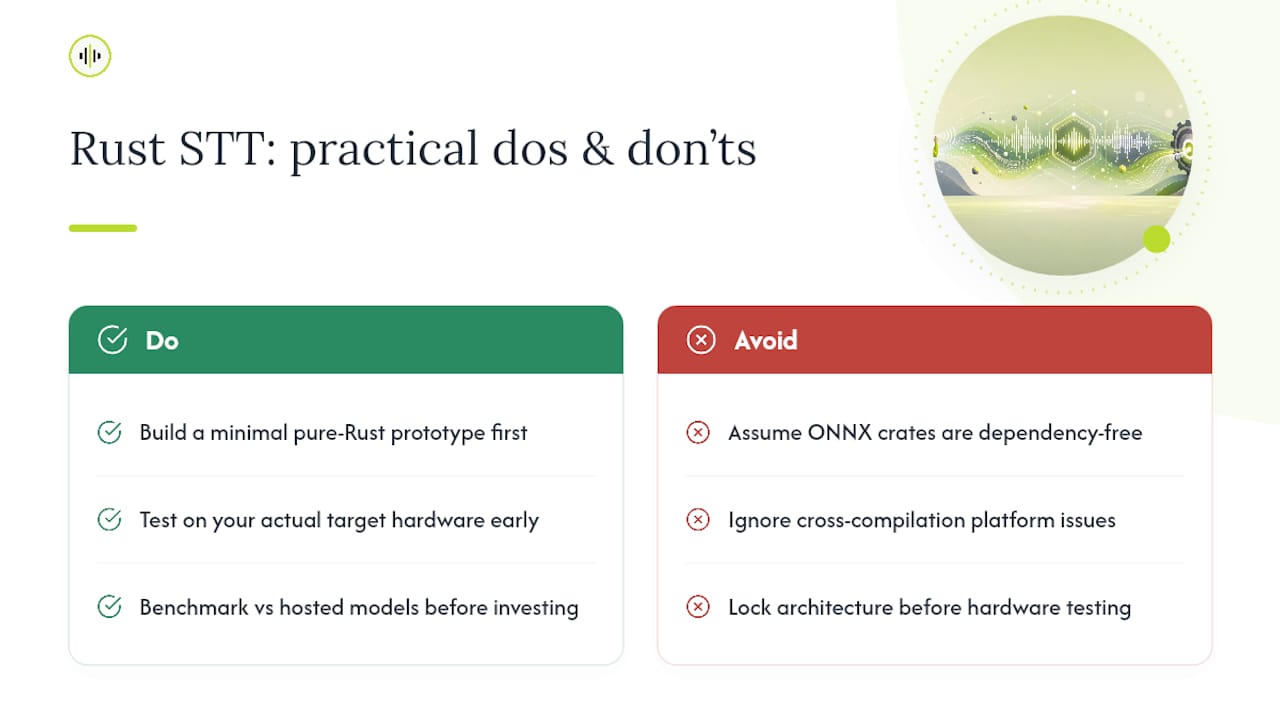
GPU backend fragmentation is the second gotcha nobody mentions until it costs them a week. Metal, CUDA, and WGPU do not behave identically, and code that streams cleanly on a Mac can stutter on a Windows machine with a different driver version. Test on your actual target hardware early, not after the architecture is locked in.
My honest recommendation: build a minimal pure-Rust prototype first, since it forces you to confront your real latency and accuracy requirements fast. Once you know what “good enough” looks like, benchmark it against hosted models before sinking more engineering time into infrastructure you might not need.
— Benjamin
Sources
FAQ
What is the best Rust library for speech recognition?
There’s no single best option. transcribe-rs offers the most flexibility through its unified backend trait, nspeech is strongest for pure-Rust GPU acceleration, and whisper.apr leads for WASM and streaming targets.
Can Rust do real-time speech-to-text?
Yes. Crates like nspeech, whisper.apr, and voicet are built specifically for realtime streaming with GGUF quantization and memory-mapped weights to minimize startup latency.
Does Rust speech-to-text work with SIMD audio optimization in the browser?
It can, through WASM. whisper.apr targets browser deployment directly with INT4/INT8 quantized models small enough to run without a server round trip, though model size and SIMD-accelerated audio processing remain real constraints.
Should I build a local Rust pipeline or use an API?
Build locally when latency or offline operation is the hard requirement. Use an API like OpenTranscription when you need broad model coverage, multiple languages, or want to avoid maintaining GPU infrastructure.
What causes slow cold starts in Rust ASR crates?
Loading full-precision model weights without quantization is the most common cause. Pre-quantizing to GGUF or INT8 and memory-mapping the weights typically cuts cold-start time significantly compared to Python-based stacks that import large ML frameworks on every launch.