

ASR Benchmark Methodology: MWER, RTFx, and Production Data
A credible ASR benchmark methodology specifies dataset scope with documented provenance, a published normalization and tokenization pipeline, ground-truth transcripts validated through double-pass annotation, core metrics (WER and CER) alongside complementary diagnostics, a deterministic scoring pipeline with multi-reference handling, and full resource reporting including RTFx and hardware configuration. Skip any one of these and the resulting numbers become an artifact of the test setup rather than a measure of the system. Multiple tracks spanning short-form, long-form, and multilingual audio, tied to open scoring scripts, are what separate a defensible result from a marketing claim.
TL;DR:
- Running multiple datasets, tracks, and rotating test sets ensures benchmark stability and reduces bias, preventing overfitting to a single test scenario.
- Explicitly publishing normalization and scoring scripts, along with hardware and environment details, makes results reproducible and comparable across labs.
- Normalization choices, such as punctuation and number handling, can shift WER by several points, so precise rules must be disclosed to interpret results correctly.
- Authentic dataset composition that matches real-world conditions, including demographic, audio, and domain diversity, is essential for production-relevant performance estimates.
- Using double-pass human transcription with linguistic auditing and multi-reference annotations validates ground truth quality and mitigates annotation variance impact.
Table of Contents
- Why ASR Benchmark Methodology Matters for Reproducible Results
- How Do WER and CER Actually Work, and When Should You Normalize Text?
- What Makes a Dataset Production-Representative?
- How Do You Validate Ground-Truth Transcription Quality?
- What Tools Handle Alignment and Multi-Reference Scoring?
- What Evaluation Tracks Should a Benchmark Include?
- How Do You Report RTFx and Resource Usage Correctly?
- What Causes Misleading Benchmark Results, and How Do You Catch Them?
- A Compact Protocol for Running an ASR Benchmark
- How OpenTranscription Implements This Methodology in Practice
- Lessons From Building and Running These Benchmarks
- Run Your Own Reproducible ASR Benchmark Faster
- Sources
- FAQ
Why ASR Benchmark Methodology Matters for Reproducible Results
Every ASR benchmark exists to answer three questions: does this system work as claimed, does it work fairly across the conditions that matter to the reader, and can someone else verify the result without access to the original lab. A formal methodology is the only mechanism that keeps those three questions answerable at scale, particularly as commercial ASR vendors multiply and publish self-reported numbers with no shared baseline.
Most benchmarking failures trace back to a small set of recurring mistakes. A single aggregate WER on one dataset creates an illusion of precision that collapses the moment the audio conditions shift. Undocumented normalization, stripping punctuation or lowercasing text before scoring, can shave several points off WER without disclosure, making two “identical” benchmark runs incomparable. Dataset bias toward clean, read speech overstates real-world accuracy, and omitted resource reporting hides the fact that a top score came from a model running on hardware no production team could afford.
The fix is structural, not cosmetic:
- Run multiple datasets and tracks rather than one flagship test set.
- Publish the exact normalization and scoring scripts used, not just the final numbers.
- Report efficiency alongside accuracy so cost and latency trade-offs stay visible.
- Rotate or partially withhold test data to reduce contamination risk over time.
The ASR Leaderboard project demonstrates this directly: evaluating 86 systems across 12 datasets, it found that no single dataset or metric produced a stable ranking across short-form, multilingual, and long-form audio. A methodology built around one benchmark is a methodology built to mislead eventually.
How Do WER and CER Actually Work, and When Should You Normalize Text?
Word Error Rate remains the default accuracy metric, and its formula is simple to state but easy to misuse: WER equals the sum of substitutions, insertions, and deletions divided by the total words in the reference, expressed as a percentage. A substitution is a wrong word swapped for the right one, an insertion is an extra word the system hallucinated, and a deletion is a word the system dropped entirely. Each error type tells you something different about failure mode: high insertion rates often point to noise sensitivity, while high deletion rates suggest the model is under-transcribing fast or overlapping speech.
Character Error Rate applies the same substitution/insertion/deletion logic at the character level instead of the word level. CER becomes the more informative metric for morphologically dense or logographic languages, where word boundaries are ambiguous or a single character error can distort WER disproportionately. Recent work on multilingual evaluation found that CER correlates better with human judgment than WER for a range of non-English languages, which is why multilingual benchmarks should report both metrics rather than defaulting to WER alone.
Statistic Callout: Text normalization choices, casing, punctuation stripping, number formatting, filler-word handling, can shift reported WER by several points on the same audio and the same model, according to Hugging Face’s ASR evaluation documentation. Two labs testing the identical system can publish materially different scores purely from undisclosed text cleanup.
A rigorous methodology publishes the normalization rules explicitly:
- Whether punctuation and casing are scored or stripped before comparison.
- How numbers, dates, and currency are normalized (digits versus spelled-out forms).
- How disfluencies and filler words (“um,” “uh”) are treated.
- Whether the original, unnormalized transcript is preserved for later re-analysis.
Some deployments care less about raw accuracy and more about whether a model follows specific formatting instructions, entity casing, disfluency removal, punctuation style. Preference-aware evaluation frameworks test exactly that, exposing gaps between models that look identical on aggregate WER but diverge sharply once graded against a client’s actual formatting preferences.
What Makes a Dataset Production-Representative?
A benchmark dataset only means something if its composition mirrors the audio the system will actually encounter in deployment. Building that scope requires deliberate choices, not a convenient corpus grabbed off the shelf.
- Define the acoustic and demographic envelope first. Specify the accents, age ranges, recording devices, background noise levels, and turn-taking patterns (single speaker, overlapping dialogue, call-center crosstalk) the benchmark needs to cover before sourcing any audio.
- Choose scripted or conversational protocols deliberately. Scripted read speech produces cleaner, more reproducible baselines and isolates acoustic modeling performance; conversational or spontaneous speech captures disfluencies, code-switching, and overlap that scripted audio never will. Most production-representative benchmarks need both, reported as separate tracks rather than blended into one score.
- Size the sample for statistical validity. Stratify by the demographic and acoustic categories defined in step one, and ensure each stratum carries enough utterances that a swing from one bad clip doesn’t move the aggregate score.
- Document provenance and licensing on every clip. Appen’s five-stage benchmark methodology, scoping, contributor sourcing, speech design, recording with metadata, and transcription QA, treats this as a first-class deliverable, not an afterthought.
- Rotate or partially withhold test sets over time. Static, publicly posted benchmarks eventually leak into training data. Periodic rotation and held-back partitions reduce that contamination risk.
Vocabulary domain and utterance length deserve the same rigor: a benchmark built entirely from short customer-service utterances will not predict performance on 40-minute podcast transcription, and vice versa.
How Do You Validate Ground-Truth Transcription Quality?
Every benchmark is only as trustworthy as its reference transcripts.
Industry guidance from cloud speech-to-text documentation recommends double-pass human transcription paired with senior-linguist auditing as the baseline standard, not an optional upgrade. A second transcriber working independently catches errors a single pass misses, and a linguist audit resolves disagreements against a published style guide rather than ad hoc judgment calls.
- Run two independent transcription passes and reconcile discrepancies against a documented style guide.
- Use multi-reference annotation with wildcard syntax to mark acceptable variant wordings (contractions, alternate spellings, optional filler words) instead of penalizing valid alternatives as errors.
- Measure inter-annotator agreement and spot re-annotate a sample to catch systematic drift.
- Publish the reference QA procedure alongside the dataset, not just the final transcript files.
Annotation variability is not a rounding error at the top end of performance. Research on annotation variance found that as systems approach state-of-the-art WER, human disagreement on the correct transcription becomes a dominant source of measured error, which means a methodology should quantify what fraction of tokens carry multiple valid annotations and report how much of the measured gap between systems could be explained by that variance alone.
Pro Tip: Before trusting a benchmark’s headline number, ask for the inter-annotator agreement rate on its reference set. A benchmark that cannot produce that figure has not actually validated its ground truth.
What Tools Handle Alignment and Multi-Reference Scoring?
The scoring pipeline sits between raw model output and the final WER number, and small implementation choices here produce large swings in reported accuracy. A deterministic pipeline, the same normalizer, the same alignment algorithm, the same tokenizer, applied identically to every system under test, is the only way to make cross-system comparison meaningful.
- Tokenization and normalization come first, in a fixed order. Language-specific normalizers (handling contractions, diacritics, or word segmentation for non-space-delimited languages) must run identically for every submission, and the exact script should ship with the benchmark.
- Alignment algorithm choice affects stability. Traditional edit-distance alignment can misattribute errors when a model produces a valid but differently ordered phrase; token-based alignment with relaxed insertion penalties reduces that noise, an approach NIST’s OpenASR21 evaluation plan formalizes through its SCTK/sclite scoring toolchain.
- Multi-reference scoring resolves legitimate wording variance. Minimum Word Error Rate (MWER) scoring compares model output against several acceptable references and takes the best alignment, rather than penalizing a correct-but-unanticipated phrasing against a single rigid reference. The asr_eval toolkit implements MWER along with wildcard handling and streaming-specific plots, purpose-built for benchmarks that need to score partial and multi-reference hypotheses without hand-rolled scripts.
- Publish exact command lines, not descriptions of the process. A methodology section that says “we used standard WER scoring” tells another lab nothing; a repository with the exact invocation, flags, and normalizer version lets them reproduce the number.
Multi-reference scoring is not a cosmetic improvement. It reduces the spurious error count that comes purely from a model choosing a valid synonym or contraction the reference writer didn’t anticipate, which otherwise inflates WER without reflecting a real capability gap.
What Evaluation Tracks Should a Benchmark Include?
No single track can represent the full range of ASR use cases, so credible benchmarks split evaluation into separate tracks rather than blending everything into one score.
- Short-form covers utterances typically under 30 seconds, close to voice-command or call-center turn length, where latency and per-utterance accuracy matter more than long-context modeling.
- Long-form covers extended audio, podcasts, lectures, and meetings, often chunked into 30-second windows for models with fixed context limits; the chunking boundary itself needs to be documented since it affects word-boundary errors at chunk edges.
- Multilingual tracks isolate performance by language family and script, since a system’s aggregate score across ten languages can hide near-total failure on one.
Training condition also needs disclosure. NIST’s OpenASR21 plan formalizes three tiers, Constrained (only the provided training data), Constrained-plus (provided data plus a limited external set), and Unconstrained (any data), each requiring separate submission and separate leaderboard placement so a system trained on internet-scale data never gets compared against one trained on a fixed, audited corpus as if they competed on equal terms.
Aggregating results across tracks should never collapse into one blended number. Reporting per-track results side by side, and flagging when one dataset drives an outsized share of the aggregate error, is what catches a model that excels on read speech but fails badly on conversational overlap.
How Do You Report RTFx and Resource Usage Correctly?
Accuracy without efficiency context is half a result. Inverse real-time factor, RTFx, measures how many seconds of audio a system processes per second of compute time; an RTFx of 50 means the system transcribes 50 seconds of audio in one second of processing. Reporting it consistently means fixing whether you are timing single-utterance or batched inference, and using wall-clock time rather than a theoretical FLOPs estimate.
- Report GPU or CPU model, driver version, batch size, numerical precision (FP16 versus FP32), and peak memory usage alongside every RTFx figure.
- Discard the first run as a warm-up and average or take the median across several trials, since cold-start latency skews single-run numbers.
- Capture the environment as a manifest, container hash or dependency lockfile, not just a written description, since driver and CUDA version mismatches are a common source of irreproducible RTFx numbers between labs running “the same” benchmark.
Statistic Callout: NIST’s OpenASR21 evaluation plan treats time and memory usage as mandatory secondary metrics, not optional disclosures, precisely because resource reporting lets teams weigh accuracy against inference cost and catch results that only look strong because they ran on disproportionate hardware. For a deeper look at how latency budgets get set in production voice systems, this breakdown of conversational latency is a useful companion reference.
What Causes Misleading Benchmark Results, and How Do You Catch Them?
Three failure patterns recur across public ASR benchmarks, and each has a specific mitigation.
Test-set contamination happens when benchmark audio, or transcripts closely matching it, leaks into a model’s training data, inflating scores on that specific set without reflecting general capability. Checking dataset licensing, confirming the corpus wasn’t scraped into a training set, and periodically rotating or withholding a portion of the test data all reduce this risk.
“Benchmaxxing,” tuning a system specifically to excel on one popular leaderboard rather than on general performance, produces scores that don’t transfer. Running multiple independent datasets, maintaining a hidden test fold that never gets published, and publicly flagging anomalous score jumps between benchmark versions all counter this pattern.
Annotation-style bias emerges when a system’s output style (verbatim disfluencies versus cleaned prose) happens to match one annotator’s conventions and mismatches another’s, producing WER swings that have nothing to do with transcription accuracy. Multi-reference annotation and periodic re-annotation against a published style guide are the direct fix.
- Verify dataset licensing and provenance before including any corpus.
- Maintain at least one withheld or rotating test fold per track.
- Flag anomalous score jumps publicly rather than quietly updating a leaderboard.
- Re-annotate a sample periodically to catch annotation-style drift.
A Compact Protocol for Running an ASR Benchmark
A reproducible benchmark run follows the same sequence regardless of scale, from a two-person research project to a leaderboard covering dozens of commercial systems.
- Scope the benchmark. Define target languages, accents, devices, acoustic conditions, and utterance lengths before sourcing any audio.
- Assemble and document the dataset. Source audio matching that scope, record licensing and provenance for each clip, and stratify sampling across the defined categories.
- Produce validated reference transcripts. Run double-pass transcription, linguist auditing, and multi-reference annotation where variant wordings are acceptable.
- Fix and publish the normalization pipeline. Lock casing, punctuation, number formatting, and filler-handling rules, then ship the exact script.
- Run deterministic scoring. Use a fixed alignment algorithm and multi-reference-aware metric (MWER where relevant), and log every command line used.
- Report accuracy and efficiency together. Publish WER, CER where applicable, RTFx, and full hardware/environment details for every system tested.
- Publish all artifacts. Release the audio manifest, reference transcripts, scoring scripts, and hardware logs, not just the summary table.
| Artifact | Minimum content |
|---|---|
| Audio manifest | File paths, speaker demographics, device type, environment tags, license |
| Reference transcripts | Double-pass validated text, style guide version, multi-reference variants where applicable |
| Normalization script | Casing, punctuation, number, and filler-handling rules, version-controlled |
| Scoring output | Per-track WER/CER, alignment method, exact command line |
| Hardware log | GPU/CPU model, driver version, batch size, precision, peak memory, RTFx |
How OpenTranscription Implements This Methodology in Practice
OpenTranscription operationalizes most of this protocol directly. The platform runs live comparisons across 40+ transcription models, generating structured transcripts with word-level timestamps and confidence scores, the kind of granular output that supports multi-reference scoring rather than a single flattened transcript. Its model ranking dashboard reports accuracy and efficiency side by side, which shortens the distance between the protocol above and an actual result a team can act on. Because it spans 105+ languages, it also gives multilingual benchmark design a practical starting point without assembling infrastructure from scratch for every track.
Lessons From Building and Running These Benchmarks
If resources are limited, spend them on reference quality before dataset breadth. A benchmark with pristine ground truth on 500 well-stratified utterances tells you more than 5,000 utterances scored against sloppy transcripts, because annotation error dominates the signal exactly where it matters most, at the top end of system performance.
Accuracy and latency trade off constantly, and the “best” model on WER is often the wrong production choice once RTFx and cost enter the picture. A system running two points worse on WER but five times faster frequently wins in deployment, particularly for real-time or high-volume workloads.
The field benefits when labs publish their scripts, manifests, and hardware logs rather than just a leaderboard row. Reproducibility compounds: every open benchmark makes the next one cheaper to build correctly.
— Benjamin
Run Your Own Reproducible ASR Benchmark Faster
Building the protocol above from scratch, sourcing audio, wiring up scoring scripts, tracking RTFx across hardware configurations, takes real engineering time before you see a single comparative result. Some platforms compress that path by benchmarking numerous transcription models side by side on cost, speed, and accuracy, with structured transcripts, confidence scores, and word-level timestamps as standard output rather than something you build yourself.
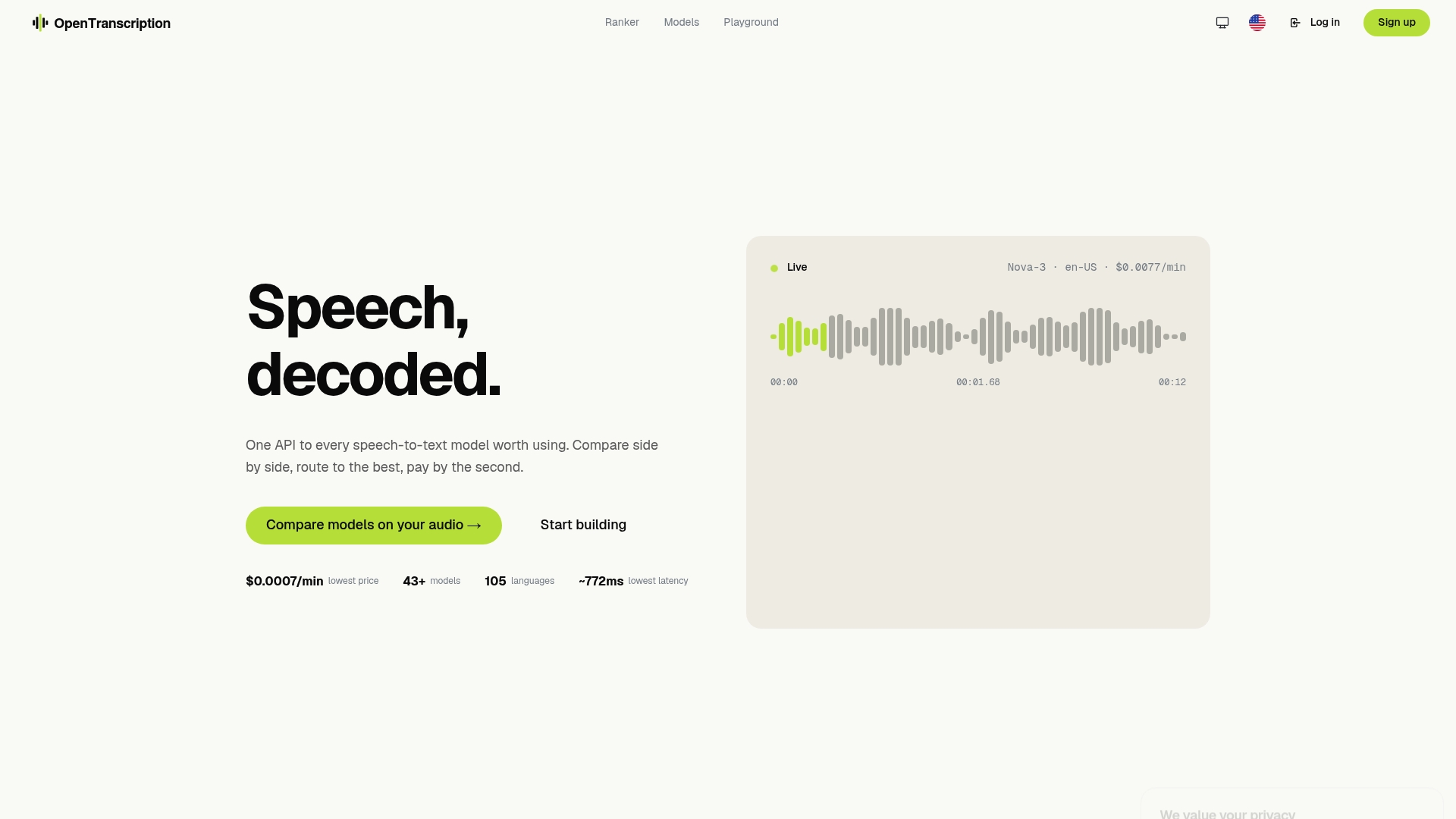
A few ways to put this to work immediately:
- Check real-time performance specifically on the realtime model ranking page if latency is part of your evaluation criteria.
- Browse the model catalog to confirm language and format coverage against your own dataset scope.
Pricing can run per second of audio processed, so testing a small evaluation set against multiple models costs only what you actually use. Start by uploading a sample batch through OpenTranscription’s platform and compare the structured output against your own reference transcripts.
Sources
- OpenASR21 Evaluation Plan (NIST)
- asr_eval: Algorithms and tools for multi-reference and streaming speech recognition evaluation
- Building Production-Representative Speech Benchmarks to Improve Speech Model Performance (Appen)
FAQ
What Is the Difference Between WER and CER?
WER measures errors at the word level (substitutions, insertions, deletions divided by total reference words), while CER performs the same calculation at the character level. CER is generally preferred for morphologically complex or logographic languages, where it correlates better with human judgment.
Why Does Text Normalization Change Reported WER So Much?
Normalization choices, casing, punctuation, number formatting, filler handling, alter which errors count against a system before scoring even begins. Two labs testing the same model can report meaningfully different WER purely from undisclosed normalization differences, which is why publishing the exact normalization script matters.
What Is RTFx and Why Does It Matter in ASR Benchmarking?
RTFx, inverse real-time factor, measures how many seconds of audio a system processes per second of compute time. It matters because accuracy figures alone hide the cost and latency trade-offs that determine whether a model is actually deployable at production volume.
How Many Reference Transcriptions Should a Benchmark Use?
Best practice calls for double-pass human transcription with linguist auditing, plus multi-reference annotation where multiple wordings are genuinely acceptable. A single unvalidated reference pass risks conflating annotation error with real model error.
Can I See Model Comparisons Without Building My Own Benchmark?
Yes. OpenTranscription publishes live rankings across 40+ transcription models on accuracy, speed, and cost, letting you review comparative results on the model ranking dashboard before committing engineering time to a custom benchmark.