

Engineers: Ship Overlapped Speech Detection to Production (82.76% F1)
Overlapped speech detection (OSD) identifies the frames or segments in an audio stream where two or more speakers talk at once, and it functions as a gating layer on which diarization and ASR systems depend to avoid irreversible errors. The current consensus favors speaker-aware progressive architectures built on self-supervised learning (SSL) backbones like WavLM or wav2vec 2.0, paired with realistic augmentation and joint modeling rather than rigid cascades. One speaker-aware progressive model using WavLM reached an F1 of 82.76% on the AMI test set, and OpenTranscription’s benchmarking approach reflects the same principle: match the model to the acoustic domain instead of chasing a single leaderboard number.
TL;DR:
- Overlapped speech detection models trained on large-scale, noisy, and domain-specific data outperform traditional systems, especially in challenging natural conversation settings.
- Combining SSL-based Conformers with progressive, speaker-aware pipelines improves F1 scores beyond 82%, with careful domain adaptation being critical for robustness.
- Proper evaluation requires metrics like F1, AP, diarization error rate, and cpWER, with segmentation and overlap density analysis essential to understand real-world performance.
- Large-scale training should include synthetic overlaps, reverberation simulation, and balanced class sampling to prevent bias toward dominant classes and improve generalization.
- Benchmarking across diverse datasets like AMI, DIHARD, LibriCSS, and AliMeeting reveals substantial domain gaps, emphasizing the need for domain-specific fine-tuning in deployment.
Table of Contents
- What Is Overlapped Speech Detection and Where Does It Fit?
- Which Model Architectures Work Best for Overlapped-Speech Detection?
- What Datasets and Benchmarks Should You Use to Test OSD?
- How Do You Train an OSD System That Survives Real Audio?
- How Do You Measure and Report OSD Performance Correctly?
- How Do You Deploy OSD in a Production Transcription Pipeline?
- Where Is OSD Research Heading Next?
- Ready to Benchmark OSD-Aware Transcription Models?
- Sources
- FAQ
What Is Overlapped Speech Detection and Where Does It Fit?
OSD is the task of labeling each frame or segment of an audio signal according to how many speakers are active in it, distinguishing silence, single-speaker speech, and overlapped speech. The JASA overview of phase-based OSD methods frames this as a core subtask of multi-speaker recognition: separating frames with exactly one active speaker from frames where two or more voices compete for the same channel.
Three formulations dominate published work, and each serves a different downstream goal.
- Binary OSD labels each frame as overlapped or not, which is enough for flagging problem regions before diarization.
- Three-class OSD splits frames into non-speech, single-speaker, and overlapped speech, which handles class imbalance better because silence and single-speaker frames dominate most corpora.
- Speaker-counting OSD estimates the exact number of active speakers per frame, useful when downstream separation needs to know how many sources to extract.
Pipeline placement matters as much as the formulation. In a cascade system, OSD output feeds a voice activity detector and then a diarization module, and any misclassification at the OSD stage propagates forward, since diarization boundaries set early are rarely revisited. Joint models that condition ASR or diarization directly on soft OSD posteriors avoid this brittleness by letting downstream layers weigh uncertainty rather than accept a hard cut.
Statistic Callout: Meeting corpora used for OSD research routinely contain overlap in a meaningful share of speech time, and this proportion of speech signal processing time spent in overlap is exactly why treating OSD as a throwaway preprocessing step produces diarization error rate (DER) inflation downstream, particularly on datasets like AMI and DIHARD where natural conversation overlap is common rather than exceptional.
Which Model Architectures Work Best for Overlapped-Speech Detection?
The architecture choice usually comes down to how much labeled data you have, how much latency you can tolerate, and whether your deployment target is near-field (headset, lapel mic) or far-field (conference room array). Four families cover almost every production and research system in circulation today.
CRNN and three-class CRNN baselines
Convolutional recurrent neural networks (CRNNs) remain a common starting point because the convolutional front end extracts local spectral patterns while the recurrent layer models the temporal continuity of speaker turns. Three-class CRNN variants, which separate non-speech, single-speaker, and overlapped frames instead of collapsing everything into a binary label, consistently show better calibration on imbalanced meeting data. The three-class framing forces the network to learn a genuine decision boundary for overlap instead of treating it as a rare edge case of “speech present.”
TCN-based detection and speaker counting
Temporal convolutional networks (TCNs) trade the sequential bottleneck of recurrent layers for stacked dilated convolutions, which widens the receptive field without the vanishing-gradient issues that plague deep RNNs on long meeting recordings. TCN-based speaker-counting variants extend this by predicting a distribution over the number of active speakers per frame rather than a single overlap flag, which is useful when the downstream task is source separation rather than just flagging problem regions. The tradeoff is that TCNs need careful dilation-rate tuning to match the acoustic context length of your target domain. A TCN tuned for two-person phone calls will not generalize cleanly to four-person conference rooms without retraining.
Conformer and SSL frontends
Conformer architectures combine convolution and self-attention in a single block, giving the model both local acoustic detail and long-range contextual awareness in one pass. This matters for OSD because overlap onset and offset boundaries depend on context well outside a single 25-millisecond frame. Pairing a Conformer or a lighter transformer classifier with SSL frontends like WavLM or wav2vec 2.0 is now the dominant pattern in published work, because these backbones are pretrained on thousands of hours of unlabeled speech and already encode speaker-discriminative and phonetic information that a small labeled OSD dataset alone could never teach.
Speaker embedding models such as CampPlus add a complementary signal here. Instead of asking the network to infer “how many speakers” purely from acoustic mixture cues, a speaker attention module conditions the OSD decision on embeddings extracted from enrollment segments or from running clustering, sharpening the boundary between “one loud speaker” and “two overlapping speakers with similar spectral energy.”
Speaker-aware progressive approaches
The most consequential architectural shift in recent overlapped dialogue analysis research is the move to speaker-aware progressive pipelines. Rather than training a single end-to-end OSD classifier on raw audio, these systems first run voice activity detection, mask the SSL representation using VAD output, and then decode overlap probability from the masked, speaker-conditioned features. The speaker-aware progressive approach using WavLM demonstrated this directly, injecting frame-level speaker features into a VAD-masked representation to reach an F1 of 82.76% on the AMI test set, a meaningful jump over architectures that treat VAD and OSD as fully separate stages with no shared representation.
This progressive framing shares conceptual DNA with Serialized Output Training (SOT), a technique originally developed for multi-talker ASR where speaker turns get serialized into a single output stream rather than requiring parallel decoder branches. Both approaches reject the idea that speaker separation and content recognition must happen in strictly sequential, irreversible stages.
Pro Tip: If you are choosing between a CRNN baseline and an SSL-backed Conformer for a new domain, run both on a small labeled slice of your target acoustic environment before committing. SSL backbones pretrained on read speech and podcasts sometimes underperform a lightweight CRNN on distant-microphone meeting audio until you fine-tune the backbone layers, not just the classification head.
Trade-offs that actually decide production choices
| Consideration | CRNN / TCN | Conformer + SSL backbone |
|---|---|---|
| Parameter count | Low, fast to train from scratch | High, benefits from pretraining |
| Latency for streaming | Generally lower | Higher unless distilled or chunked |
| Far-field robustness | Weaker without heavy augmentation | Stronger, especially with RIR-augmented fine-tuning |
| Data requirement | Works with modest labeled sets | Needs fine-tuning data but leverages pretraining |
Throughput and parameter count favor CRNN and TCN designs for edge or low-latency deployments, while SSL-backed Conformers win on accuracy whenever you can afford the extra compute and have at least a modest fine-tuning set from the target domain.
What Datasets and Benchmarks Should You Use to Test OSD?
Four corpora anchor almost every published OSD result, and each stresses a different failure mode.
AMI consists of scenario and natural meetings recorded with multiple microphone arrays plus individual headset mics, and it remains the most cited benchmark for speaker-aware progressive OSD work, including the WavLM-based system that reached an F1 of 82.76% on its test set.
DIHARD (in its second and third iterations) deliberately spans wildly different domains, from clinical interviews to YouTube audio to restaurant recordings, making it the harshest test of cross-domain generalization rather than in-domain accuracy.
LibriCSS repurposes clean LibriSpeech read speech into simulated overlapping conversations at controlled overlap ratios, which makes it valuable for isolating how a system degrades as overlap density increases in a controlled setting rather than the messier variable overlap of natural meetings.
AliMeeting provides far-field, multi-speaker Mandarin meeting audio with array recordings, and it has become the reference point for evaluating whether OSD systems trained mostly on English data actually transfer to another language and a genuinely far-field acoustic setup. Conformer-based OSD trained with large-scale learning reported an average F1 near 81.6% on the AliMeeting test set, a useful cross-check against AMI-only results.
- Report performance separately for low, medium, and high overlap density bins, not just an aggregate score.
- Use forced-alignment-derived frame labels rather than coarse segment boundaries wherever the corpus supports it.
- Fix your frame rate (commonly 10ms or 25ms hops) and state it explicitly, since F1 comparisons across papers using different frame rates are not directly comparable.
- Decide upfront whether you evaluate against oracle VAD segments or your own system’s segmentation output, and report both if resources allow.
- Pull canonical corpus metadata and licensing terms from the LDC dataset catalog rather than relying on secondhand descriptions.
Cross-domain robustness is where most published systems quietly fall apart. A model tuned on AMI’s headset-heavy recording setup often loses several points of F1 the moment it faces DIHARD’s unconstrained domain mix, which is exactly why the large-scale learning studies discussed in the next section matter more than another architecture tweak.
How Do You Train an OSD System That Survives Real Audio?
Training recipes matter more than most published leaderboards suggest, because the gap between a clean benchmark score and real deployment performance almost always traces back to what the model saw during training, not what it was built from.
- Simulate room acoustics with RIR convolution. Convolving clean training audio with room impulse responses exposes the model to reverberation patterns it will face in far-field deployment, and domain-specific noise studies show this kind of augmentation often outweighs architecture choice in far-field performance.
- Add MUSAN noise at varied SNR ranges. Mixing in the MUSAN noise corpus across a spread of signal-to-noise ratios, rather than a single fixed level, forces the classifier to learn overlap cues that survive degraded conditions instead of memorizing clean-audio artifacts.
- Apply speed perturbation and synthetic overlap mixing. Randomly time-stretching utterances and synthetically summing pairs or triples of single-speaker segments at controlled offsets generates far more overlap-labeled training data than natural recordings alone typically provide.
- Use forced alignment for frame-level speaker posteriors. Tools that align transcripts to audio at the phoneme or word level let you derive precise frame-level speaker activity labels instead of relying on coarse, manually annotated segment boundaries.
- Balance classes explicitly in three-class training. Since non-speech and single-speaker frames dominate raw counts, oversampling overlapped segments or applying class-weighted loss functions keeps the model from defaulting to “predict no overlap.”
Temporal masking deserves its own note. Progressive training strategies that condition the OSD decoder on VAD-masked representations, rather than feeding raw SSL features directly into the classifier, teach the model to focus computation on regions already flagged as containing speech. This is the same mechanism behind the WavLM-based progressive system’s AMI results, and it generalizes: masking irrelevant frames before the overlap decision reduces false positives triggered by background noise misclassified as a second speaker.
Pro Tip: When assembling a large-scale training set, don’t just concatenate corpora. Stratify your sampling so no single dataset (AMI headset audio, for instance) dominates gradient updates, or the model will quietly specialize on whichever domain has the most hours, even if you intended a balanced mix.
How Do You Measure and Report OSD Performance Correctly?
Four metrics cover nearly all published OSD and multi-speaker ASR evaluation, and conflating them is one of the more common ways teams misread their own results.
- F1 score (frame-level or segment-level) balances precision and recall on the overlap-versus-not decision, and it is the most frequently reported metric in OSD papers, including the 82.76% AMI result from speaker-aware progressive modeling.
- Average Precision (AP) summarizes performance across every possible decision threshold rather than one fixed operating point, which matters because production systems often need to tune thresholds differently for high-recall alerting versus high-precision filtering.
- Diarization Error Rate (DER) decomposes into missed speech, false alarm, and speaker confusion; overlapped speech disproportionately drives the confusion component, since diarizers frequently assign overlapping speech to just one of the active speakers.
- cpWER (concatenated minimum-permutation word error rate) measures multi-talker ASR accuracy after resolving speaker-permutation ambiguity, and it is the metric that most directly reflects what a downstream transcription consumer actually experiences.
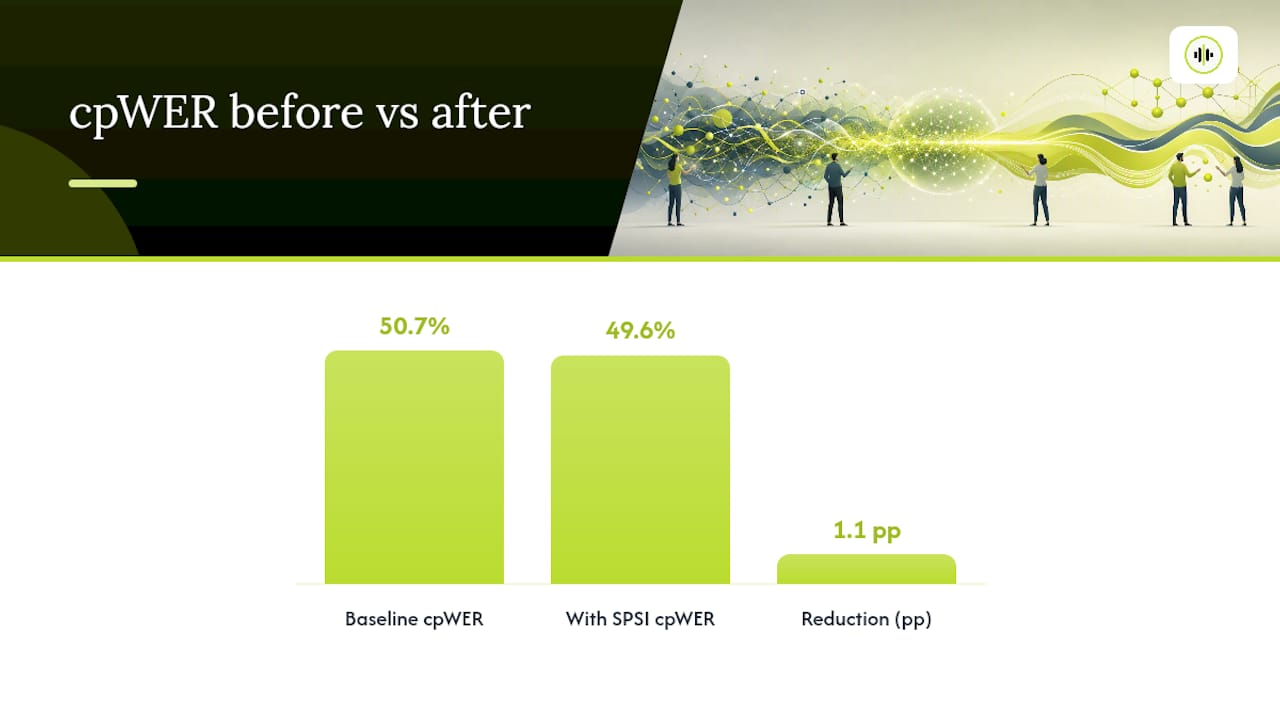
Statistic Callout: Injecting soft frame-level speaker posteriors into the ASR backbone (SPSI) reduced cpWER from 50.7% to 49.6% in a controlled overlap experiment, with the larger share of that improvement concentrated in high-overlap bins rather than spread evenly across the test set. That concentration is the detail most aggregate cpWER tables hide.
Report metrics broken out by overlap density bin (low, medium, high) rather than a single blended number, because a system can post a strong aggregate F1 while still failing badly in the highest-overlap segments that matter most for meeting transcription. Bootstrapped confidence intervals over held-out sessions, rather than a single point estimate, catch the cases where a reported gain is smaller than session-to-session variance. Timeline overlays comparing predicted overlap regions against ground truth, alongside confusion matrices broken out by speaker count, surface systematic failure patterns that a scalar metric averages away entirely.
How Do You Deploy OSD in a Production Transcription Pipeline?
Two architectural patterns dominate production deployment, and the right choice depends on whether you control the full pipeline or need to bolt OSD onto an existing ASR service.
- Front-end OSD feeding downstream diarization and ASR. Run OSD as a discrete gating stage, route overlapped segments to a separation or multi-talker ASR path, and route clean single-speaker segments through a standard transcription pipeline. This pattern is easier to instrument and debug, and it works well when you already have a reliable diarizer and just need to flag problem regions.
- End-to-end joint models conditioning ASR directly on speaker posteriors. Techniques like Soft Posterior Speaker Injection skip the hard segmentation boundary entirely, feeding soft speaker-activity signals into the recognition backbone via FiLM conditioning or decoder prompts. This avoids the irreversible-error problem of cascade systems, at the cost of needing a backbone that supports that conditioning mechanism.
- Chunking and windowing for streaming. Real-time OSD needs a fixed lookahead window, typically a few hundred milliseconds to a couple of seconds, to resolve overlap onset reliably; shrinking that window cuts latency but raises false negatives at overlap boundaries.
- Threshold calibration and post-processing smoothing. Raw frame-level overlap probabilities are noisy; median filtering or a minimum-duration constraint on predicted overlap segments removes single-frame flicker without meaningfully hurting recall.
- Drift monitoring and re-benchmarking cadence. Acoustic domain shift (a new microphone array, a new meeting platform’s codec) degrades OSD silently; scheduling periodic re-evaluation against a held-out sample of live traffic catches this before it shows up as downstream transcript complaints.
Domain mismatch is the single most common production failure mode. A model validated on AMI or LibriCSS can look excellent on paper and then underperform badly the moment it meets a client’s actual conference-room hardware, an issue domain-specific noise research consistently flags as more impactful than any architecture swap.
This is precisely the gap an API-based benchmarking workflow is built to close. Instead of committing to one model based on a published leaderboard number, running the same audio session through several transcription models side by side, using OpenTranscription’s model catalog, shows you which backbone actually holds up on your specific acoustic domain, complete with word-level confidence scores you can correlate against known overlap regions. Teams that need to track model performance over time as new releases land can use the ranking tool to compare runs without rebuilding an evaluation harness from scratch every quarter.
Pro Tip: Before committing to a joint model architecture in production, prototype the cascade version first. It is easier to instrument, and the gap between cascade and joint performance tells you whether your segmentation errors are actually the bottleneck, or whether your OSD classifier itself needs more training data.
Where Is OSD Research Heading Next?
The clearest trend across recent work is the convergence of OSD with foundation-model integration rather than treating it as a standalone classifier problem. Speaker-aware progressive approaches built on WavLM point toward a future where OSD, diarization, and ASR share a single pretrained backbone with task-specific heads, instead of three separately trained systems stitched together at inference time. Soft posterior injection techniques extend this logic directly into the recognition backbone, and the cpWER improvements reported in high-overlap bins suggest this direction has real headroom left, not just marginal gains.
The most useful next experiments are narrower than a new architecture launch. Ablating encoder freezing versus full fine-tuning on a fixed SSL backbone, sweeping overlap density bins independently rather than reporting one blended score, and testing temporal anchor intervals for any system that injects speaker posteriors at fixed time steps would all clarify which design choices generalize and which are artifacts of one benchmark’s quirks. Domain mismatch remains the caveat that no benchmark fully captures. AMI and AliMeeting numbers describe how a system does on meeting-style audio, but temporal grounding failures, where a model correctly detects overlap but misattributes which speaker started first, rarely show up in aggregate F1 at all. Any group evaluating a new OSD system should treat that gap as unresolved, not solved, no matter how strong the headline number looks.
— Benjamin
Ready to Benchmark OSD-Aware Transcription Models?
Choosing a single OSD architecture from a paper is the easy part. Confirming it holds up on your actual meeting recordings, your actual microphone array, and your actual overlap rate is the part most teams skip, and it is the part that determines whether your transcripts are usable. OpenTranscription gives you a direct path around that gap: instead of committing to one vendor’s model and hoping it generalizes, you run the same audio session through more than 40 speech-to-text models side by side and compare their output on cost, speed, and accuracy for your specific domain.
The platform’s model catalog covers the SSL-backed and Conformer-based systems discussed throughout this article, and every transcript comes back with word-level timestamps and confidence scores you can correlate directly against known overlap regions in your test set. Because billing is usage-based rather than subscription-based, you can run a real A/B comparison on a batch of overlap-heavy sessions without committing to a long-term contract first. Start with a small benchmark job on OpenTranscription’s comparison platform: upload a handful of your highest-overlap recordings, compare model outputs against your current pipeline, and use the ranking tool to track which model actually wins on your data, not just on AMI.
FAQ
What Does “Voice Overlapping” Mean?
Voice overlapping refers to intervals in an audio recording where two or more speakers talk simultaneously, which is exactly what overlapped speech detection systems are trained to locate frame by frame.
What Are the Two Main Types of Speech Recognition Approaches for Overlapping Speakers?
The two dominant paradigms are SIMO, which separates speakers first and then transcribes each stream, and SISO, which uses serialized output training to produce one interleaved transcript without a separate separation stage.
What Is the Latest Technology in Overlapped Speech Detection?
Speaker-aware progressive architectures built on SSL backbones like WavLM currently lead published results, with one such system reaching an F1 of 82.76% on the AMI test set, and platforms like OpenTranscription let engineers benchmark these newer models directly against established ones on their own audio.
What Is Speech Segmentation and How Does It Relate to OSD?
Speech segmentation divides an audio stream into meaningful units, such as speaker turns or utterances, and OSD is a specialized form of it that specifically flags which segments contain simultaneous speakers rather than a single speaker or silence.