Multilingual Speech Recognition: Models, Datasets & Deployment
Multilingual speech recognition (ASR) uses shared, cross-lingual speech representations to transcribe audio across many languages within a single model architecture. The current research consensus is that large self-supervised learning (SSL) encoders, such as wav2vec 2.0 and XLS-R, combined with decoder conditioning or in-context prompting, enable zero-shot extension to languages unseen during fine-tuning. The Omnilingual ASR family, for instance, covers 1,600+ languages using models ranging from ~300M to 7B parameters, trained on approximately 4.3 million hours of audio.
TL;DR:
- Language coverage spans from tens of languages (compact models like Qwen3-ASR’s 52-language scope) to 1,600+ languages (Omnilingual ASR). MMS recognizes 1,100+ languages, and supports LID across 4,000+.
- Zero-shot accuracy is consistently lower than fine-tuned accuracy on a target language; the gap narrows significantly with in-context examples or adapter-based fine-tuning.
- Common use cases include research benchmarking, product localization, endangered language documentation, language identification (LID), and code-switching transcription.
- Key open-source families: wav2vec 2.0 / XLS-R, HuBERT, Omnilingual ASR, MMS, and Qwen3-ASR.
- Primary evaluation datasets: Common Voice, Multilingual LibriSpeech (MLS), FLEURS, BABEL, and the Omnilingual corpus on Hugging Face.
Table of Contents
- What is multilingual speech recognition, and how does it work?
- Self-supervised pretraining and the major multilingual model families
- What datasets and benchmarks should you use for multilingual ASR?
- How should you measure multilingual ASR performance?
- What are the hardest open problems in multilingual ASR research?
- Deployment trade-offs: latency, streaming, and model size
- How to start a multilingual ASR project: a practical guide for developers
- OpenTranscription benchmarking: practical platform insights
- Essential papers, repositories, and datasets to read next
- Key Takeaways
- Where should multilingual ASR research focus next?
- OpenTranscription: benchmark and deploy multilingual ASR without the infrastructure overhead
- Useful sources
What is multilingual speech recognition, and how does it work?
Automatic speech recognition (ASR) is the computational task of converting spoken audio into text. The multilingual variant extends this to a single model that handles many languages, rather than training one dedicated model per language. The architectural shift that made this practical at scale is the SSL encoder: a neural network pretrained on massive amounts of unlabeled audio to learn language-agnostic acoustic representations, which can then be fine-tuned or prompted for specific languages.
Encoder–decoder, CTC, transducer, and non-autoregressive approaches
Four architectural families dominate multilingual ASR research, each with distinct latency and accuracy trade-offs.

Encoder–decoder (seq2seq with Transformer decoder): The encoder maps raw audio features to a sequence of contextualized representations; the decoder generates token sequences autoregressively. This family supports flexible output (transcription, translation, LID tokens in the same pass) and handles long-range dependencies well. The cost is autoregressive decoding latency, which scales linearly with output length.
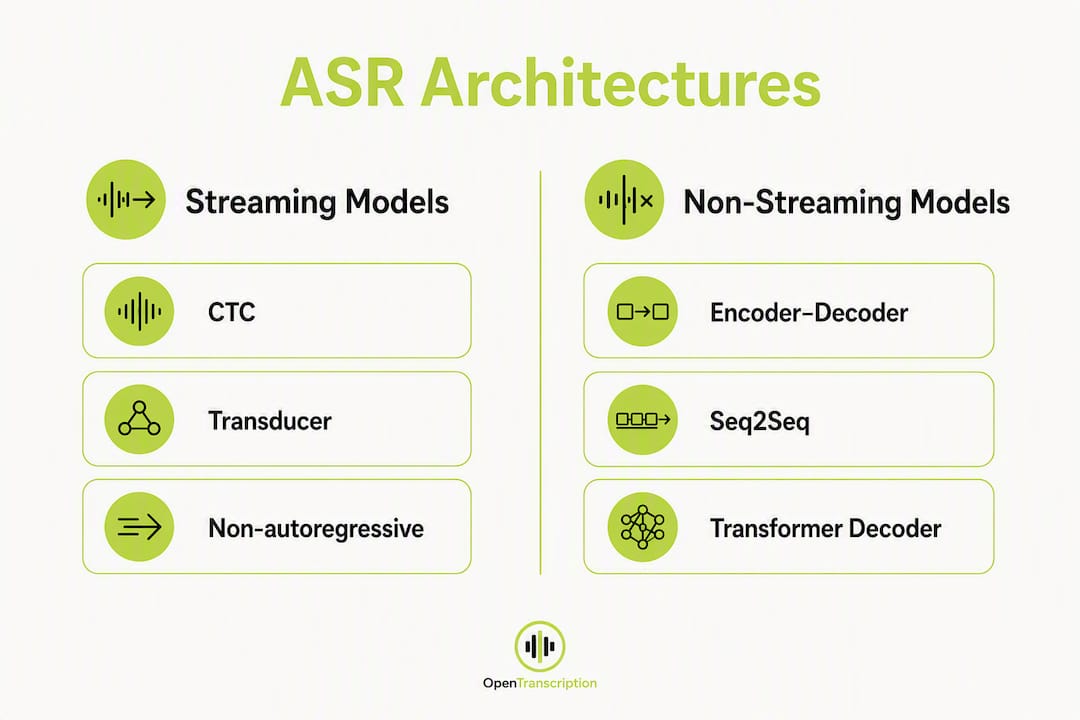
CTC (Connectionist Temporal Classification): CTC attaches a linear projection head directly to the encoder and predicts per-frame labels with a conditional independence assumption. Decoding is fast and parallelizable, making CTC attractive for streaming and on-device inference. Accuracy on low-resource languages is generally lower than seq2seq, but CTC is a common auxiliary loss used alongside cross-entropy in hybrid models.
Transducer (RNN-T): The transducer combines an audio encoder with a prediction network and a joint network, enabling truly streaming recognition without a fixed output-length assumption. It is the dominant architecture in production streaming ASR, particularly in voice assistant pipelines, because it emits partial hypotheses incrementally.
Non-autoregressive (NAR): NAR models predict all output tokens in parallel, eliminating the sequential bottleneck. The Qwen3-ASR family includes a non-autoregressive forced-alignment model for 11 languages, demonstrating that NAR approaches are viable for timestamp generation and high-throughput batch workloads.
Shared vs. language-conditioned decoders and LID integration
A shared decoder processes all languages through the same parameters, relying on the encoder’s cross-lingual representations to disambiguate. Language-conditioned decoders receive an explicit language token or embedding at the start of decoding, which reduces ambiguity in code-switching scenarios and improves accuracy on low-resource languages by narrowing the output distribution. LID modules can be integrated as a prefix token (as in Whisper-style models), a separate classification head on the encoder output, or a dedicated lightweight model that gates the main ASR decoder.
Code-switching, where a speaker alternates between two or more languages mid-utterance, remains an open challenge for both shared and conditioned decoders. Byte-pair encoding (BPE) or byte-level tokenization helps because it avoids language-specific vocabularies, but the decoder still needs to track language state across token boundaries.
“Scaling SSL encoders to billions of parameters enables generalization to many languages, but decoder design and training recipes — context conditioning, in-context examples — are the practical enablers for zero-shot extension.” — Omnilingual ASR research
Pro Tip: When extending a pretrained multilingual model to a new language zero-shot, prepend 2–3 speech–text example pairs as in-context prompts before the target utterance. Omnilingual ASR’s LLM-ASR design explicitly supports this pattern, and it consistently outperforms naive greedy decoding on unseen languages without any gradient updates.
Self-supervised pretraining and the major multilingual model families
SSL pretraining is the reason multilingual ASR at scale is now tractable. By training on hundreds of thousands to millions of hours of unlabeled audio, SSL encoders learn acoustic representations that transfer across languages, reducing the supervised labeled hours required to reach acceptable word error rates (WER) on any individual language.
Why SSL is central to language coverage
The core SSL objective in wav2vec 2.0 is contrastive: the model learns to identify the correct quantized speech representation for a masked time step among a set of distractors. Because this objective requires no transcriptions, training data can be sourced from any audio, including radio broadcasts, audiobooks, and community recordings in low-resource languages. HuBERT (Hidden-Unit BERT) uses an offline clustering step to generate pseudo-labels for masked prediction, producing representations that are particularly stable for fine-tuning. Both approaches have been scaled to cross-lingual settings: XLS-R extends wav2vec 2.0 pretraining to 128 languages using 436,000 hours of public audio.
Meta’s Massively Multilingual Speech (MMS) project pushed this further, pretraining on approximately 500,000 hours across 1,400+ languages and fine-tuning a 1B-parameter wav2vec 2.0 model to support recognition in 1,100+ languages and LID across 4,000+ languages. The training data strategy relied on Bible readings, which provided aligned audio and text in many languages that lack other digital resources.
Model family profiles by parameter regime
Compact models (0.6B–1.7B parameters): The Qwen3-ASR 0.6B variant targets high-throughput streaming scenarios, covering 52 languages and dialects with competitive WER on FLEURS and Common Voice benchmarks. At this scale, quantized inference on a single GPU or high-end CPU is feasible, making these models practical for on-device or edge deployment.
Mid-range models (~1B parameters): MMS’s 1B wav2vec 2.0 model sits in this regime, offering broad language coverage with manageable VRAM requirements. Fine-tuning from this checkpoint is a common starting point for researchers targeting specific language families.
Large models (7B parameters): Omnilingual ASR scales to 7B parameters, pairing a wav2vec 2.0-style SSL encoder with an LLM-inspired Transformer decoder. This architecture enables zero-shot extension to 1,600+ languages using in-context speech–text examples, and it supports speech-to-text translation without dedicated S2TT training recipes. The trade-off is substantial: 7B models require multi-GPU inference or aggressive quantization for production deployment.
Statistic callout: Meta’s MMS experiments show that scaling from 61 to 1,107 languages increased character error rate by only ~0.4% while expanding language coverage 18x, a result that directly challenges the assumption that broader coverage requires proportionally higher error rates.
- Decoder architecture matters as much as encoder scale: LLM-style decoders with in-context prompting enable zero-shot extension; linear CTC heads do not.
- Byte-level or multilingual BPE tokenization avoids vocabulary explosion as language count grows.
- Few-shot fine-tuning on as few as 10 minutes of labeled audio per language can close a significant portion of the zero-shot accuracy gap for SSL-pretrained models.
What datasets and benchmarks should you use for multilingual ASR?
Selecting the right evaluation corpus is as consequential as model architecture. The datasets below cover the range from clean read speech to conversational and telephone-quality audio, and they differ substantially in language coverage, hours per language, and licensing.
| Dataset | Language coverage | Typical hours per language | Common evaluation splits | License |
|---|---|---|---|---|
| Common Voice | 100+ languages | 1–100+ hours (highly variable) | train / dev / test (validated clips) | CC-0 |
| Multilingual LibriSpeech (MLS) | 8 languages | 100–several hundred hours | train / dev / test | CC-BY 4.0 |
| FLEURS | 102 languages | ~10 hours | train / dev / test | CC-BY 4.0 |
| BABEL | 25 languages | 40–80 hours (conversational) | dev / eval | LDC (restricted) |
| Omnilingual corpus | 1,600+ languages | Variable (Bible-sourced) | Defined in repo | See repo |
Common Voice (Mozilla) is the most accessible starting point: it is crowd-sourced, CC-0 licensed, and covers 100+ languages, though hours per language vary from a few hours to several hundred. The validated-clips split is the standard evaluation partition, but researchers should check for speaker overlap between train and test before reporting numbers.
Multilingual LibriSpeech (MLS) covers only 8 languages but provides substantially more hours per language than Common Voice, all sourced from LibriVox audiobooks. It is the standard benchmark for high-resource multilingual evaluation and is widely used in published WER comparisons.

FLEURS (Few-shot Learning Evaluation of Universal Representations of Speech) covers 102 languages with approximately 10 hours each, making it the most balanced benchmark for cross-lingual evaluation at moderate scale. Its uniform structure across languages makes it the preferred dataset for reporting per-language WER in multilingual papers.
BABEL provides conversational telephone speech in 25 languages, most of them low-resource. It is LDC-licensed, which restricts use to academic institutions with LDC membership. Its value is in testing robustness to real-world audio conditions rather than clean read speech.
The Omnilingual ASR corpus on Hugging Face (facebook/omnilingual-asr-corpus) extends coverage to 1,600+ languages, primarily through Bible-sourced aligned audio and text, and is the largest publicly accessible multilingual ASR corpus by language count.
Best practices for benchmark split selection:
- Always use the official test split; never tune hyperparameters on the test set.
- Report per-language WER alongside the macro-average to expose performance gaps on low-resource languages.
- Verify that your tokenizer and text normalization match the dataset’s reference transcripts exactly before computing WER.
- For FLEURS, use the
testsplit only; thevalidationsplit is appropriate for development but not final reporting. - When combining datasets, check for audio source overlap, particularly between Common Voice and MLS, which both draw from some LibriVox recordings.
How should you measure multilingual ASR performance?
WER, CER, and LID accuracy
Word Error Rate (WER) is the standard metric for languages with clear word boundaries (space-delimited orthography). It counts substitutions, deletions, and insertions at the word level, normalized by the reference word count. WER is sensitive to text normalization: punctuation, casing, and number formatting must be handled consistently between hypothesis and reference before scoring.
Character Error Rate (CER) is preferred for languages without explicit word boundaries, including Chinese, Japanese, Thai, and several Southeast Asian languages. CER operates at the character level and is less sensitive to tokenization choices, making it more comparable across orthographic systems.
LID accuracy measures the fraction of utterances where the model correctly identifies the spoken language, either as a standalone task or as a prefix to ASR decoding. It is reported separately from WER because a model can achieve low WER on recognized languages while failing silently on misidentified ones.
Methodology checklist for reproducible results
- Document the exact dataset version, download date, and split used.
- Specify the tokenizer, vocabulary size, and any text normalization applied (lowercasing, punctuation removal, number expansion).
- Report decoding hyperparameters: beam size, language model weight (if applicable), and any temperature or repetition penalty for LLM-style decoders.
- Include the model checkpoint hash or version tag so results can be reproduced from the same weights.
- Report both macro-average WER and per-language WER for at least the 10 lowest-resource languages in your evaluation set.
Common evaluation pitfalls:
- Mismatched orthography between training normalization and test reference transcripts inflates WER artificially.
- Punctuation handling inconsistencies, particularly apostrophes and hyphens, cause spurious substitution errors.
- Speaker overlap between train and test splits produces optimistic WER that does not generalize.
- Reporting only macro-average WER masks catastrophic failure on individual low-resource languages.
- Using a language model trained on the test domain during decoding without disclosing it makes results non-reproducible.
What are the hardest open problems in multilingual ASR research?
Data scarcity and long-tail languages
The distribution of available labeled speech data is extremely skewed. A handful of high-resource languages (English, Mandarin, Spanish) account for the majority of publicly available transcribed audio, while thousands of languages have fewer than one hour of labeled data. SSL pretraining reduces but does not eliminate this gap: even with strong pretrained representations, fine-tuning on fewer than 10 minutes of labeled audio produces high WER for languages with complex morphology or tonal systems.
Dialectal variation, accent robustness, and code-switching
Standard multilingual models are typically trained on a single dialect or accent per language, which means they degrade on regional varieties. Arabic dialectal variation is a well-documented example: a model trained on Modern Standard Arabic performs substantially worse on Moroccan Darija or Egyptian Arabic. Code-switching compounds this problem because the model must track language state at the sub-utterance level, and training data for specific language pairs (e.g., Hindi-English or Spanish-English) is scarce relative to monolingual data.
Domain mismatch and real-world audio conditions
Most benchmark datasets consist of read speech or audiobooks, which differ substantially from conversational, telephone, or far-field audio. Models that achieve strong WER on MLS or FLEURS often degrade significantly on spontaneous speech, noisy environments, or overlapping speakers. Forced alignment and timestamping accuracy also deteriorate under these conditions, which matters for downstream applications like subtitle generation or speaker diarization.
Fairness, bias, and community-driven extension
Large multilingual models trained on internet-sourced or Bible-sourced audio inherit demographic biases: they tend to perform better on male speakers, standard accents, and languages with larger digital footprints. Measuring and mitigating these disparities requires per-demographic WER breakdowns and community involvement in data collection, neither of which is standard practice in most published evaluations.
Short-term research priorities:
- Develop standardized fairness evaluation protocols that report WER by speaker gender, age, and dialect.
- Build community-driven data collection pipelines for endangered languages, using tools like Common Voice’s recording interface.
- Investigate adapter-based and prompt-based fine-tuning for rapid language extension with minimal labeled data.
- Evaluate zero-shot performance rigorously on held-out language families, not just held-out languages within seen families.
Pro Tip: For domain mismatch experiments, create a held-out “noisy” test set by augmenting clean FLEURS audio with RIR (room impulse response) convolution and additive noise at multiple SNR levels. This gives you a reproducible robustness benchmark without requiring new recordings.
Deployment trade-offs: latency, streaming, and model size
Streaming patterns and latency targets
Production ASR systems typically target end-to-end latency under 300ms for voice assistant applications and under 1 second for live captioning. Achieving these targets with large multilingual models requires architectural choices made at design time, not as afterthoughts.
Chunked streaming divides the audio stream into fixed-length segments (typically 80–320ms) and processes each chunk independently or with a limited lookahead window. Transducer-based models handle this naturally because they emit tokens incrementally. Encoder–decoder models require either a fixed chunk size with no lookahead or a sliding window with partial hypothesis generation, both of which introduce latency proportional to the chunk size.
Non-autoregressive models, including the forced-alignment variant in Qwen3-ASR, process the entire input in parallel and are well-suited to batch transcription workloads where latency is less critical than throughput.
Model size, VRAM, and quantization
A 7B-parameter model in FP16 requires approximately 14GB of VRAM for inference, which exceeds the capacity of most consumer GPUs and many cloud inference instances. Practical options for deploying large multilingual models include:
- INT8 quantization: Reduces VRAM by roughly half with minimal WER degradation on high-resource languages; low-resource language accuracy may degrade more noticeably.
- INT4 quantization (GPTQ/AWQ): Reduces VRAM to approximately 4–5GB for a 7B model, enabling single-GPU deployment, but requires careful calibration to avoid accuracy collapse on rare languages.
- Pipeline sharding: Splits the model across multiple GPUs, preserving FP16 precision at the cost of inter-GPU communication overhead.
- Hybrid architecture: A compact on-device model (0.6B–1.7B) handles real-time transcription; a large cloud-hosted model processes difficult utterances or performs zero-shot language extension on demand.
Statistic callout: Qwen3-ASR demonstrates that smaller, optimized models can reach high throughput while larger models provide best accuracy on benchmarks. The 0.6B variant is designed for streaming and high-throughput scenarios, while the 1.7B variant targets accuracy-first use cases across 52 languages and dialects.
Pro Tip: Profile your inference pipeline with mixed-precision (FP16 encoder + INT8 decoder) before committing to full INT8 quantization. The encoder’s convolutional front-end is typically the throughput bottleneck, and keeping it in FP16 often preserves accuracy on tonal and morphologically complex languages where INT8 quantization error concentrates.
How to start a multilingual ASR project: a practical guide for developers
Step-by-step baseline setup
-
Select your evaluation dataset. For broad language coverage, start with FLEURS (102 languages, ~10 hours each, CC-BY 4.0). For high-resource benchmarking, add MLS. For low-resource and conversational robustness, include BABEL if your institution has LDC access.
-
Choose a pretrained checkpoint. For most research projects, a mid-range SSL model (1B parameters) fine-tuned on a broad multilingual corpus is the right starting point. MMS’s 1B wav2vec 2.0 checkpoint covers 1,100+ languages and is publicly available. For zero-shot extension experiments, use the Omnilingual ASR checkpoints.
-
Set your evaluation metrics. Define WER for space-delimited languages and CER for character-segmented languages. Apply consistent text normalization (lowercase, punctuation removal, number expansion) to both hypothesis and reference before scoring. Log LID accuracy separately if your model outputs language tokens.
-
Run the baseline experiment. Fine-tune the chosen checkpoint on your target language(s) using the official train split. Evaluate on the official test split. Record WER, CER, and LID accuracy with the exact checkpoint hash and decoding hyperparameters.
-
Integrate LID. Add a language identification prefix token or a lightweight LID head. Evaluate LID accuracy on a held-out set that includes languages not in the fine-tuning set to measure zero-shot LID robustness.
-
Test forced alignment. Use the model’s encoder attention weights or a dedicated forced-alignment model (e.g., Qwen3-ASR’s NAR aligner) to generate word-level timestamps. Evaluate alignment accuracy on a subset with manually verified timestamps.
-
Build a streaming prototype. Implement chunked decoding with a 160ms chunk size and measure real-time factor (RTF) on your target hardware. Compare RTF and WER against the batch baseline to quantify the streaming accuracy penalty.
-
Iterate with few-shot adaptation. For languages where baseline WER exceeds your target, collect 10–30 minutes of labeled audio and fine-tune with a low learning rate. Measure WER improvement per hour of labeled data to estimate the adaptation cost curve.
Checklist before reporting results:
- Confirm no test data leaked into training or hyperparameter tuning.
- Verify tokenizer and normalization match the dataset’s reference format.
- Document hardware, batch size, and decoding beam width.
- Report per-language WER, not only the macro-average.
- Use OpenTranscription’s model catalog to run side-by-side comparisons of model outputs on the same audio, which provides a reproducible external reference point for your benchmark numbers.
OpenTranscription benchmarking: practical platform insights
Researchers and developers evaluating multilingual ASR models face a consistent practical problem: running controlled comparisons across model families requires significant infrastructure, and published benchmark numbers rarely reflect the audio conditions or language mix of a real deployment. OpenTranscription addresses this by providing a multi-model benchmarking platform that aggregates 40+ transcription models behind a single API, with real-time ranking by accuracy, speed, and cost.
Benchmark comparison: model capability dimensions
| Dimension | Entry-level field models | Mid-range research models | Large-scale multilingual models |
|---|---|---|---|
| Languages supported | 10–52 | 100–128 | 1,100 (MMS) / 1,600+ (Omnilingual ASR) |
| Published WER on FLEURS | Competitive on covered languages | Strong cross-lingual | Variable; best on high-resource |
| Model size | 0.6B–1.7B | 1B–1.7B | 7B+ |
| Streaming support | Yes (NAR / transducer) | Partial (chunked encoder) | Limited (high latency) |
| Training data type | Supervised + SSL fine-tune | SSL pretrain + supervised | Massive SSL + in-context |
| License | Open (Apache / MIT) | Open (CC-BY / MIT) | Open (research license) |
| Adaptation support | Few-shot fine-tune | Adapter / LoRA | In-context prompting |
Statistic callout: OpenTranscription’s platform covers 105+ languages across its model catalog, with per-second billing and no subscription lock-in, making it practical to run cost-controlled A/B comparisons between compact and large multilingual models on the same audio corpus.
Pro Tip: Use OpenTranscription’s per-second billing structure to run a controlled cost experiment: transcribe the same multilingual test set with a 0.6B model and a 7B model, then compare WER per dollar. For most production workloads, the compact model reaches 80–90% of the large model’s accuracy at a fraction of the cost, and the gap narrows further with domain-specific fine-tuning.
OpenTranscription also supports real-time streaming rankings, speaker diarization, and structured transcripts with word-level timestamps and confidence scores, which are directly useful for forced-alignment validation and speaker-overlap analysis in research workflows.
Essential papers, repositories, and datasets to read next
The following resources are the primary references for researchers entering or deepening work in multilingual ASR.
-
Omnilingual ASR paper (arXiv 2511.09690) — The primary reference for the Omnilingual model family. Covers the LLM-ASR architecture, zero-shot extension methodology, and 1,600+ language coverage results. Read this before designing any zero-shot multilingual experiment.
-
Omnilingual ASR GitHub repository — Code repository with inference pipelines, model architecture documentation, and links to the Hugging Face corpus (
facebook/omnilingual-asr-corpus). Clone this to reproduce baseline experiments. -
Qwen3-ASR GitHub repository — Model family covering 52 languages with 0.6B and 1.7B variants, benchmark tables for FLEURS and Common Voice, and a non-autoregressive forced-alignment model. The primary reference for streaming and throughput-focused deployment.
-
Meta MMS project blog — Accessible summary of the Massively Multilingual Speech project, covering SSL pretraining on 500,000+ hours, 1,100+ language recognition, and 4,000+ language LID. Includes the key result on CER scaling with language count.
-
wav2vec 2.0 paper (arXiv 2205.12446) — The foundational SSL pretraining paper whose architecture underlies XLS-R, MMS, and Omnilingual ASR. Required reading for understanding the contrastive pretraining objective and quantized speech unit design.
Dataset pages to bookmark:
Key Takeaways
Self-supervised pretraining on massive unlabeled audio corpora, combined with LLM-style decoder conditioning, is the architecture pattern that makes 1,600+ language coverage achievable in a single multilingual ASR model. MMS achieves recognition on 1,100+ languages and LID across 4,000+.
| Point | Details |
|---|---|
| Architecture choice drives trade-offs | CTC and transducers suit streaming; seq2seq with LLM decoders enable zero-shot extension to unseen languages. |
| Dataset selection shapes evaluation validity | FLEURS (102 languages, ~10 hours each) is the most balanced benchmark; always report per-language WER alongside macro-averages. |
| Scaling coverage has low accuracy cost | Meta’s MMS data shows expanding from 61 to 1,107 languages increased CER by only ~0.4%, a strong argument for broad SSL pretraining. |
| Deployment requires size-aware planning | A 7B model needs ~14GB VRAM in FP16; INT8 quantization or hybrid on-device/cloud architectures are necessary for real-time constraints. |
| OpenTranscription for controlled comparison | OpenTranscription’s 40+ model catalog with per-second billing lets teams run cost-controlled A/B benchmarks across compact and large multilingual models. |
Where should multilingual ASR research focus next?
The field has made remarkable progress on language coverage, largely by scaling SSL pretraining and leveraging Bible-sourced aligned audio to reach languages with no other digital resources. That progress is real. But coverage is not the same as usability, and the gap between the two is where the next two to three years of research should concentrate.
The most pressing priority is evaluation infrastructure for low-resource and endangered languages. Published WER numbers on FLEURS or Common Voice tell you almost nothing about how a model performs on a language spoken by 50,000 people with no standardized orthography and no digital text corpus. The community needs standardized evaluation protocols that include speaker diversity metrics, dialectal coverage, and domain robustness, not just aggregate WER on clean read speech.
The second priority is compute efficiency for the long tail. A 7B-parameter model is not deployable by a community organization in West Africa or a university linguistics department in Southeast Asia. The Qwen3-ASR 0.6B result is encouraging: it shows that smaller, well-trained models can reach competitive accuracy on covered languages. The research question is how to extend that efficiency to languages currently requiring large models for acceptable accuracy. Adapter-based fine-tuning, distillation from large multilingual teachers, and NAR architectures for low-resource languages are all promising directions, but none has been benchmarked systematically across the long tail of FLEURS.
One caution worth stating plainly: parameter scale alone is not a research contribution. A 7B model that outperforms a 300M model on FLEURS is an expected result, not a finding. The interesting experiments are those that isolate the contribution of decoder design, tokenization strategy, or data curation from raw parameter count. Funding and compute should follow those experiments, not the next incremental scale-up.
OpenTranscription: benchmark and deploy multilingual ASR without the infrastructure overhead
Researchers and development teams working on multilingual speech-to-text projects spend a disproportionate amount of time managing inference infrastructure rather than running experiments. OpenTranscription provides direct API access to 40+ transcription models, including models spanning compact 0.6B variants to large-scale multilingual systems, with real-time benchmarking that ranks models by accuracy, speed, and cost on your own audio.
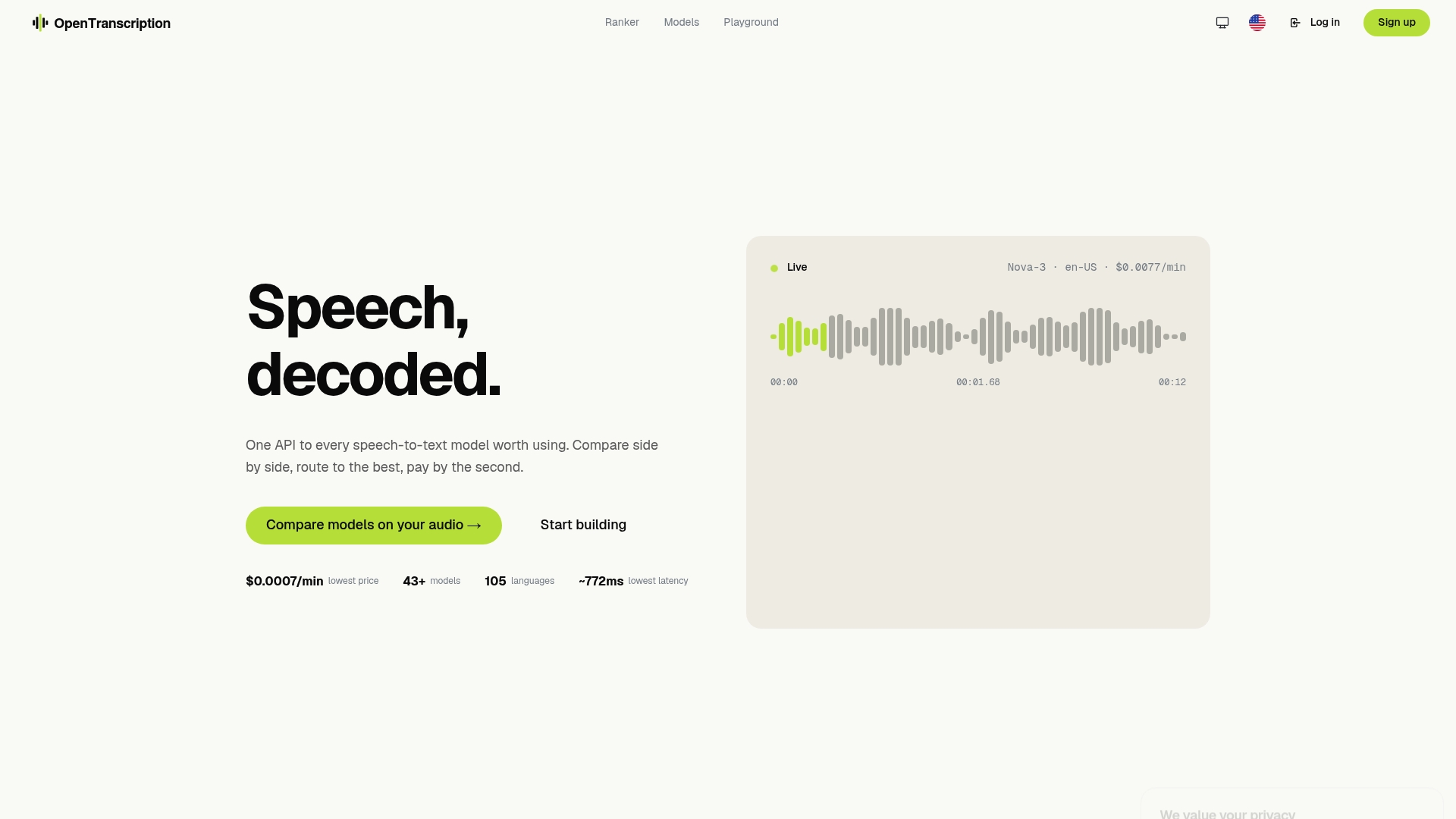
For multilingual ASR work specifically, the platform’s 105+ language support, structured transcripts with word-level timestamps and confidence scores, and speaker diarization make it directly applicable to forced-alignment validation, code-switching analysis, and per-language WER comparison. The pay-as-you-go, per-second billing means you can run a controlled cost experiment comparing a compact model against a large one on the same test set without committing to a subscription or provisioning dedicated GPU instances.
Practical use cases for research and production teams:
- Run side-by-side WER comparisons across model families on a shared multilingual test set.
- Evaluate real-time streaming accuracy using the live model ranker before committing to a production architecture.
- Validate forced-alignment timestamps against manually verified references using structured transcript outputs.
- Benchmark cost per language by routing the same audio through compact and large models and comparing per-second billing against WER.
Access the full model catalog at OpenTranscription to compare language coverage, latency, and accuracy across the available model families and identify production candidates for your multilingual deployment.
Useful sources
- Omnilingual ASR: Open-Source Multilingual Speech Recognition for 1600+ Languages (arXiv) — Primary paper; covers model architecture, zero-shot methodology, and 1,600+ language coverage results.
- Omnilingual ASR HTML preprint (arXiv v1) — Full HTML version of the paper with detailed architecture descriptions and training recipe notes.
- facebookresearch/Omnilingual-ASR (GitHub) — Code repository with inference pipelines and links to the Hugging Face corpus.
- Qwen3-ASR (GitHub) — Model repository for the 0.6B and 1.7B ASR variants, benchmark tables, and the NAR forced-alignment model.
- Meta MMS project blog — Summary of the Massively Multilingual Speech project, including SSL pretraining scale and CER scaling results.
- wav2vec 2.0 paper (arXiv 2205.12446) — Foundational SSL pretraining paper underlying XLS-R, MMS, and Omnilingual ASR.
- OpenTranscription platform — Multi-model benchmarking API with 105+ language support and per-second billing.
- OpenTranscription model catalog — Primary product catalog for comparing models by language coverage, latency, and accuracy.