

Topic Modeling From Transcripts: A Reproducible Pipeline
The fastest, reproducible path to extracting themes from noisy transcripts follows one sequence: segment the transcript into coherent units, clean it with ASR-aware filtering, choose an input unit, generate either a term matrix or embeddings, run a model suited to the corpus, then validate with coherence metrics and human checks. Topic modeling from transcripts differs from topic modeling on clean documents because automatic speech recognition (ASR) introduces disfluencies, misheard words, and fragmented utterances that break assumptions built into classic natural language processing pipelines.
The method you choose depends on two variables: document length and noise level.
- Short utterances riddled with ASR artifacts call for sentence-level embedding plus clustering (BERTopic with HDBSCAN).
- Long, well-formed documents, such as full interview transcripts, respond well to matrix factorization methods like LDA or NMF.
- Transcripts with unknown topic counts, multi-scale content, or heavy noise benefit from graph-based or hierarchical hybrid methods (GraphTMT, MSHTM, TreeSeg).
Key Takeaways
Reliable topic modeling from transcripts depends on matching model class to input unit and noise level, then validating with coherence scores and human checks rather than either alone.
| Point | Details |
|---|---|
| Match method to corpus | Use embedding plus clustering for short, noisy utterances; LDA or NMF for long, stable-vocabulary documents. |
| Segment before modeling | Divide transcripts by speaker turn or with a hierarchical segmenter like TreeSeg to avoid context dilution. |
| Clean with ASR awareness | Filter low-confidence spans and normalize disfluencies before building term matrices or embeddings. |
| Validate with multiple metrics | Combine coherence, stability metrics, and human word-intrusion tests rather than trusting one score. |
| Improve the input transcript | Testing ASR models through OpenTranscription’s benchmarking catalog reduces the transcription errors that corrupt topic models. |
Table of Contents
- Which Method Fits Your Transcript Data?
- How Do You Preprocess a Transcript for Topic Modeling?
- What Libraries and Workflows Work Best in Practice?
- How Do You Know if a Topic Model Is Any Good?
- What Do Graph-Based and Hierarchical Methods Solve?
- From Topic Keywords to Reportable Themes
- Trade-Offs Worth Watching in Practice
- Better Transcripts Make Better Topic Models
- Sources
- FAQ
Which Method Fits Your Transcript Data?
Matrix factorization methods (LDA, NMF) and embedding-based clustering (BERTopic) solve different problems, and the choice hinges on how noisy and how short your transcript units are. LDA assumes a bag-of-words structure and performs best on longer documents with stable vocabulary, while BERTopic works at the sentence or utterance level because it clusters dense embeddings rather than counting term co-occurrence.

A study comparing BERTopic against an optimized LDA on a focus-group transcript found BERTopic scored higher coherence than LDA, showing a notable relative gain. That gap widens further on shorter, choppier utterance sets where LDA’s word co-occurrence signal thins out.
| Method | Best for | Input unit | Handles short/noisy text | Requires embeddings | Sets topic count | Scalability |
|---|---|---|---|---|---|---|
| LDA | Broad themes, long documents | Document/paragraph | Weak | No | Yes, manual | High |
| NMF | Interpretable broad themes | Document/paragraph | Moderate | No | Yes, manual | High |
| BERTopic | Fine-grained, sentence-level topics | Sentence/utterance | Strong | Yes (sentence-transformers) | No, inferred via HDBSCAN | Moderate |
| GraphTMT | Video/noisy transcripts, unknown K | Sentence/utterance | Strong | Yes, graph embeddings | No | Moderate |
| MSHTM / TreeSeg | Hierarchical, multi-scale topics | Document + sentence | Strong | Yes | No | High (optimized) |
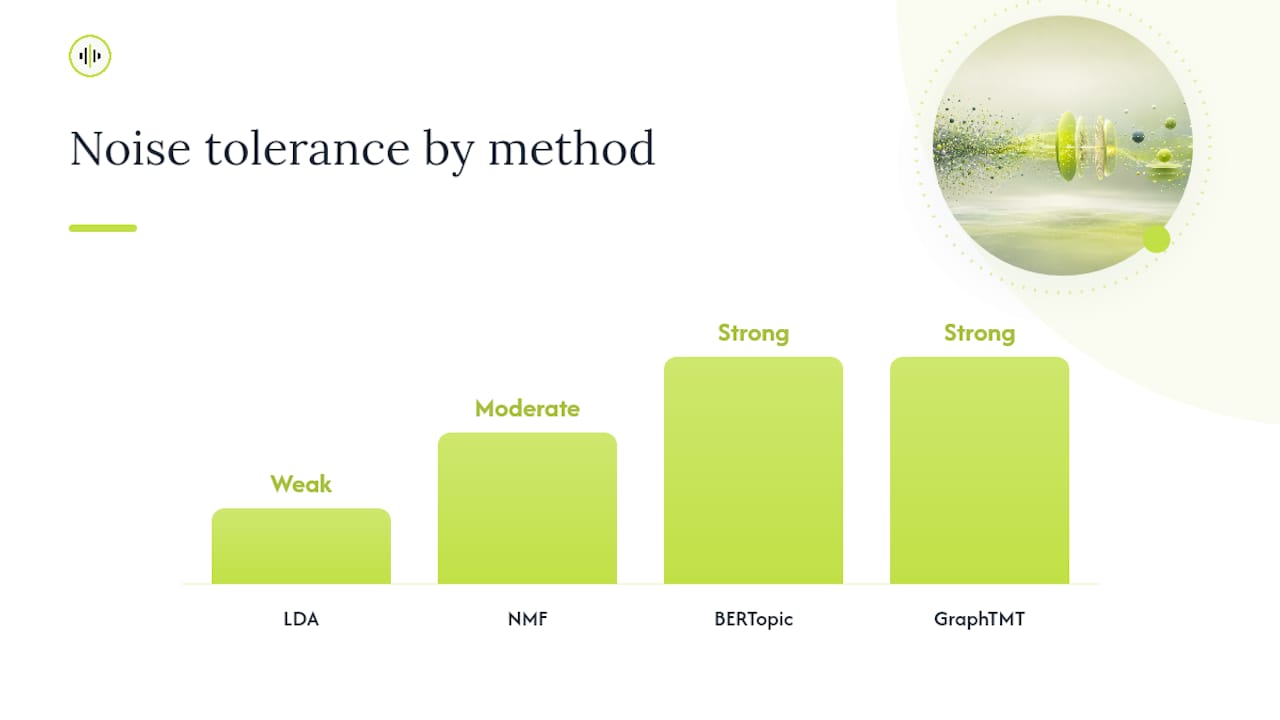
Decision logic is straightforward: many short utterances with ASR noise point toward embedding plus clustering; long-form transcripts with a stable vocabulary point toward NMF or LDA; unclear topic counts or multi-scale structure point toward graph or hierarchical hybrids.
Pro Tip: Run a quick LDA baseline even when you plan to use BERTopic. The comparison reveals whether your corpus has enough lexical redundancy for a cheaper matrix method to suffice, which matters when processing thousands of transcripts on a budget.
How Do You Preprocess a Transcript for Topic Modeling?
Preprocessing determines whether your topic model surfaces themes or artifacts of transcription error. ASR-generated transcripts can carry word error rates around 28% in multimodal datasets, and unfiltered noise clusters into false topics almost every time.
A working checklist looks like this:
- Strip filler tokens (“um,” “uh,” repeated words) and normalize disfluencies before tokenizing.
- Preserve ASR confidence scores as metadata and filter or down-weight low-confidence spans rather than deleting them outright.
- Segment by speaker turn, utterance window, or a divisive segmenter like TreeSeg to avoid diluting context across topic shifts.
- Tag speaker identity and consider modeling per-speaker topic distributions when roles differ (interviewer vs. subject, host vs. guest).
- Handle overlapping speech with short-window aggregation rather than discarding overlapping segments entirely.
- For short utterances, concatenate adjacent turns from the same speaker or switch to sentence-level embeddings instead of forcing bag-of-words counts on fragments.
- Lemmatize rather than stem when keyword interpretability matters, since stemmed tokens (“analyz”) read poorly in topic reports.
Pro Tip: Interestingly, ASR noise is not as destructive as it sounds. One evaluation found that statistics-based ASR-like noise dropped topic similarity by only about 8 to 9%, compared to a much sharper decline under uniformly random noise. Realistic transcription errors tend to preserve enough semantic structure for topic models to still work.
What Libraries and Workflows Work Best in Practice?
Two workflow recipes cover most transcript topic-modeling projects, and both are reproducible with open-source libraries.
Workflow A, sentence-level embedding plus clustering, fits short ASR utterances. Encode each utterance with a sentence-transformers model, reduce dimensionality if needed, then cluster with BERTopic’s default HDBSCAN backend. This setup infers the topic count automatically rather than forcing a fixed K.
Workflow B, document-level matrix factorization, fits long-form transcripts with stable vocabulary. Build a TF-IDF matrix with scikit-learn, then run gensim’s LDA or NMF implementation across a topic-count sweep, comparing coherence at each K.
Key library roles:
- gensim handles LDA and NMF training along with coherence scoring.
- scikit-learn provides TF-IDF and count vectorizers, plus an alternative NMF implementation.
- sentence-transformers generates the dense embeddings BERTopic and GraphTMT depend on.
- BERTopic wraps embedding, dimensionality reduction, and clustering into one reproducible pipeline.
- hdbscan performs the density-based clustering step, and its
min_cluster_sizeparameter is the single most impactful lever for controlling topic granularity.
Search NMF and LDA topic counts across a range (commonly 5 to 30) and score each with coherence rather than picking a number by intuition. For BERTopic, adjusting min_cluster_size upward merges near-duplicate topics; adjusting it downward surfaces more granular subtopics at the cost of more noise-labeled outliers.
How Do You Know if a Topic Model Is Any Good?
Coherence scores alone are not sufficient evidence that a topic model is producing meaningful themes. Automated metrics and human judgment need to agree before you trust the output.
- Coherence variants (c_v, UCI) measure how semantically related the top words in a topic are to each other, and they remain the standard first-pass metric.
- Perplexity, despite its historical use with LDA, correlates poorly with human-judged topic interpretability and should not be your primary selection criterion.
- Cluster stability metrics (NMI, ARI) matter specifically for embedding-based methods, where you want the same topics to reappear across bootstrapped resamples of the corpus.
- Word-intrusion tests, where a human identifies a deliberately inserted “intruder” word among a topic’s top terms, remain one of the most direct ways to check whether a topic is coherent to a person, not just to an algorithm.
Coherence, stability, and human word-intrusion checks frequently disagree with each other, and multi-criteria model selection means choosing the configuration that performs acceptably across all three rather than optimizing any single number. A model with the highest c_v score but poor stability across resamples is not a trustworthy final choice.
What Do Graph-Based and Hierarchical Methods Solve?
Standard LDA and BERTopic pipelines struggle with two recurring transcript problems: not knowing the right number of topics in advance, and losing coherence across long, drifting conversations. Three newer approaches address these directly.
GraphTMT builds a graph from transcript embeddings and extracts topics as k-component subgraphs, which means the number of topics emerges from the graph structure instead of being fixed by the analyst. On the MuSe-CaR video transcript dataset, GraphTMT reported a coherence score of c_v = 0.85, outperforming conventional baselines without requiring a pre-specified K.
MSHTM takes a different route: NMF finds broad document-level themes first, then BERTopic runs within each broad theme to surface sentence-level subtopics. The authors report this hybrid processing 450,000 sentences in roughly 15 minutes using about 8MB of RAM, a substantial efficiency gain over running BERTopic alone on the full sentence set.
TreeSeg addresses the segmentation problem upstream of topic modeling. It embeds overlapping utterance blocks and applies divisive clustering to build a hierarchical transcript partition, outperforming baseline segmenters on standard meeting corpora such as ICSI and AMI. Feeding TreeSeg’s segments into a topic model, rather than a flat transcript, avoids the context dilution that quietly degrades topic quality in hour-long recordings.
From Topic Keywords to Reportable Themes
A list of top keywords is not a theme. A theme is an interpretive claim you construct by reading the keywords, the representative utterances behind them, and the research question together, in line with the Braun and Clarke thematic analysis phases.
Report the following so another researcher can reproduce your result:
- Model class and input unit (document, sentence, or utterance).
- Every preprocessing step, including ASR-specific filtering and segmentation method.
- How the hyperparameter search was conducted (topic count sweep,
min_cluster_sizerange). - Which multiple metrics were used to select the final model, not just one coherence score.
- How human validation was performed, including how coder disagreement was resolved rather than discarded.
Pro Tip: Save your random seed, sampling parameters, and a short notebook alongside your write-up. A topic model that cannot be rerun to the same result is not a finding, it’s an anecdote.
Trade-Offs Worth Watching in Practice
The most common mistake is running a model on an unsegmented, hour-long transcript and expecting clean topics; context dilution guarantees mush. The second is trusting a single coherence score as proof of quality when stability checks disagree. Coder disagreement is not a dataset flaw, it’s information about where your codebook needs sharpening. Every choice here trades granularity against interpretability and automation against the depth manual coding provides for high-stakes claims.
Better Transcripts Make Better Topic Models
Every method described here inherits the errors baked into its input transcript, so the highest-leverage improvement available to most researchers is not a better topic model but a lower-error transcript. Lower word error rates, accurate speaker diarization, and word-level confidence scores all reduce the false-topic noise that clustering algorithms otherwise mistake for real themes.
OpenTranscription addresses this directly by giving you access to more than 40 transcription models in one API, benchmarked side by side on cost, speed, and accuracy, so you can test which model produces the cleanest input for your specific transcript domain, whether that’s noisy multi-speaker interviews or single-speaker podcast audio, instead of committing to one ASR provider and hoping its error profile fits your topic-modeling pipeline. Structured output includes word-level timestamps and confidence scores you can feed directly into the ASR-aware filtering step described earlier, and diarization tags that support per-speaker topic modeling without extra tooling. If you are evaluating a research workflow that depends on transcript quality, start by comparing models on the OpenTranscription model catalog and run a sample batch through the live rankings before locking in a pipeline. Teams analyzing sales calls for recurring themes have applied similar diarization-first approaches, as seen in discovery call analysis workflows.
Sources
Reproducing the methods above starts with the original papers and a couple of accessible practitioner guides.
- GraphTMT: Unsupervised graph-based topic modeling from video transcripts
FAQ
What Is Topic Modeling From Transcripts?
It is the application of unsupervised methods, such as LDA, NMF, or embedding-based clustering like BERTopic, to extract recurring themes from spoken-language text, typically ASR output from interviews, meetings, or podcasts.
Which Method Works Best for Short, Noisy Transcripts?
Sentence-level embedding combined with clustering, specifically sentence-transformers paired with BERTopic and HDBSCAN, handles short utterances and ASR noise better than matrix methods like LDA.
Does ASR Error Ruin Topic Modeling Results?
Not necessarily. One evaluation found realistic, statistics-based ASR noise reduced topic similarity by only about 8 to 9%, far less than uniformly random noise, suggesting topic structure survives typical transcription errors.
Do I Need to Set the Number of Topics in Advance?
Only with LDA and NMF, which require a fixed topic count you select through a coherence-based sweep. BERTopic, GraphTMT, and hierarchical hybrids like MSHTM infer the topic count from the data.
How Can I Improve Topic Quality Without Changing My Model?
Reducing transcription error at the source often improves results more than tuning the model itself. Testing multiple ASR models through a platform like OpenTranscription lets you compare word error rates and diarization accuracy before committing to a pipeline.