

Structured Transcripts API: What Developers Should Require
Use an API that returns structured JSON transcripts rather than plain text or caption files. The correct baseline includes word-level timestamps, speaker labels, and confidence scores, and it should support both real-time streaming and post-call batch ingestion through a single integration surface.
The verdict for engineering teams comes down to four criteria: accuracy on your actual audio, latency that fits your use case, schema consistency across jobs, and integration ergonomics that don’t require a rewrite every time you add a provider. A structured transcripts API built around those priorities gives you:
- Searchable, timestamp-indexed transcripts instead of flat text blobs
- Analytics-ready payloads with per-word confidence for downstream NLP
- Webhooks and SDKs that automate delivery instead of forcing you to poll
- Speaker diarization that stays stable across a session, not just per-utterance guesses
Key Takeaways
The most reliable structured transcripts API pairs a consistent JSON schema with both streaming and batch support, verified through domain-specific testing rather than vendor-reported benchmarks alone.
| Point | Details |
|---|---|
| Demand structured JSON, not text | Require timestamps, speaker IDs, and confidence scores in every response, not just plain transcribed text. |
| Test with your own audio | Run multi-speaker, accented, and noisy-environment test cases before trusting any vendor benchmark. |
| Build a normalization layer early | Map every provider’s output to one internal schema so switching models doesn’t break downstream code. |
| Match model cost to content stakes | Route low-risk audio to cheaper models and reserve premium accuracy for compliance-critical content. |
| Compare models before committing | OpenTranscription lets teams benchmark 40+ models on cost, speed, and accuracy under one pay-as-you-go API. |
Table of Contents
- What a Structured Transcripts API Actually Delivers
- Core Features a Production-Ready API Must Offer
- How Should You Capture Audio and Integrate the API?
- What Does a Structured Transcript JSON Payload Look Like?
- Security and Compliance Checklist for Transcription APIs
- Which Performance Metrics Actually Predict Production Success?
- How Should You Choose a Pricing Model and Transcription Model?
- What Should You Test Before Committing to an API?
- How OpenTranscription Handles Structured Transcripts at Scale
- What Engineers Consistently Underestimate About This Evaluation
- Start Comparing Structured Transcription Models
- Sources
- FAQ
What a Structured Transcripts API Actually Delivers
A structured transcript is a JSON payload, not a text file. It carries segments, word-level timings, speaker diarization, confidence scores, and metadata that describe the transcription job itself, not just the words spoken. That distinction is what separates a structured audio transcription service from a captioning tool that hands you an SRT file and calls it done.
At minimum, expect these fields in any response from a serious transcript generation API:
timestamps: start and end offsets per segment and per word, ideally in millisecondswordsortokens: individual word entries with offset, duration, and confidencespeakerId: a stable identifier tying utterances to a specific speaker across the sessionconfidence: a score per word or segment indicating model certaintylanguage: detected or specified language codemodelIdandjobStatus: metadata for tracking which model produced the result and its processing state
This matters because plain text is a dead end for automation. A structured payload lets you build search indexes, run sentiment or topic analysis on specific speakers, trigger workflows off keyword timestamps, or feed a compliance review tool without re-parsing raw text. Structured data transcripts are the difference between a transcript you read and one your application can act on.
Core Features a Production-Ready API Must Offer
Before you go deep on any vendor evaluation, confirm the API clears a baseline feature set. Skipping this step is how teams end up locked into a provider that can’t handle their actual traffic pattern six months in.
Capture and delivery mechanics:
- Both streaming (low-latency, partial results) and asynchronous batch processing
- REST for job submission and status, WebSocket or gRPC for live streams
- Official SDKs in at least Node.js and Python, with documented error enums
- Webhooks for job completion, not just polling
- Downloadable artifacts in SRT, VTT, and raw JSON formats
Quality signals worth checking before you trust the output:
- Word-level timestamps with per-word confidence, not just segment-level averages
- Speaker diarization with IDs that stay consistent across a full session
- Punctuation and casing handled automatically, not left to post-processing
- Filler-word handling you can toggle on or off depending on use case
- Optional profanity and PII redaction for regulated or public-facing content
Operational features that only matter once you’re at scale:
- Documented rate limits and clear retry semantics
- Signed uploads for large files, with resumable upload support
- Region or data-residency options if you handle EU or regulated data
- Structured error codes rather than generic 500s
Documentation patterns across the industry commonly show two request shapes: a synchronous call that returns a transcript directly for short audio, and an asynchronous job-based flow that returns a job ID for polling or webhook delivery on longer files, a pattern reflected in API references for audio transcription endpoints. Knowing which shape you’re getting changes how you architect your ingestion pipeline.
Pro Tip: Every model you evaluate will structure its JSON slightly differently; even the same provider often changes field names between model versions. Build a small normalization layer that maps every provider’s output to your own internal schema before you write a single line of business logic against raw API responses. This one architectural decision saves months of rework later, since swapping models without a normalization layer tends to force a rewrite of every downstream consumer.
How Should You Capture Audio and Integrate the API?
The right capture mode depends on whether you need results while someone is still talking or whether you’re processing recordings after the fact. Real-time streaming over WebSocket or gRPC delivers partial results as audio arrives, which is what live captioning, call-center coaching tools, and voice assistants require. Post-call ingestion, typically through signed uploads or multipart/form-data, fits transcription of recorded meetings, podcasts, and archival audio where a few seconds or minutes of processing latency is fine.

For meeting platforms like Zoom, Google Meet, and Microsoft Teams, the common technical pattern is either a recording export you feed into the API after the call, or a meeting SDK hook that captures audio live and streams it in. Telephony integrations usually route through SIP or VoIP gateways that forward audio to the streaming endpoint in real time. There’s no single universal connector across platforms. You’re integrating at the audio-capture layer, not through a plug-and-play meeting bot for every provider.
A few integration details determine how clean your pipeline stays over time:
- Webhooks beat polling for job completion; reserve polling for debugging or low-volume use
- Signed URLs handle large file uploads without routing raw audio through your own servers, a pattern grounded in standard HTTP upload and content-handling conventions
- Batch processing needs pagination logic if you’re submitting hundreds of files at once
- Recordings over one to two hours often need chunked submission or extended job timeouts
For best accuracy, submit uncompressed or lightly compressed audio at 16kHz or higher, in WAV or FLAC where possible. Heavily compressed MP3s at low bitrates degrade word-level confidence scores measurably, especially on accented speech.
What Does a Structured Transcript JSON Payload Look Like?
A practical schema needs a small set of top-level fields and a nested structure for segments and words. The community-proposed Standard Transcription JSON specification is a useful reference point precisely because “structured” isn’t a single agreed-upon standard across vendors. JSON transport is common; the actual field layout varies widely from provider to provider.
A minimal but production-usable schema looks like this:
| Field | Type | Description |
|---|---|---|
jobId |
string | Unique identifier for the transcription job |
status |
string | queued, processing, completed, or failed |
language |
string | language code, detected or specified |
segments[] |
array | List of utterance-level segments |
segments[].speakerId |
string | Stable speaker identifier within the session |
segments[].start / end |
integer | Millisecond offsets for the segment |
words[] |
array | Word-level entries nested inside each segment |
words[].confidence |
float | Per-word model confidence, 0 to 1 |
In practice, parsing this in Python is a matter of iterating segments and flattening the nested word arrays:
for segment in transcript["segments"]:
    for word in segment["words"]:
        if word["confidence"] < 0.7:
            flag_for_review(word, segment["speakerId"])
Segment arrays with offset and duration fields, plus optional word-level timing and ISO language codes, reflect the common shape used across transcription API references. A few design decisions matter more than they look:
- Make every optional field nullable rather than omitted, so your parser doesn’t break on missing keys
- Keep speaker IDs stable across the entire session, not just within a segment
- Standardize on milliseconds for every timestamp field, no exceptions
- Always include model metadata (
modelId, model version) so you can trace accuracy issues back to a specific model run
Security and Compliance Checklist for Transcription APIs
Audio data is frequently sensitive: medical dictation, legal depositions, customer service calls with payment details. Encryption in transit (TLS 1.2 or higher) and at rest is table stakes, not a differentiator. Authentication should support API keys for simple integrations and OAuth or short-lived tokens for anything touching production traffic at scale, paired with role-based access controls and audit logging on who accessed which transcript.
Ask providers directly about data residency and retention. Can you delete a transcript on demand through an API call, or only through a support ticket? Do they offer bring-your-own-key (BYOK) encryption, or private deployment for regulated workloads? These aren’t hypothetical concerns for teams in healthcare or finance.
A provider that can’t produce a SOC 2 report, a recent penetration-test summary, or a documented incident response process on request is not ready for regulated data, regardless of how polished its API documentation looks.
Before signing anything, get concrete answers on:
- GDPR compliance for EU user data, and whether a data processing addendum is available
- HIPAA eligibility if you’re handling medical audio
- SOC 2 Type II reports, not just a badge on the marketing page
- Published SLA uptime figures and how incidents get communicated
Which Performance Metrics Actually Predict Production Success?
Latency and accuracy numbers on a vendor’s homepage rarely match what you’ll see on your own audio. The metrics worth tracking during evaluation and after launch fall into three buckets.
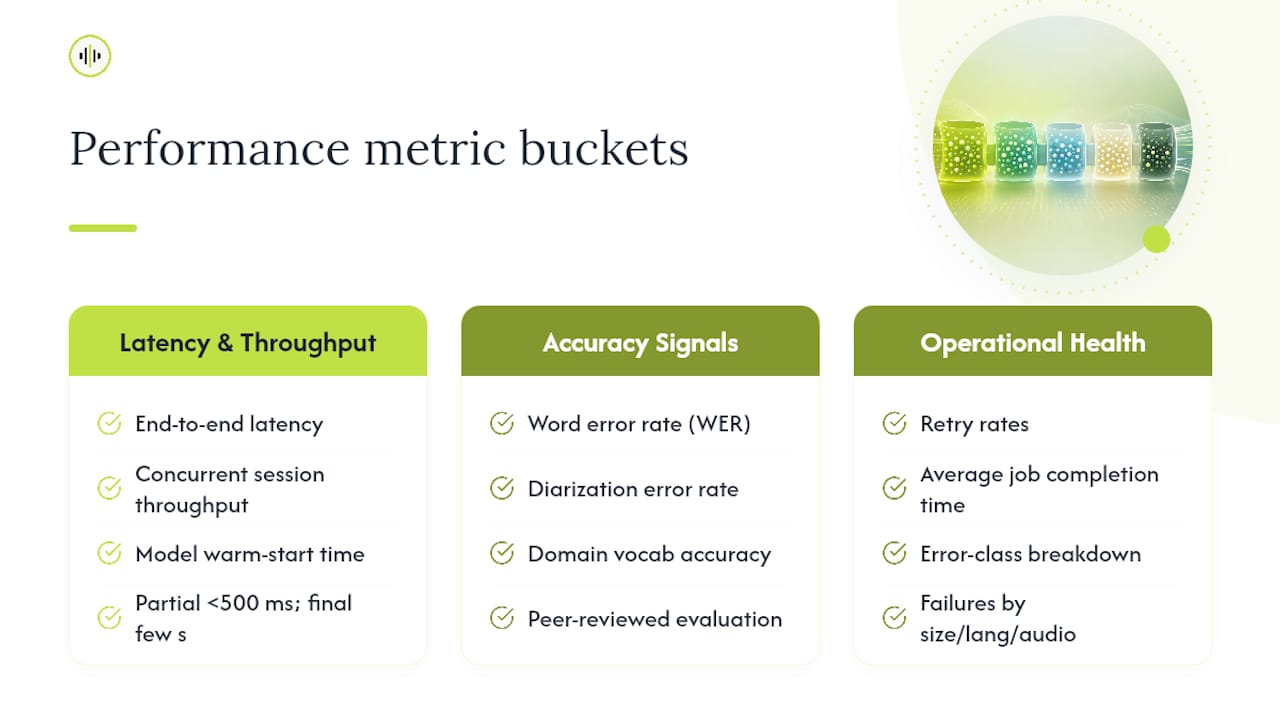
Latency and throughput: end-to-end latency for both streaming partials and full batch jobs, concurrent session throughput, and model warm-start time if you’re routing across multiple models.
Accuracy signals: word error rate (WER), diarization error rate, and accuracy specifically on your domain vocabulary, since general-purpose benchmarks rarely reflect performance on industry jargon or proper nouns. Established methodologies for measuring these come from peer-reviewed evaluation research on conversational transcription and speaker attribution, which is a more reliable baseline than a vendor’s self-reported number.
Operational health: retry rates, average job completion time, and a breakdown of error classes so you know whether failures cluster around file size, language, or audio quality.
A realistic benchmark target for streaming is partial results under 500 milliseconds and finalization within a few seconds for short utterances, though this varies meaningfully by model choice and input audio quality. Treat any number a vendor quotes without showing you their own benchmark methodology with some skepticism.
How Should You Choose a Pricing Model and Transcription Model?
Billing for transcription APIs generally falls into a few shapes: per-second billing tied directly to audio duration, per-job flat fees, subscription tiers with bundled volume, and bring-your-own-provider (BYOP) routing where you pay a markup on top of the underlying model’s own cost. Per-second billing tends to suit variable, unpredictable workloads best, while subscriptions make sense once your volume is stable and high enough to justify a committed tier.
Higher-accuracy models generally cost more and run slightly slower, so match the model to the stakes of the content. Real-time captions for a live event tolerate a small accuracy trade-off for speed; archival indexing for legal discovery does not.
To control cost without sacrificing quality where it matters:
- Sample a subset of long recordings with a cheap model before committing to full processing
- Route low-risk content (internal notes, casual recordings) to lower-cost models
- Reserve premium models for content that feeds compliance, legal, or customer-facing outputs
Pro Tip: Run a two-stage pipeline: a fast, low-cost model handles the immediate need (live captions, quick search indexing), and a higher-accuracy model reprocesses flagged or high-value segments afterward. This gets you speed where it matters and accuracy where it counts, without paying premium rates on every second of audio you process.
What Should You Test Before Committing to an API?
A proof-of-concept that only tests clean, single-speaker audio in English will pass every vendor’s demo and then fail on your actual production traffic. Build your test set around the conditions your real audio will contain.
Run these before signing anything:
- Multi-speaker meetings with three or more overlapping voices
- Accented speech representative of your actual user base
- Phone audio at typical telephony sample rates (often 8kHz)
- Noisy environments: background chatter, traffic, HVAC hum
- Long recordings exceeding one hour to test job stability and timeout handling
- Domain-specific vocabulary your general dataset won’t cover
Set concrete acceptance criteria rather than a vague “seems good” judgment call:
- Diarization stability: the same speaker keeps the same
speakerIdthroughout a session - A defined maximum word error rate on your representative dataset, not a generic benchmark
- Webhook delivery within a documented time window after job completion
- A successful failover test if the primary model or region goes down mid-job
Representative test cases like these, covering multi-speaker meetings, noisy telephony, and long recordings, are consistent with the practitioner guidance behind open schema and testing recommendations for transcript validation. Skipping this step is the single most common reason teams discover accuracy problems after launch instead of during evaluation.
How OpenTranscription Handles Structured Transcripts at Scale
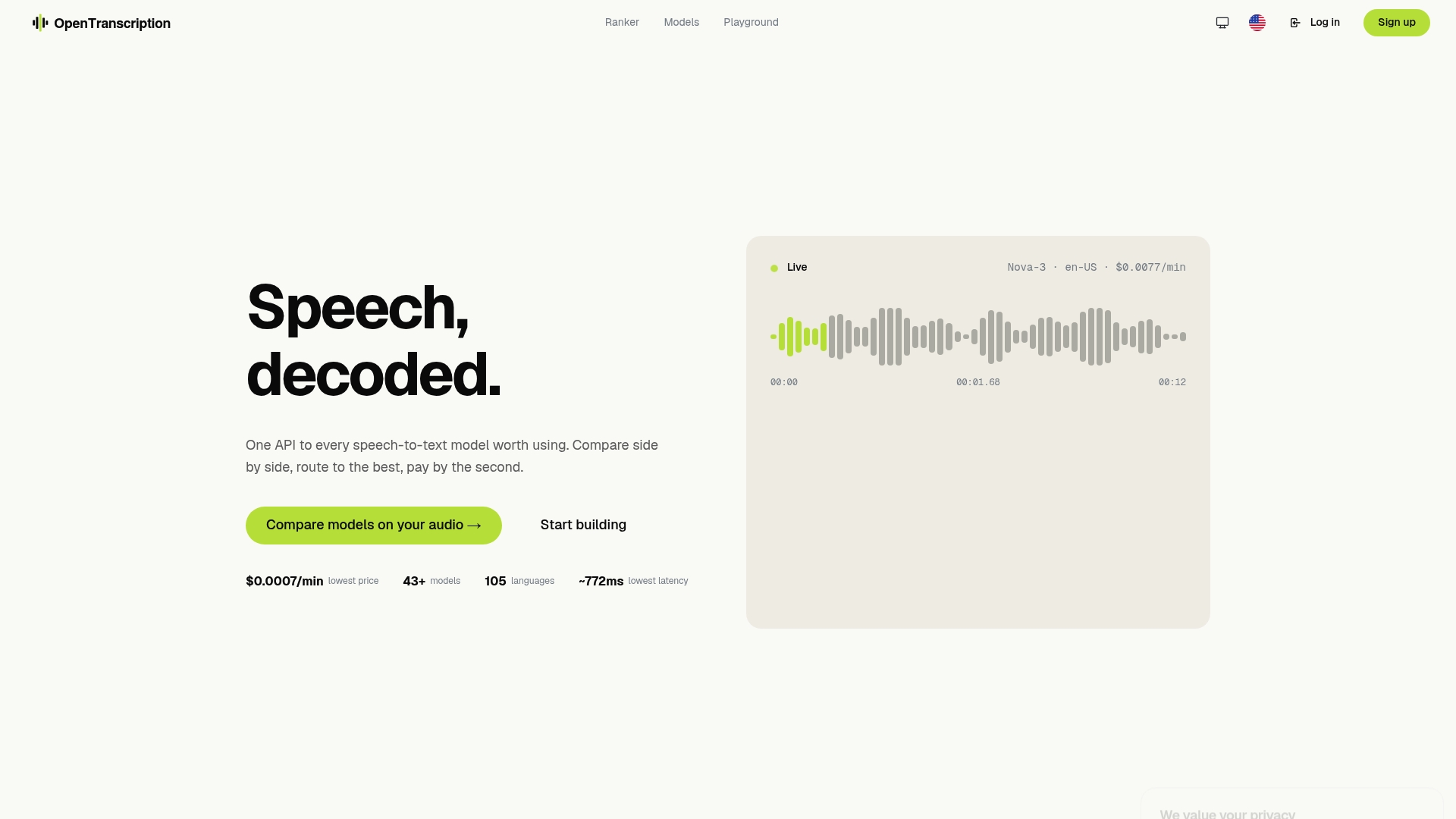
OpenTranscription’s API is built around the exact requirements this evaluation process surfaces: real-time streaming, stable speaker identification, and structured JSON output across more than 105 languages, all through a single integration point rather than a separate contract per model.
What sets it apart in day-to-day use is the model benchmarking layer. Instead of committing to one provider’s accuracy and pricing blind, teams can compare over 40 transcription models side by side on cost, speed, and accuracy through the transcription models catalog, then route traffic to whichever model fits a given job’s stakes and budget.
For teams that have been burned by locking into a single model and later discovering a competitor handles their domain vocabulary better, live benchmarking removes the guesswork from that decision entirely.
The practical upshot for engineering teams: faster integration because you’re building against one schema instead of several, predictable costs because billing is transparent and per-second rather than opaque subscription tiers, and production-ready features (webhooks, SDKs, and model routing) available from day one rather than bolted on after a support ticket.
What Engineers Consistently Underestimate About This Evaluation
The instinct in most POCs is to obsess over raw accuracy numbers first and treat schema consistency as an afterthought. That ordering is backwards. Prioritize schema consistency, diarization reliability across full sessions, and observability (logs, metrics, structured errors) before you rank models by benchmark scores alone. If you’re starting a POC, build a small representative dataset and write your acceptance criteria down before you make a single API call. Vague satisfaction is not a test result.
Start Comparing Structured Transcription Models
Every requirement covered here, structured JSON with word-level timestamps, stable speaker diarization, streaming and batch support, and transparent per-second pricing, maps directly onto what OpenTranscription’s platform provides out of the box. Instead of committing to a single provider’s accuracy and cost profile upfront, you get live access to more than 40 models you can benchmark against your own audio before routing production traffic.
Billing runs pay-as-you-go per second of audio processed, with model routing that lets you send low-stakes content to cheaper models and reserve premium models for what actually needs the accuracy. Advanced teams can also bring their own provider credentials (BYOP) for direct billing control. Developer resources, including SDKs and full API documentation, are built to get a working integration running without a lengthy sales cycle.
Start by comparing model performance and pricing on your own sample audio at OpenTranscription’s model comparison page, or browse the full transcription model rankings to see current cost and accuracy benchmarks before you commit to a provider.
Sources
FAQ
What Is a Structured Transcripts API?
It’s an API that returns transcripts as JSON payloads containing timestamps, speaker labels, confidence scores, and metadata, instead of plain text or a caption file alone.
How Is a Structured Transcript Different From a Regular Transcript?
A regular transcript is readable text; a structured transcript is machine-parseable data with word-level timing and speaker attribution that supports search, analytics, and automation.

Do Structured Transcripts APIs Support Real-Time Streaming?
Yes, most production APIs, including OpenTranscription, support both real-time streaming over WebSocket for live use cases and asynchronous batch processing for recorded files.
What Should I Check Before Choosing a Transcription API?
Test diarization stability, word error rate on your own domain audio, webhook reliability, and schema consistency across model versions before committing to any provider.
Can I Compare Multiple Transcription Models Through One API?
Yes. OpenTranscription lets developers benchmark and route across more than 40 transcription models by cost, speed, and accuracy through a single unified API.