

Streaming Speech Recognition: Architecture and Latency Guide
For sub-500ms live transcription, use a causal streaming encoder, either a conformer or a monotonic-attention variant, paired with short-frame buffering, incremental decoding, and voice activity detection. This combination remains the most reliable path to acceptable latency without collapsing word error rate. Two tradeoffs govern every design decision from here forward.
- Latency vs. accuracy: shorter lookahead windows cut delay but raise WER; predictive decoding and small fixed lookahead (roughly 300 to 600ms of context) recover some of that accuracy without reintroducing the delay you just removed.
- Segmentation vs. stability: monotonic attention mechanisms reduce revision churn in partial transcripts, but they need careful read/write policy tuning or they clip words mid-utterance.
Three references anchor the technical detail in this piece: a decoder-only LLM streaming paper, OpenAI’s realtime transcription guide, and Google Cloud’s streaming speech-to-text documentation. Each documents a different layer of the stack: model research, API contract design, and production SDK patterns.
Key Takeaways
Reliable streaming speech recognition depends on matching encoder architecture, chunk size, and VAD sensitivity to the latency bucket your specific use case actually requires.
| Point | Details |
|---|---|
| Pick a latency bucket first | Sub-200ms for assistants, 150–500ms for captions, above 500ms for high-accuracy transcription review. |
| Start with a conformer | Causal or limited-lookahead conformers give a predictable latency baseline before trying MoChA or LLM-based streaming. |
| Instrument all four latency stages | Log capture, server receive, decode, and render timestamps separately to isolate where delay originates. |
| Tune VAD and chunk size together | Testing them as a joint matrix reduces choppy partials more than adjusting either variable alone. |
| Prototype quickly with OpenTranscription | Its realtime model rankings and per-second billing let engineers compare latency and accuracy before building custom infrastructure. |
Table of Contents
- Streaming Speech Recognition Terms and Metrics Engineers Should Standardize
- Model Architectures Built for Streaming Speech to Text
- WebSocket, WebRTC, and Audio Framing for Real-Time Transcription APIs
- Measuring Latency and Accuracy Tradeoffs in Streaming ASR
- Building a Streaming Speech Recognition Pipeline Step by Step
- Running Streaming Transcription in Production at Scale
- Where OpenTranscription Fits in a Streaming ASR Stack
- Primary Research and API Documentation for Streaming ASR
- What the Research Actually Tells Us About Streaming ASR
- Get Streaming Transcription Running Without Building Infrastructure First
- Sources
- FAQ
Streaming Speech Recognition Terms and Metrics Engineers Should Standardize
Every team building real-time speech recognition eventually invents its own vocabulary for the same five concepts, and that inconsistency is where integration bugs come from. A partial transcript is an unconfirmed, revisable hypothesis emitted before the model has enough context to commit. A final transcript is the output the system will not retract. UIs should render partials in a visually distinct state (grayed text, no punctuation commitment) and never let downstream systems like search indexing or compliance logging treat a partial as ground truth.
Latency itself breaks into five measurable stages: capture (microphone to buffer), encode (buffer to network payload), network transit, decode (server-side inference), and render (client display). Instrumenting each stage separately, rather than logging a single end-to-end number, is what lets you find out whether your 400ms delay is a network problem or a model problem.
- Timestamp audio at capture using a monotonic clock, not wall-clock time, to avoid drift across long sessions.
- Log server receive time and decode completion time separately so encode/network latency is isolable from inference latency.
- Track the real-time factor (processing time divided by audio duration) alongside word error rate, not instead of it.
Word error rate on its own is a poor stand-in for streaming quality because it ignores when a correct word arrived. A model can post a strong final WER while still producing unusable partials for live captioning. Test against both synthetic audio (controlled noise injection, known transcripts) and real recorded calls or meetings, since vendor benchmarks built purely on clean synthetic sets tend to overstate real-world accuracy.
Model Architectures Built for Streaming Speech to Text
Not every acoustic model can run incrementally, and the ones that can make very different tradeoffs between the causal receptive field and the flexibility to revise a hypothesis.
Conformer-based streaming encoders dominate production deployments today because they combine convolutional local feature extraction with self-attention, restricted to a causal or limited-lookahead window. This bounds how far into the future the model can peek, typically a few hundred milliseconds, which keeps latency predictable but caps how much disambiguating context the model gets for tricky phonemes.
Monotonic chunkwise attention (MoChA) solves a different problem: segmentation. Rather than deciding lookahead purely by a fixed window, MoChA learns a read/write policy that decides, chunk by chunk, when it has heard enough to commit a decoding step. This is what allows a model to hold off on a word boundary that’s genuinely ambiguous rather than guessing on a fixed clock.
Decoder-only large language models, the newest entrant, were not designed for streaming at all. A 2026 arXiv paper on streaming LLM-based ASR shows that adapting them requires bolting on a read/write policy network integrated with monotonic chunkwise attention to segment audio embeddings and interleave them with output labels during training. The practical caveat: this buys you the LLM’s superior language modeling for disfluent or domain-specific speech, but it adds architectural complexity most teams don’t need for straightforward captioning.
- Conformers: best default for general-purpose live captioning and voice assistants where predictable latency matters more than squeezing out the last WER point.
- MoChA-based models: worth prototyping when your audio has frequent mid-sentence pauses or code-switching, where fixed-window segmentation produces choppy partials.
- Decoder-only LLM streaming: reserve for domain-specific transcription (medical, legal) where language modeling quality outweighs added latency and engineering overhead.
Pro Tip: Prototype with a conformer first even if your end goal is an LLM-based pipeline. It gives you a working latency and WER baseline in days, and you’ll need that baseline to justify the added complexity of read/write policy tuning later.
WebSocket, WebRTC, and Audio Framing for Real-Time Transcription APIs
Transport choice is not a style preference. It changes your latency floor and your failure modes.
WebRTC fits browser-native, peer-to-peer scenarios where you need the lowest possible latency and can tolerate its heavier connection setup (ICE negotiation, STUN/TURN for NAT traversal). WebSocket fits server-driven pipelines, batch-adjacent architectures, and any case where you control both endpoints and want a simpler, ordered message contract. Most streaming speech to text APIs, including Google Cloud’s streaming recognition service, default to WebSocket for exactly this reason.
On audio formatting, the convergence across major providers is strong: PCM 16-bit, mono, at 16kHz or 24kHz. Chunk sizes of 50 to 150 milliseconds strike the balance most APIs recommend, small enough for frequent partial updates, large enough to avoid overwhelming the connection with tiny frames.
- Session start: client sends a session.started message carrying sample rate, encoding, and language hints before any audio.
- Streaming audio: chunks flow with sequence IDs attached, so the server can detect drops or reordering.
- Partial events: the server emits transcript.partial messages as hypotheses firm up, OpenAI’s realtime API and similar contracts follow this same pattern.
- Finalize: the client sends an explicit finalize or the server auto-commits on a VAD-detected pause, producing a transcript.final event.
- Close: session teardown flushes any buffered audio and confirms the last final was delivered.
Resilience matters more in streaming than in batch transcription, because a dropped connection mid-utterance loses context, not just bytes.
- Implement reconnection with session resumption tokens so a network blip doesn’t restart the entire utterance.
- Use a jitter buffer on the client to smooth out network-induced gaps before they reach the encoder.
- Make transcript application idempotent: if a partial arrives twice due to retry logic, applying it twice should not duplicate text on screen.
Measuring Latency and Accuracy Tradeoffs in Streaming ASR
You cannot tune what you have not instrumented, and streaming systems hide their worst behavior in percentile tails, not averages.
- Instrument every stage. Log capture timestamp, server receive timestamp, decode completion timestamp, and render timestamp as four separate fields per utterance, not one aggregate latency number.
- Run a chunk size × lookahead × VAD sensitivity matrix. Hold two variables fixed while sweeping the third, then measure both WER and latency at the p50, p95, and p99 percentiles, since tail latency is what users actually notice.
- Set targets by use case, not by what the model can technically do. Voice assistants generally need sub-200ms round trip to feel responsive; live captions tolerate roughly 150 to 500ms without feeling laggy; high-accuracy transcription for legal or medical review can accept latencies above 500ms in exchange for materially lower WER.
- Separate partial WER from final WER. A system with jittery, frequently-revised partials can still post excellent final accuracy. If your product surfaces partials to end users (live captions do; backend pipelines usually don’t), partial stability deserves its own metric, not just a footnote.
Vendor and research benchmarks report optimized realtime models reaching roughly 150ms end-to-end latency under favorable conditions, a useful ceiling to calibrate expectations, though your production network and audio conditions will rarely match a benchmark’s clean setup. Real-world testing, not published figures, decides whether your architecture hits the latency bucket your product actually needs.
Building a Streaming Speech Recognition Pipeline Step by Step
The path from raw microphone input to a stable transcript involves more moving parts than most teams budget for upfront, and each stage introduces its own failure mode.
- Client-side capture: fix sample rate at the source (16kHz is the common floor), enable automatic gain control and acoustic echo cancellation on the client, and resist the urge to do this server-side, where you’ve already lost signal quality.
- Server ingestion contract: define the exact audio format, chunk cadence, and control-message schema before writing a line of decoding logic. Undocumented assumptions here are the most common source of client/server desync bugs.
- VAD strategy: voice activity detection decides when to start and stop a segment. Overly aggressive VAD clips soft consonants at utterance boundaries; overly lenient VAD sends silence into the decoder and wastes compute.
- Chunking and read triggers: pick between time-based triggers (simple, predictable, sometimes choppy), speech-activity triggers (adapts to natural pauses), or token-aware commit patterns (waits for decoder confidence, adds a small delay but improves stability). Tuning VAD sensitivity and chunk size together, rather than treating them as independent knobs, tends to cut choppy partials in noisy audio more effectively than adjusting either alone.
- Applying partials in the UI: render partials as provisional (different styling, no final punctuation) and replace them atomically when the final arrives, never append the final on top of an unremoved partial.
- Merging finals and handling edits: if your system allows post-hoc correction (spelling fixes, punctuation normalization), version the transcript rather than mutating history in place, downstream consumers may have already read the earlier version.
- Diarization fallback: real-time speaker labeling remains genuinely difficult. Streaming diarization is limited in most production APIs, which typically recommend batch post-processing for high-confidence speaker labels. Plan for a hybrid approach: rough real-time speaker tags during the live session, refined diarization applied after the fact.
Pro Tip: Treat token-aware commit patterns as your default, not time-based chunking, if your product shows partials to end users. The extra 50 to 100ms of commit delay is usually invisible to a human reader but dramatically reduces the “typing then erasing” flicker that makes live captions feel unreliable.
Running Streaming Transcription in Production at Scale
Deployment decisions that look purely infrastructural, edge versus cloud, autoscaling policy, monitoring dashboards, actually determine whether your latency budget survives contact with real traffic.
Edge inference cuts network latency to near zero but constrains you to smaller models and device-specific optimization work. Cloud inference gives you access to larger, more accurate models and centralized updates, at the cost of network round-trip time. Most production systems land on a hybrid: lightweight on-device VAD and wake-word detection, with the heavier transcription model running server-side.
- Autoscale WebSocket frontends on active session count, not just CPU, since a streaming connection can sit idle between speech bursts while still holding a slot open.
- Use session affinity (sticky routing) so a reconnecting client lands back on a server that still has its session state cached.
- Control cost through model selection rules, route routine traffic to smaller, cheaper models and only escalate to premium models for flagged high-stakes audio.
Monitor latency percentiles (p50/p95/p99) continuously, not just in pre-launch load tests, along with the ratio of partial to final events per session and the raw transcription error rate. A sudden spike in disconnects often precedes a latency regression by hours, not the other way around.
On privacy, enterprise cloud speech SDKs document retention windows, custom speech models, and diarization limits that matter for compliance planning. If your audio includes regulated data, on-prem or private cloud deployment is worth evaluating early, retrofitting data residency requirements onto a live system is far more expensive than designing for them from the start.
Where OpenTranscription Fits in a Streaming ASR Stack
Teams prototyping a real time transcription API rarely want to train and deploy a custom streaming encoder before validating whether their product even needs one. OpenTranscription addresses that gap directly: it provides real-time streaming transcription, speaker identification, and support across 105+ languages, exposed through a single API rather than a separate integration per model.
- Model selection without lock-in: OpenTranscription’s realtime model rankings let you compare latency and accuracy across models before committing engineering time to any one architecture.
- Structured output: transcripts return with word-level timestamps and confidence scores, useful for the same instrumentation this article recommends building yourself.
- Cost control: per-second billing with no subscription means a prototype phase costs proportionally to the audio you actually process, not a flat platform fee.
Pro Tip: If you’re still in the chunk size × lookahead experiment phase described earlier, running that matrix against OpenTranscription’s model catalog is often faster than provisioning your own GPU inference stack for a comparison you may abandon after the first result.
For teams weighing build versus buy, the honest answer depends on timeline: self-hosting wins when you need a proprietary domain-adapted model at high volume; a managed API wins when time-to-first-working-prototype matters more than owning the inference stack.
Primary Research and API Documentation for Streaming ASR
- Streaming Speech Recognition with Decoder-Only Large Language Models, the read/write policy and MoChA integration approach referenced throughout the architecture section.
- OpenAI’s realtime transcription guide, session lifecycle events and tunable latency settings.
- Google Cloud’s streaming speech-to-text documentation, SDK examples and diarization limitations.
- Efficient Streaming LLM for Speech Recognition (IEEE), latency benchmarks for optimized realtime models.
- Azure Speech service documentation, production features including diarization and custom speech.
What the Research Actually Tells Us About Streaming ASR
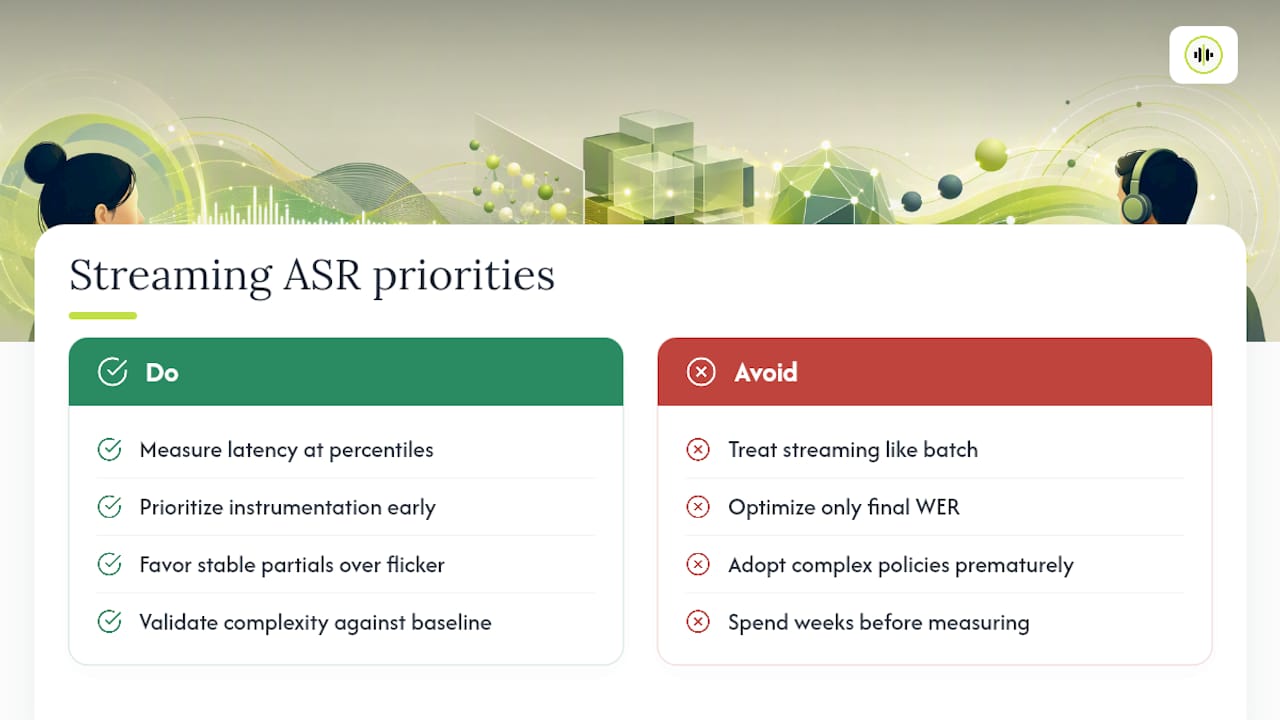
The conventional advice on streaming speech recognition treats it as a smaller, faster version of batch transcription. That framing undersells how different the engineering problem really is. Batch systems optimize for one number: final WER. Streaming systems optimize for a moving target, since a partial transcript that’s 90% accurate but constantly flickering can feel worse to a user than one that’s slightly slower but stable.
The decoder-only LLM research is genuinely exciting, but it’s also the clearest example of a pattern worth watching for: impressive benchmark numbers built on architectural adaptations (read/write policies, segmentation) that add real engineering cost. Teams should resist adopting that complexity before a conformer baseline proves it’s actually needed.
What gets underestimated most is instrumentation. Engineers spend weeks on model selection and days on latency logging, when the reverse ratio usually produces better outcomes faster. You cannot tune a system you cannot measure at the percentile level, and percentile-level measurement is where most streaming ASR problems actually hide.
Get Streaming Transcription Running Without Building Infrastructure First
Building a custom streaming pipeline from the architectures and protocols covered above takes real engineering time, often weeks before you know if your model choice was even the right one. OpenTranscription shortens that path by giving you real-time streaming transcription, speaker identification, and 105+ language support through one API, with the realtime model rankings showing latency and accuracy tradeoffs across more than 40 models before you commit to any single architecture.
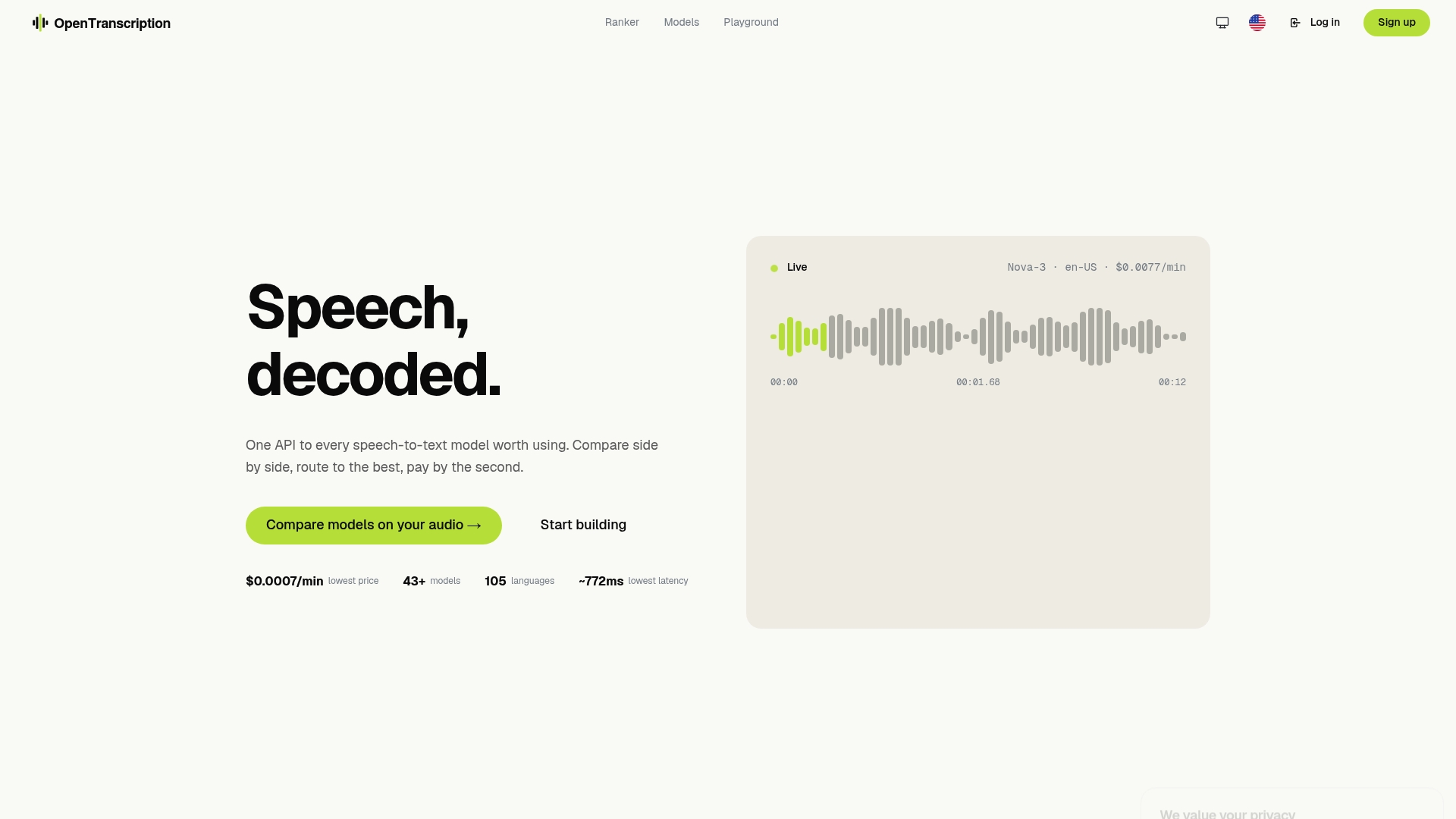
Because billing runs per second of audio with no subscription, testing three different models against your actual audio conditions costs only what you process, not a platform fee for the privilege of experimenting. If the implementation guide above raised more questions than it answered about which architecture fits your latency target, comparing models directly against your own test audio settles the question faster than building each option yourself.
Sources
- Streaming Speech Recognition with Decoder-Only Large Language Models and Latency Optimization
- Realtime transcription | OpenAI API
- Transcribe audio from streaming input
- Efficient Streaming LLM for Speech Recognition
- Speech to text — Azure Speech service
FAQ
What’s the best speech recognition software for real-time use?
There is no single best option across every use case. The right choice depends on your latency target and language needs; platforms like OpenTranscription let you benchmark multiple models directly against your audio rather than relying on published specs alone.
How do I enable speech recognition in a streaming application?
You need a client that captures and frames audio (typically PCM 16-bit mono at 16 or 24kHz), a transport layer (WebSocket or WebRTC), and a server-side model that emits partial and final transcript events as speech arrives.
What is the latest technology in streaming speech recognition?
Decoder-only large language models adapted with read/write policy networks and monotonic chunkwise attention represent the newest research direction, as detailed in a 2026 arXiv paper, though conformer-based streaming encoders remain the more common production choice.
What is online speech recognition?
Online speech recognition, more precisely called streaming speech recognition, processes audio incrementally as it arrives and emits transcripts in near real time, rather than waiting for a complete recording before transcribing it as batch systems do.
How much latency should I expect from a streaming transcription API?
Latency targets vary by use case: voice assistants generally need under 200 milliseconds, live captions tolerate roughly 150 to 500 milliseconds, and high-accuracy transcription can accept latency above 500 milliseconds in exchange for lower word error rate.