

Speech Recognition Accuracy: A 2026 Measurement Guide
Speech recognition accuracy measures how closely an automatic speech recognition (ASR) system’s output matches a human-verified reference transcript, most commonly expressed as Word Error Rate (WER), where lower is better. Noisy or multi-speaker conditions substantially increase WER compared to clean audio, and clinical conversational settings can exceed 50% WER. A 2026 benchmark of 10 tools found that providers generally scored above 95% accuracy on clean audio, but differences widened substantially under accented, noisy, and multilingual conditions. Those headline numbers, however, are only as meaningful as the normalization rules and test conditions behind them. What counts as an error changes depending on whether you strip punctuation, collapse contractions, or retain filler words, and that choice alone can shift reported WER by several percentage points.
Key Takeaways
Speech recognition accuracy is only as meaningful as the normalization protocol, test conditions, and metrics used to measure it — WER on clean audio tells a different story than WER on accented, noisy, or multi-speaker recordings.
| Point | Details |
|---|---|
| Pick the right metric | Use WER for word-level fidelity, CER for morphologically dense languages, SER for intent tasks, and F1 for downstream extraction. |
| Standardize normalization | Apply identical casing, punctuation, and numeral rules to both hypothesis and reference before scoring; inconsistent normalization shifts WER by several points. |
| Prioritize front-end audio | SNR improvement through microphone selection and noise suppression delivers faster WER gains than model changes and requires no retraining. |
| Use targeted fine-tuning | Domain vocabulary injection and fine-tuning on 200–500 in-domain utterances yields 2–4 percentage-point WER reductions for specialized terminology tasks. |
| OpenTranscription for benchmarking | OpenTranscription’s unified API lets you submit the same audio to 40+ models with versioned logging, enabling reproducible, fair comparisons in a single pipeline. |
Table of Contents
- What speech recognition accuracy metrics actually measure
- How to measure accuracy in practice
- Standard benchmarks and datasets used in ASR evaluation
- Key factors that change observed accuracy in lab and production
- Why “human parity” claims often overstate real-world performance
- What to include in accuracy reports for reproducibility
- How to improve measured accuracy and production performance
- A reproducible benchmarking workflow using OpenTranscription
- Practitioner perspective: the accuracy-cost-latency triangle
- OpenTranscription gives you a single pipeline for fair model comparisons
- Sources
- FAQ
What speech recognition accuracy metrics actually measure
WER is the dominant summary statistic in ASR evaluation, defined as the edit distance between hypothesis and reference at the word level, normalized by reference word count: WER = (Substitutions + Deletions + Insertions) / N. A WER of 0.08 means 8 words in every 100 are wrong in some way. The formula is simple, but its interpretation depends heavily on normalization choices made before scoring.
Key metrics and when to use each:
- Word Error Rate (WER): The standard for most English-language benchmarks. Use it when word-level fidelity matters, such as in dictation, meeting transcription, or any downstream task that parses individual tokens.
- Character Error Rate (CER): Computes edit distance at the character level. More appropriate for morphologically dense languages (German, Finnish, Arabic) or short-token domains where a single-character substitution changes meaning. CER is also less sensitive to tokenization inconsistencies.
- Sentence/Utterance Error Rate (SER): Marks an entire utterance as incorrect if any word-level error exists. Useful for intent detection and slot-filling tasks where a partial error invalidates the whole output.
- Precision, Recall, and F1: Applied to downstream information extraction tasks, such as named-entity recognition or clinical concept extraction. A systematic review of ASR in clinical documentation found F1 scores for clinical concept extraction ranging from 0.416 to 0.856 across 29 studies, illustrating how a single WER figure can mask wide variation in task-level utility.
- Confidence scores: Model-level probability estimates attached to each word or segment. Well-calibrated confidence scores let you flag low-certainty tokens for human review without re-transcribing the entire file. They complement edit-distance metrics rather than replace them; a system can produce a low WER on average while still generating poorly calibrated confidence scores on out-of-vocabulary terms.
WER’s core weakness is semantic blindness. Substituting “hypertension” for “hypotension” costs one word error but carries clinical consequences far beyond what the metric captures. Research evaluating ASR solutions has proposed complementary measures such as CER, Match Error Rate (MER), and Automated Caption Evaluation (ACE), with mixed results when compared against WER on accessibility tasks. The practical takeaway: report WER as the primary metric, then layer in task-specific measures that reflect what actually breaks downstream.
How to measure accuracy in practice
Producing a defensible WER number requires more than running a scorer. The following checklist covers the full pipeline from test-set design to statistical reporting.
- Select a representative test set. Stratify by audio condition (clean, noisy, far-field), speaker demographics (native vs. non-native, age range), and domain vocabulary. A test set drawn entirely from studio recordings will not predict production performance on meeting audio.
- Obtain human reference transcripts. Transcripts should be produced by trained annotators following a written style guide. Report inter-annotator agreement (ITA), typically measured as pairwise WER between annotators, to establish the human ceiling. ITA WERs of 2–5% are common for clean speech; higher ITA signals ambiguous audio that will inflate any system’s measured WER.
- Define and apply normalization rules before scoring. Decide whether to lowercase, strip punctuation, expand numerals, normalize contractions, and remove filler words (uh, um). Apply identical rules to both hypothesis and reference. Failing to normalize consistently is one of the most common sources of non-comparable WER figures across papers.
- Choose a scoring tool and fix its version. Open-source options include
jiwer(Python),sclite(NIST SCTK), andwhisper-normalizerfor Whisper-specific normalization. Record the exact tool version and command in your evaluation log. - Handle diarization and segmentation mismatches. When scoring multi-speaker audio, hypothesis segments must be aligned to reference segments before scoring. Misaligned boundaries inflate WER artificially. Use concatenated minimum-permutation WER (cpWER) or collar-based alignment to handle timing offsets. Independent benchmarks confirm that diarization quality directly correlates with multi-speaker WER, so evaluate diarization separately using Diarization Error Rate (DER) alongside transcript WER.
- Report sample counts and confidence intervals. Bootstrap resampling over utterances is the standard method for computing 95% confidence intervals on WER. With fewer than a few hundred utterances, point estimates are unreliable. Report N, WER, and the CI together.
- Run significance tests when comparing models. Matched-pair tests (e.g., McNemar’s test on utterance-level errors) or bootstrap hypothesis tests determine whether a WER difference between two systems is statistically meaningful rather than sampling noise.
Standard benchmarks and datasets used in ASR evaluation
Knowing which dataset a reported WER comes from is as important as the number itself. Each corpus encodes specific acoustic conditions, speaker demographics, and recording setups that limit generalization.
- LibriSpeech (960h): Read English speech derived from LibriVox audiobooks. Clean-test and other-test splits provide a well-understood baseline for acoustic model quality. WERs on LibriSpeech clean-test are now below 2% for top models, making it a poor discriminator for production comparisons.
- Switchboard / CallHome: Telephone-quality conversational English, 8 kHz, with natural disfluencies and speaker overlap. Historically the standard for conversational ASR; WERs in the 5–15% range are typical for modern systems.
- CHiME (4/5/6/7): Far-field, multi-microphone, multi-speaker dinner-party and dinner-party-style scenarios. CHiME-6 WERs above 30% remain common even for competitive systems, reflecting genuine difficulty of overlapping speech in reverberant rooms.
- Common Voice (Mozilla): Crowd-sourced, multilingual, variable recording quality. Useful for accent and language coverage evaluation; validation quality is inconsistent across languages, so per-language quality filtering is necessary before using it as a benchmark.
- TED-LIUM (v3): Prepared lecture speech from TED talks. Moderate difficulty; useful for evaluating domain vocabulary handling and spontaneous but structured speech.
- FLEURS: Multilingual benchmark covering 102 languages with parallel speech data. Designed for cross-lingual evaluation; WER varies enormously by language resource level.
- Multi-speaker meeting corpora (AMI, ICSI, MSDWild): Recorded meeting audio with overlapping speech and multiple microphones. Closer to enterprise meeting transcription use cases than LibriSpeech; DER and cpWER are the appropriate metrics.
Known limitations apply across all public benchmarks. Domain mismatch is the most consequential: a model tuned on LibriSpeech will underperform on medical dictation or legal depositions regardless of its benchmark WER. Speaker demographic coverage is uneven in most corpora, which means benchmark WERs for non-native speakers or regional accents are often optimistic. Academic evaluation found average WERs of approximately 7% on lecture datasets, but per-sample WERs spanned 0% to 53.8%, illustrating how a single average conceals extreme per-condition volatility. Overfitting to a specific benchmark through dataset-specific normalization or fine-tuning is a real risk; always hold out a private test split that has never touched the training or tuning pipeline.
For production evaluation, the most defensible approach combines one or two public benchmarks with an in-house test set drawn from actual production audio. The public benchmarks provide comparability to published results; the in-house set measures what actually matters for your deployment.
Key factors that change observed accuracy in lab and production
Diagnosing accuracy gaps requires knowing which category of factor is responsible. The list below is ordered roughly by how quickly each can be addressed.
Acoustic factors (fastest to fix):
- Signal-to-noise ratio (SNR) is the single strongest predictor of WER in most deployments. Even a 10 dB improvement in SNR through microphone placement or front-end noise suppression can reduce WER by several absolute points.
- Room reverberation (RT60) degrades far-field capture; close-talk microphones or beamforming arrays mitigate this without model changes.
- Microphone frequency response and dynamic range affect the acoustic front end; consumer-grade microphones clip transients that carry phoneme-distinguishing information.
Speech characteristics (medium effort):
- Non-native accents and regional dialects consistently produce higher WER on models trained predominantly on standard American or British English. An independent 8-provider benchmark found large WER increases on accented and crosstalk samples relative to clean baselines.
- Speaking rate extremes (very fast or very slow) and heavy disfluency (false starts, filled pauses) challenge acoustic models trained on fluent read speech.
- Code-switching between languages within an utterance is poorly handled by most monolingual models; multilingual models reduce but do not eliminate this gap.
- Speaker overlap and crosstalk are the hardest acoustic condition to handle; diarization quality directly determines whether overlapping segments are attributed correctly.
Data and model factors (deeper investment):
- Training data domain mismatch is the most common cause of production WER being 2–3× the benchmark WER. A model trained on general web audio will struggle with legal, medical, or financial terminology.
- Out-of-vocabulary (OOV) terms and named entities (product names, drug names, proper nouns) are disproportionately responsible for errors in specialized domains. Vocabulary injection or lexicon biasing addresses this without full retraining.
- Model size and architecture trade accuracy for latency; larger encoder-decoder models generally produce lower WER but require more compute per audio second.
- Fine-tuning on even a few hundred in-domain utterances can yield 2–4 percentage-point WER reductions for specialized vocabulary tasks, as supported by clinical ASR research.
Operational factors:
- Streaming (real-time) mode introduces partial hypothesis instability; words near the recognition boundary are revised as more audio arrives, producing higher effective WER than batch mode on the same audio.
- Diarization errors propagate into transcript WER; a missed speaker boundary creates a run-on segment that scores poorly even when the acoustic model is correct.
- Timestamping misalignment affects downstream tasks that depend on word-level timing (subtitle synchronization, meeting action-item extraction).
Why “human parity” claims often overstate real-world performance
Vendors frequently cite “human parity” to describe systems achieving WERs comparable to human transcribers on a specific benchmark. The claim is technically defensible in narrow conditions and misleading in most production contexts.
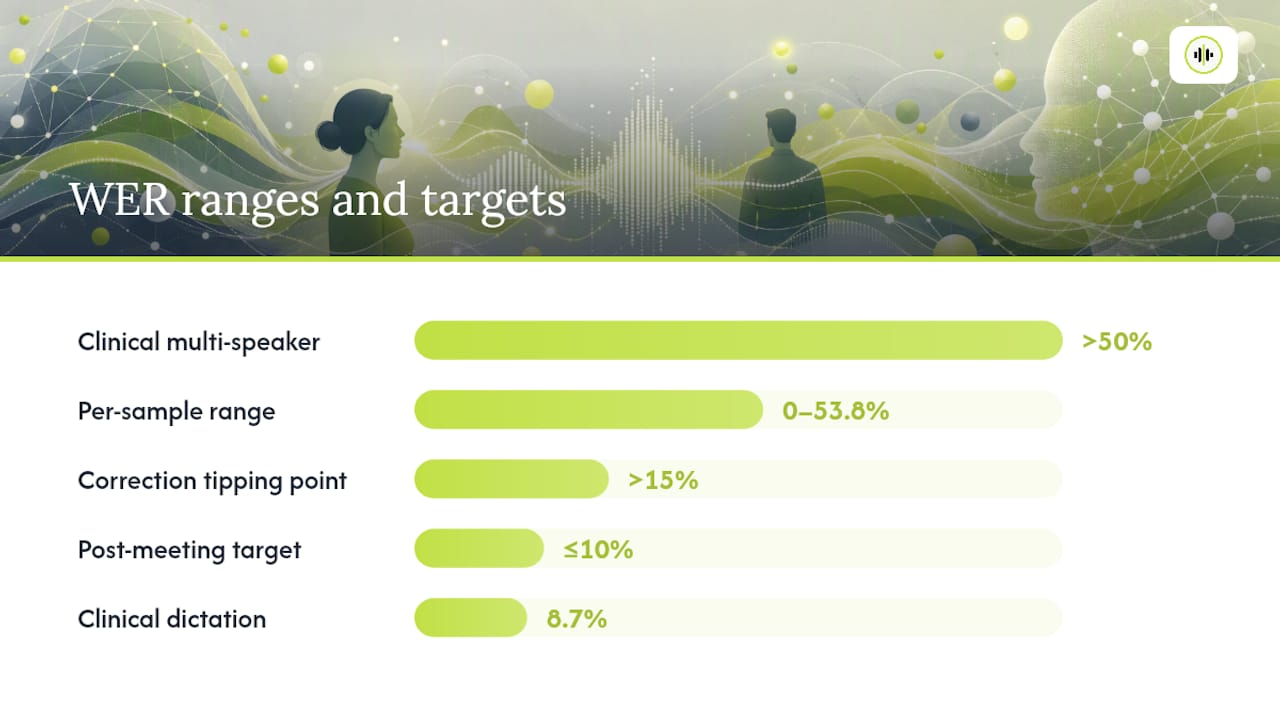
Human parity benchmarks are typically measured on clean, single-speaker, read or prepared speech with strict normalization that removes punctuation, casing, and filler words. Under those conditions, several modern large-model ASR systems do match or beat human WER. The problem is that the benchmark conditions are not the deployment conditions. Academic analysis of vendor WER claims found that no single vendor was best on every sample, and per-sample variance was extreme, with individual WERs ranging from 0% to 53.8% on the same dataset. Averages obscure the tail.
The gap between lab WER and real-world usability is sharpest in three contexts:
- Specialized vocabulary: Clinical, legal, and technical domains contain terminology that general-purpose models handle poorly. A systematic review of clinical ASR found WERs from 0.087 in controlled dictation to above 50% in conversational multi-speaker clinical settings, with inconsistent time savings and persistent need for human post-editing.
- Safety-critical and legal accuracy: A 95% word-level accuracy rate means 1 error per 20 words. In a 500-word clinical note, that is roughly 25 errors. Even if most are minor, a single substitution of a drug name or dosage can invalidate the document.
- Accessibility contexts: Users who depend on captions for comprehension cannot tolerate the same error rate as a developer running a batch job. A WER that looks acceptable in aggregate can still fail users who rely on exact terms, proper nouns, or punctuation for meaning.
Task-driven thresholds provide more useful targets than a single universal benchmark:
- Live captions (broadcast, accessibility): High accuracy on clean audio and strong overall performance across mixed conditions are recommended for professional use, per the 2026 benchmark recommendations.
- Post-meeting transcription and summarization: WER ≤10% is generally acceptable when a human reviewer will scan the output; WER above 15% typically increases correction time to the point where it negates the automation benefit.
- Clinical documentation: WER targets are less meaningful than F1 on clinical concept extraction; the PMC systematic review found F1 ranging from 0.416 to 0.856, and even high-F1 systems required post-editing in many deployments.
- Voice commands and intent detection: SER is the relevant metric; a single word error that changes the recognized intent is a complete failure regardless of WER.
What to include in accuracy reports for reproducibility
Reproducible accuracy claims require a minimum set of documented fields. Without them, a reported WER cannot be compared to any other result.
- Dataset identity and version: Name the corpus, the specific split (e.g., LibriSpeech test-clean), and the version or release date. Public datasets are updated; an unversioned citation is ambiguous.
- Audio sampling rate and format: State the sample rate (8 kHz, 16 kHz, 44.1 kHz), bit depth, channel count, and any codec applied before inference.
- Normalization rules: List every transformation applied to hypothesis and reference before scoring: lowercasing, punctuation removal, numeral expansion, contraction normalization, filler word handling. Provide the exact script or tool used.
- Scorer tool and version: Specify the scoring library (e.g.,
jiwer==3.0.3,sclitefrom NIST SCTK 2.4.10) and the exact command invoked. Different tools handle edge cases differently; the tool choice affects the number. - Model configuration: Record model name, version or checkpoint hash, inference mode (streaming vs. batch), language setting, and any biasing or adaptation applied.
- Sample counts and confidence intervals: Report N (number of utterances), total audio duration, WER point estimate, and 95% bootstrap CI.
- Human inter-annotator agreement: Report pairwise ITA WER to establish the human ceiling for the test set.
- Compute and latency: Report real-time factor (RTF) or median/P95 latency for streaming, and hardware configuration (GPU type, batch size) for batch jobs.
An example scoring command using jiwer:
python -m jiwer --hypothesis hyp.txt --reference ref.txt --output-format json
The output should report WER, CER, substitutions, deletions, insertions, and total reference words. Log this output alongside the model version and normalization script in a versioned artifact store.
Commercial providers update models regularly, and benchmark results can shift by 1–2 accuracy points between updates. Logging the model version hash or API endpoint version at the time of evaluation is necessary to make results reproducible after a provider silently updates their backend.
For sensitive audio, anonymize speaker identities before sharing evaluation splits. Techniques include voice conversion, pitch shifting, and transcript-level pseudonymization of named entities. Document the anonymization method, as it may affect WER on the anonymized segments.
How to improve measured accuracy and production performance
Improvements fall into three tiers by effort and expected impact.
Quick infrastructure fixes:
- Replace consumer-grade microphones with cardioid or hypercardioid close-talk mics for dictation use cases; for meeting rooms, use a ceiling array or tabletop beamforming device rather than a laptop microphone.
- Apply front-end noise suppression (e.g., RNNoise, DeepFilterNet, or a hardware DSP stage) before sending audio to the ASR model. Noise suppression at the capture stage is cheaper than model-side robustness and often yields immediate WER gains.
- Normalize audio levels and apply voice activity detection (VAD) to strip silence and non-speech segments before inference; this reduces both latency and the number of spurious insertions.
Model-side interventions:
- Inject domain vocabulary through lexicon biasing or constrained decoding. Most production ASR APIs support a custom vocabulary or hotwords list that boosts the prior probability of specified terms without retraining.
- Apply on-the-fly language model (LM) biasing using a shallow fusion approach: combine the acoustic model’s output distribution with a domain-specific n-gram or neural LM at inference time.
- Fine-tune on 200–500 in-domain utterances when a vocabulary list is insufficient. Domain adaptation and vocabulary injection can yield 2–4 percentage-point WER reductions on specialized terminology tasks, as documented in clinical ASR research.
Post-processing strategies:
- Apply confidence-thresholded editing: flag tokens below a calibrated confidence threshold for human review rather than accepting all output blindly. This concentrates human effort on the segments most likely to contain errors.
- Use targeted regex corrections for known high-frequency entity errors (drug names, product names, legal citations). A small correction dictionary applied post-inference can eliminate systematic substitution errors without touching the model.
- Lightweight reranking pipelines that score N-best hypotheses using a domain LM can recover correct alternatives that the primary model ranked second.
Monitoring KPIs in production:
- Track rolling WER by audio condition (clean, noisy, far-field) separately; a single aggregate WER masks condition-specific regressions.
- Monitor Diarization Error Rate (DER) for multi-speaker workflows; DER degradation often precedes WER degradation as a leading indicator.
- Track latency percentiles (P50, P95) for streaming deployments; latency and accuracy trade-offs shift when providers update models.
- For human-in-the-loop workflows, measure edit time per transcript minute as a proxy for effective accuracy from the operator’s perspective.
When to collect more data:
- Trigger a data collection sprint when rolling WER on a specific condition exceeds your task threshold for two consecutive weeks.
- Sample problematic audio systematically: prioritize recordings that generated high-confidence errors (the model was wrong but certain), as these reveal systematic gaps rather than random noise.
A reproducible benchmarking workflow using OpenTranscription
Running a fair, reproducible model comparison requires controlling for audio condition, normalization, and model configuration simultaneously. The following workflow applies whether you are evaluating two models or twenty.
Step 1: Dataset selection and stratification. Assemble a test set that covers your target conditions: at minimum, clean single-speaker, noisy single-speaker, and multi-speaker with overlap. Include a “challenge set” of utterances containing named entities, accented speech, and crosstalk segments specifically designed to expose model weaknesses. A challenge set that surfaces failures is more diagnostic than a balanced set that produces uniformly good numbers.
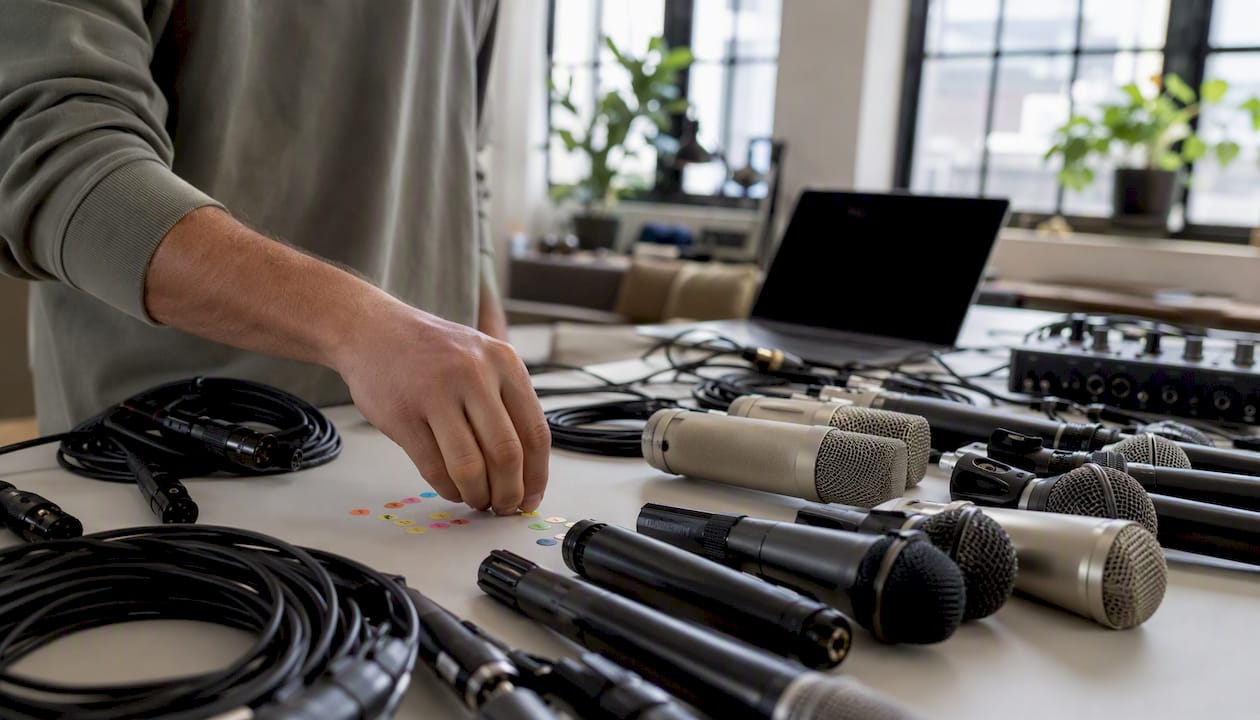
Step 2: Consistent normalization. Define normalization rules before touching any model output. Apply the same script to every hypothesis and every reference transcript. Store the normalization script in version control alongside the test set.
Step 3: Upload and ingest via OpenTranscription. The OpenTranscription models catalog provides access to 40+ transcription models through a unified API, so you can submit the same audio file to multiple models without managing separate integrations. Configure each model run with explicit parameters: language, streaming vs. batch mode, diarization on/off, and any vocabulary biasing. Log the model version identifier returned by the API for each job.
Step 4: Score and compare. Export hypothesis transcripts and run your normalization script, then score with a fixed tool version. The comparison structure below shows the columns that matter for a fair evaluation.
Pro Tip: Design your challenge set to include at least 50 utterances per failure mode (named entities, heavy accent, crosstalk). A challenge set with fewer than 30 utterances per condition produces confidence intervals too wide to distinguish models reliably.
Step 5: Log and export artifacts. Record model version, configuration snapshot, normalization script hash, scorer version, and the full scoring output (WER, CER, N, CI) as a single versioned artifact. OpenTranscription returns word-level timestamps and confidence scores alongside the transcript, which enables per-token error analysis and confidence calibration checks as part of the same export.
Practitioner perspective: the accuracy-cost-latency triangle
The most common mistake in production ASR deployments is optimizing for benchmark WER when the real constraint is latency or cost.
A larger model reduces WER by 2–3 points but may double the real-time factor, making it unsuitable for live captioning where a 500 ms delay breaks speaker synchronization. Conversely, a lightweight streaming model that meets latency requirements may produce a WER that is acceptable for meeting notes but unacceptable for clinical documentation.
Consider the concrete decision between live captioning and post-meeting transcription. The decision is not about which model is “better” but about which constraint is binding for the task.
Document these trade-offs explicitly in engineering specifications. That level of specificity is what separates a production-grade deployment from a demo.
OpenTranscription gives you a single pipeline for fair model comparisons
Selecting the right ASR model for a production deployment means running the same audio through multiple candidates under identical conditions, and that is exactly where integration overhead typically kills reproducibility. OpenTranscription removes that friction by providing a unified API that routes the same audio job to 40+ transcription models, returning structured transcripts with word-level timestamps and per-token confidence scores in a consistent format.
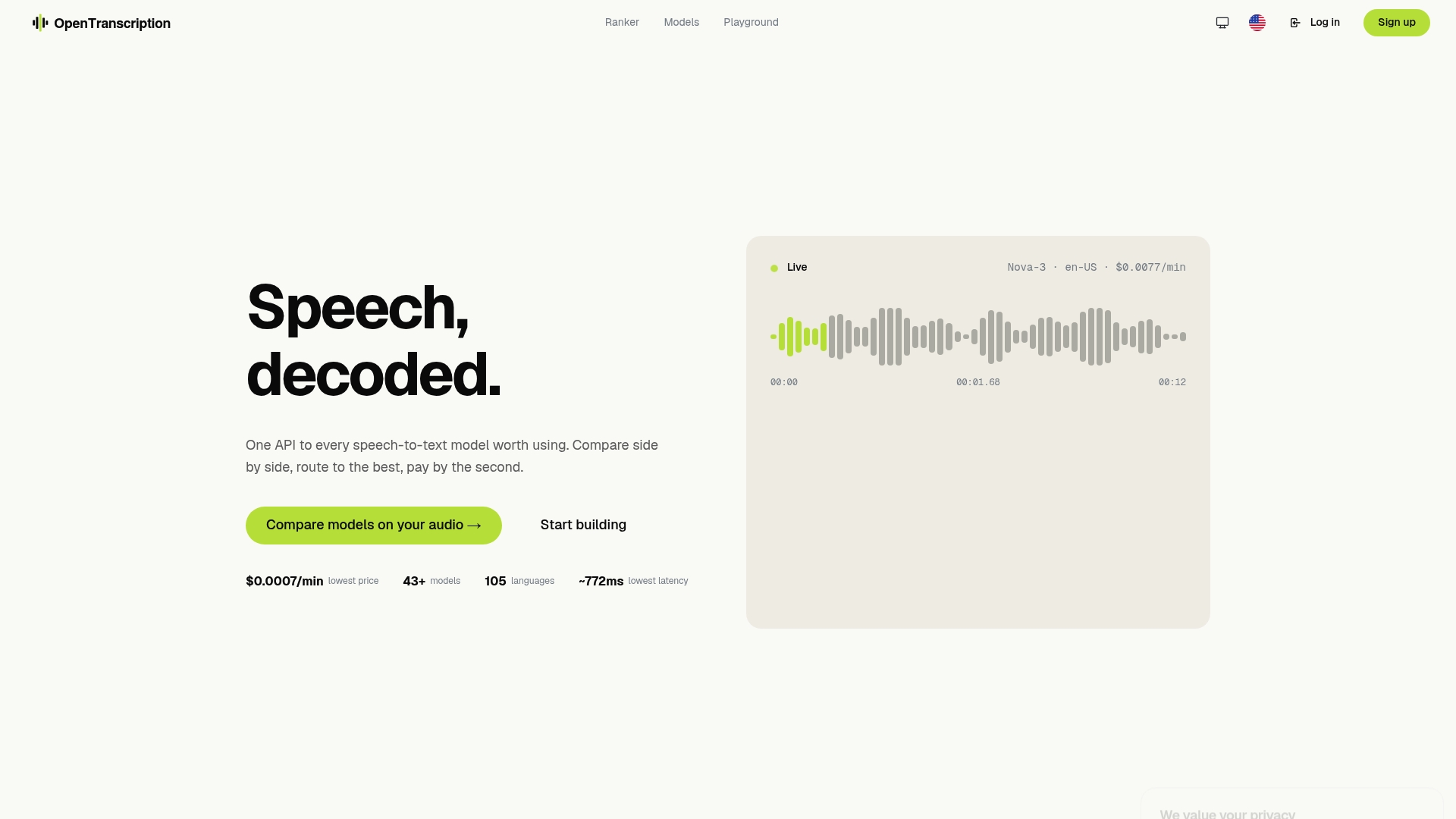
The platform’s models catalog surfaces per-model metadata including supported languages, streaming vs. batch availability, and cost per audio second, so you can filter candidates before running a full benchmark. For latency-sensitive workflows, the realtime model rankings show accuracy-latency trade-offs across streaming-capable models side by side. Every job logs the model version and configuration, giving you the artifact trail that reproducible benchmarking requires. Pay-as-you-go billing with no subscription means you can run a rigorous multi-model benchmark on your own test set without committing to a contract. Run your first benchmark on OpenTranscription and compare models against your actual audio in one session.
Sources
- Measuring the Accuracy of Automatic Speech Recognition Solutions
- Evaluating the performance of artificial intelligence-based speech recognition for clinical documentation: a systematic review - PMC
- Transcription Accuracy Tested Across 8 Providers | meetingstack
- Speech-to-Text Accuracy Benchmark 2026: 10 Tools Tested | LecSync
FAQ
What is considered a good WER for speech recognition?
A 2026 benchmark recommends high word accuracy on clean audio and strong performance overall across mixed conditions for professional use.
How do you measure speech recognition accuracy?
Compute WER by aligning the system’s hypothesis transcript against a human reference using edit distance, then divide the total substitutions, deletions, and insertions by the reference word count. Consistent normalization (casing, punctuation, numeral expansion) must be applied to both transcripts before scoring, and results should include sample counts and confidence intervals to be statistically meaningful.
Is ASR considered AI?
Yes. Modern ASR systems are built on deep learning architectures, typically large encoder-decoder or transducer models trained on thousands of hours of labeled audio, which places them firmly within the applied AI category. Earlier rule-based and hidden Markov model systems were not considered AI in the contemporary sense, but current production systems from major providers are neural models.
Why does WER on benchmarks differ so much from real-world performance?
Benchmark WERs are measured on curated, often clean audio with strict normalization that removes punctuation and filler words, conditions that rarely match production audio. Academic evaluation found per-sample WERs ranging from 0% to 53.8% on the same dataset, showing that averages conceal extreme condition-specific variance. Production audio introduces accents, background noise, speaker overlap, and domain-specific vocabulary that benchmark corpora underrepresent.
How does diarization quality affect transcription accuracy?
Diarization errors propagate directly into transcript WER: a missed speaker boundary creates a merged segment that scores poorly even when the acoustic model output is phonetically correct. Independent benchmarking found that better speaker separation correlated with meaningfully lower multi-speaker WER, making Diarization Error Rate (DER) a necessary companion metric to WER in any multi-speaker evaluation.