


The Best Architecture for Punctuation Restoration in 2026

For most ASR post-processing pipelines, the strongest engineering choice is a pretrained transformer encoder (BERT, RoBERTa, or XLM-RoBERTa) topped with a BiLSTM layer and a token-level classification head, trained with ASR-style noise augmentation. This pattern consistently outperforms simple rule-based or n-gram approaches on published benchmarks, and it scales down gracefully when latency matters more than a marginal accuracy gain. Simpler alternatives, a linear classifier directly on encoder outputs, or a lightweight CRF, remain preferable when inference budgets are tight or when a team lacks the labeled data to fine-tune a full BiLSTM head.
The evidence for this recommendation is specific, not aspirational:
- RoBERTa-large paired with a BiLSTM top layer reached roughly 97% accuracy on controlled social media data and about 90% on Telekom-style conversational data in published WNUT 2020 experiments.
- Models trained purely on clean text (news, Wikipedia) can lose more than 10% of their performance when evaluated against real ASR transcripts, which is the single biggest reason augmentation matters more than architecture choice for many teams.
- Accuracy and latency trade off directly: a transformer + BiLSTM stack adds meaningful inference overhead compared to a transformer-only classifier, a cost that matters for streaming captioning but not for batch archival transcription.
If you’re starting from scratch, run a quick baseline this week: fine-tune a small BERT variant on an open punctuation dataset, evaluate it against real ASR output rather than clean text, and only then decide whether the BiLSTM layer earns its latency cost. Pairing that experiment with an ASR benchmarking platform to collect diverse model outputs will tell you faster than any paper whether your noise profile matches what you trained on.
Key Takeaways
Punctuation restoration works best when a pretrained transformer encoder is paired with a BiLSTM or linear classification head and trained on ASR-noise-augmented data rather than clean text alone.
| Point | Details |
|---|---|
| Default architecture | Fine-tune BERT, RoBERTa, or XLM-R with a token classification head; add BiLSTM when latency budget allows. |
| Augmentation beats architecture | Deletion and substitution noise simulating ASR errors closes most of the gap between clean-text and real-transcript performance. |
| Evaluate per punctuation mark | Report macro and micro F1 by mark, plus performance broken out by word error rate bucket. |
| Editorial review stays essential | Automated output reflects grammar, not spoken prosody; pair it with a style-guide mapping layer for archival transcripts. |
| OpenTranscription for data diversity | Pulling transcripts from 40-plus benchmarked ASR models gives training and validation data with realistic, varied noise profiles. |
Table of Contents
- What Punctuation Restoration Is and Why It Matters
- Model Architectures That Actually Work
- Building Datasets and Training Recipes
- How to Evaluate Punctuation Restoration Fairly
- Getting the Implementation Details Right
- Multilingual and Low-Resource Language Strategies
- When Automated Restoration Isn’t Enough
- Where to Find Code, Datasets, and Starter Templates
- OpenTranscription’s Practical Findings on Building These Pipelines
- An Engineer’s Roadmap for a New Punctuation Restoration Project
- Bootstrap Your Punctuation Restoration Pipeline With OpenTranscription
- Primary Sources and Recommended Reading
- Sources
- FAQ
What Punctuation Restoration Is and Why It Matters
Punctuation restoration is the task of inserting punctuation marks and correcting capitalization in text that arrives without them, most commonly the raw output of an automatic speech recognition (ASR) system. The task also covers casing restoration in the same pass, since ASR engines typically emit lowercase, unpunctuated token streams. It’s a token classification problem at its core: for every token or subword boundary, the model predicts whether a comma, period, question mark, or no mark belongs there, along with whether the following token should be capitalized.
Consider a raw ASR output: “so the meeting is at three right after that we need to review the budget with finance.” A restoration model transforms this into: “So the meeting is at three, right after that. We need to review the budget with finance.” The same pipeline handles genuine ambiguity too. “well i dont know maybe we should ask sarah” plausibly becomes either “Well, I don’t know. Maybe we should ask Sarah.” or “Well, I don’t know, maybe we should ask Sarah?” depending on the intonation the model never actually heard, since most restoration systems work from text alone.
The downstream stakes go well beyond readability. Named entity recognition, dependency parsing, and chunking all rely on sentence boundaries and clause structure that unpunctuated text simply doesn’t provide. Recent workshop research has shown that punctuation restoration as an auxiliary training objective measurably improves structure understanding in downstream NLP tasks, even when the target task never touches punctuation directly. Summarization models fed unpunctuated transcripts tend to produce run-on, poorly segmented output. Captioning and accessibility tools depend on sentence-level chunking to time text on screen. Search and indexing pipelines that tokenize on sentence boundaries will silently fail on a transcript that’s one giant unbroken clause.
Model Architectures That Actually Work
Three architectural families dominate current practice, and each has a distinct sweet spot depending on your latency budget, data volume, and language coverage.
Sequence labeling on pretrained encoders. The dominant pattern fine-tunes BERT, RoBERTa, or XLM-RoBERTa as a token classifier, predicting a punctuation label (or “none”) at each token position. Bidirectional context matters enormously here: a comma decision at token 12 often depends on clause structure that only becomes clear at token 20, which is exactly what a masked-language-model pretrained encoder is built to exploit. XLM-RoBERTa extends this to multilingual settings by sharing subword vocabulary and representations across roughly 100 languages, making it the default choice when you need one model across several markets rather than a model per language.
Transformer + BiLSTM + classification head. Stacking a bidirectional LSTM on top of the transformer’s final hidden states adds a recurrent layer that reinforces local sequential consistency, useful for long-form transcripts where punctuation decisions should stay coherent across a full meeting or podcast episode rather than resetting at each attention window. This is the pattern behind the strongest reported results in the WNUT 2020 benchmarks, and it’s the configuration this article’s opening verdict recommends as a default starting point.
Encoder-decoder and CRF alternatives. Sequence-to-sequence models (encoder-decoder transformers) reframe restoration as a generation task, rewriting the whole sentence with punctuation inserted. This handles cases where punctuation depends on reordering or paraphrase-like decisions, but it’s slower at inference and harder to constrain to exactly one output token per input token, which complicates alignment with word-level timestamps from your ASR pipeline. A Conditional Random Field (CRF) layer, meanwhile, is worth adding on top of either architecture when you need to enforce label transition constraints, for instance, preventing two sentence-ending marks from appearing back to back.
| Architecture | Robustness to ASR noise | Typical dataset fit | Reported performance | Inference footprint |
|---|---|---|---|---|
| Transformer-only classifier | Moderate without augmentation | Clean text, news corpora | Strong on in-domain text, weaker on ASR | Lowest latency, smallest memory |
| Transformer + BiLSTM | Strong with augmentation | Conversational, social media | Up to ~97% accuracy on controlled data, ~90% on noisier sets | Moderate latency overhead |
| Transformer + CRF | Strong, enforces valid sequences | Meeting transcripts, multi-speaker audio | Comparable to BiLSTM with better label consistency | Moderate, adds decoding cost |
| Encoder-decoder (seq2seq) | Variable, sensitive to length | Short-form, paraphrase-tolerant tasks | Competitive but less standardized reporting | Highest latency, largest footprint |
A few tradeoffs are worth internalizing before you commit engineering time:
- BiLSTM layers improve long-range consistency but add real inference latency, which matters if you’re restoring punctuation inside a realtime captioning pipeline.
- XLM-R’s multilingual coverage comes at the cost of per-language accuracy compared to a monolingual model trained on the same data volume.
- CRF layers are cheap to add and rarely hurt, but they solve a narrower problem (valid label sequences) than most teams initially expect.
A minimal starter setup fine-tunes a bert-base or xlm-roberta-base checkpoint with a linear head over Hugging Face’s Trainer API, using BIO-style or direct punctuation-class labels aligned to subword tokens; several public repos, including the maveryn punctuation-restoration project covered later in this piece, provide working templates for exactly this configuration.
Building Datasets and Training Recipes
Training data for punctuation restoration usually comes from one of three places: news corpora with dense, well-formed punctuation (fast to source, but a poor match for spoken language patterns), conversational corpora like meeting transcripts or podcast archives (closer to real deployment conditions, but scarcer and noisier), and synthetically de-punctuated text generated by stripping marks from any clean corpus you already have. Most production systems blend all three, weighting toward conversational data as the primary signal.
Label generation starts by stripping punctuation from clean text and recording, at each token boundary, which mark (if any) originally sat there. The harder part is mapping those labels onto subword tokenizers. A word like “restructuring” might split into three or four BPE or WordPiece pieces, and the punctuation label belongs only on the final subword of that span. Getting this alignment wrong is the single most common bug in restoration pipelines: label the wrong subword position and your model learns a systematically shifted, unusable signal.
Augmentation is where most of the real accuracy gains come from, not architecture tweaks. A tested recipe:
- Randomly delete a fraction of ground-truth punctuation from training sentences to simulate an ASR system’s tendency to drop cues entirely.
- Insert casing noise by lowercasing a sample of tokens, mimicking raw ASR casing behavior.
- Simulate word error rate by substituting or deleting a small percentage of tokens outright, since real ASR transcripts always carry substitution and deletion errors on top of missing punctuation.
- Insert synthetic speaker-overlap or crosstalk markers where your target domain includes multi-speaker audio.
Published work on high- and low-resource languages reports these deletion and substitution strategies as effective levers for closing the gap between clean-text training and real ASR-transcript performance, including an experimental setup with roughly 14.8% word error rate used to stress-test the trained model.
A short training checklist worth pinning above your desk:
- Batch size and learning rate should follow standard transformer fine-tuning defaults (2e-5 to 5e-5) rather than task-specific tuning, since the label space is small.
- Class imbalance is severe: periods and “no punctuation” dominate, while question marks and semicolons are rare. Oversample rare-label sentences or apply class weighting in the loss function.
- Your validation split must include real ASR transcripts, not just held-out clean text, or your reported dev accuracy will systematically overstate production performance.
- Track per-punctuation-mark metrics during training, not just aggregate accuracy, since aggregate numbers can hide near-total failure on question marks while looking fine overall.
How to Evaluate Punctuation Restoration Fairly
Aggregate accuracy is close to useless for comparing punctuation restoration systems, because the label distribution is so skewed toward periods and “none” that a model predicting the majority class everywhere can still post a respectable-looking number. Report per-punctuation-mark precision, recall, and F1 instead, then average with both macro (equal weight per class) and micro (weighted by frequency) methods so readers can see performance on rare marks like question marks and semicolons separately from the dominant comma and period classes.
Slot-level and sentence-level metrics matter too. Slot-level F1 scores each punctuation decision independently, which is standard for training-time evaluation. Sentence-level metrics ask whether an entire sentence’s punctuation matches the reference exactly, a much harsher and more production-relevant bar, since a single missed comma in an otherwise perfect sentence still counts as a full sentence failure.
Reporting under ASR noise is where most published papers fall short, and where you can differentiate your own results. This shows exactly where a model degrades, and it’s the format increasingly expected in ACL and ICASSP workshop submissions.
A reproducible benchmark report should include the following, at minimum:
- Dataset name, train/dev/test split sizes, and source domain (news, conversational, meeting transcript).
- ASR system and measured word error rate on the test set, if evaluating on ASR output rather than clean text.
- Hyperparameters, random seed, and checkpoint or model card link so results can be independently verified.
- Per-punctuation-mark F1 alongside macro and micro averages.
| Model configuration | Dataset | Reported F1 / accuracy |
|---|---|---|
| RoBERTa-large + BiLSTM | Social media (controlled) | ~97% accuracy |
| RoBERTa-large + BiLSTM | Telekom-style conversational data | ~90% accuracy |
| Transformer + augmentation | High-resource language (English) | Comparable to reported state-of-the-art |
| Transformer + augmentation | Low-resource language (Bangla) | Competitive after augmentation, per Alam et al. |
Getting the Implementation Details Right
Tokenization and label alignment cause more silent bugs than any modeling choice. When a word splits into multiple subword pieces, propagate the punctuation label only to the final subword and mark intermediate subwords with an ignore index so the loss function doesn’t penalize the model for a position where no decision should exist. Fast tokenizers in Hugging Face’s transformers library expose word-to-token offset mappings specifically to make this alignment mechanical rather than error-prone, and skipping this step is the fastest way to produce a model that looks fine in training loss but fails silently in production.

Class imbalance deserves a second pass beyond the training checklist above. Weighted loss functions, oversampling sentences containing rare marks, or a focal-loss variant that down-weights easy majority-class examples all help; test more than one, since the right fix depends heavily on your specific label distribution.
At inference time, greedy decoding, taking the single highest-probability label at each position, works fine for most deployments and is dramatically faster than any constrained or beam-search alternative. Constrained decoding, enforced through a CRF layer or a rule-based post-filter, earns its cost only when you need to guarantee valid label sequences (no double sentence-enders, no orphaned closing quotes) for archival or legal transcripts where a malformed sequence is unacceptable.
- Batch requests where latency budgets allow; a 10 to 20 sentence batch on a modern GPU costs barely more than a single sentence and multiplies throughput.
- Apply mixed-precision inference (FP16 or BF16) to cut memory footprint roughly in half with negligible accuracy loss on transformer classifiers.
- Quantize to INT8 for edge or on-device deployment where GPU access isn’t available, accepting a small, usually tolerable, accuracy tradeoff.
Pro Tip: For realtime streaming pipelines, use a sliding-window context with state carryover rather than restarting context at each chunk boundary. Carrying the last few tokens of hidden state forward keeps punctuation decisions consistent across chunk boundaries and avoids the jarring mid-sentence resets that plague naive streaming implementations.
Multilingual and Low-Resource Language Strategies
XLM-RoBERTa is the right default when you need one model covering multiple languages, or when any single target language lacks enough punctuated training data to fine-tune a monolingual model from scratch. Monolingual BERT variants still outperform XLM-R on a per-language basis when you have sufficient labeled data in that language, so the tradeoff is coverage versus peak accuracy, not a strict either-or choice.
Cross-lingual transfer offers a practical path for languages with thin punctuated corpora: fine-tune on a high-resource language first (English or another language with abundant clean text), then continue fine-tuning on whatever smaller labeled dataset exists for your target language. An alternative when even that smaller dataset doesn’t exist is synthetic label projection, using a machine translation system to project punctuation labels from a high-resource source sentence onto its target-language translation, then training on the projected labels directly.
A few practical notes that get overlooked until they break something in production:
- Script differences change what “punctuation” even means; languages that don’t use Latin-derived punctuation conventions need their own label set rather than reusing an English-derived scheme.
- Token-to-subword mapping behaves differently across scripts, so alignment code tested only on English needs re-validation for languages with different tokenization behavior, particularly agglutinative or logographic languages.
- Low-frequency punctuation marks are often even rarer in low-resource language corpora, so report per-mark metrics separately for each language rather than pooling scores across languages, which can hide near-zero performance on the rarest marks in your smallest dataset.
- Augmentation strategies documented for high- and low-resource language experiments transfer reasonably well across languages, though the optimal deletion and substitution rates should be tuned per language rather than copied wholesale.
When Automated Restoration Isn’t Enough
Every punctuation restoration model trained on written text inherits a structural blind spot: it never heard the audio. A pause that a human transcriber would render as an em-dash for an interruption, or an ellipsis for a trailing-off thought, is invisible to a model working from a token stream alone. Surveys of the field describe this directly as a prosody-versus-grammar tradeoff: models trained on written conventions predict grammatically plausible punctuation, not the punctuation that would actually capture how a specific speaker paused, interrupted themselves, or trailed off.
This produces a predictable set of recurring errors. Comma splices show up where a model chains two independent clauses together because the acoustic pause that would have signaled a full stop was never in its training signal. Interruptions and crosstalk in multi-speaker audio confuse models trained mostly on single-speaker, monologue-style text, often producing run-on sentences that ignore a genuine speaker change. Quotation-mark edge cases, nested quotes, quotes spanning multiple sentences, are a frequent failure point since most training corpora underrepresent this pattern relative to how often it occurs in interview transcripts.
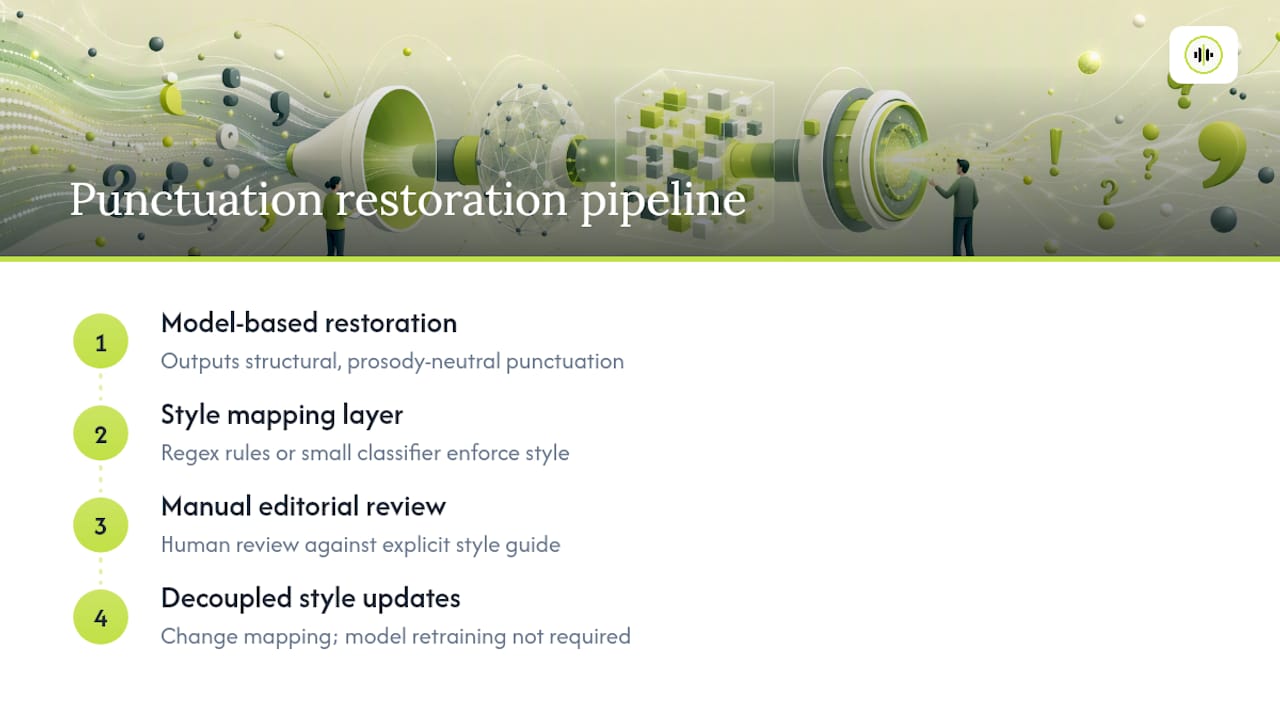
Automated punctuation restoration should be treated as a structural first draft, not a final editorial product. Institutional transcription guides consistently recommend a manual review pass against an explicit style guide before any transcript is considered archival-quality.
Concrete style-guide decisions make this manual pass fast rather than open-ended. The Institute for Oral History’s transcription guide follows Chicago Manual of Style conventions, including the Oxford comma, and specifies em-dashes for interrupted speech rather than ellipses. Separately, accessibility-focused captioning guidelines recommend conservative, sparing use of ellipses and consistent quotation-mark handling, rules that translate directly into a rule-based post-processing layer.
The practical fix is architectural, not just editorial: keep punctuation restoration and style enforcement as two separate pipeline stages. Let the model output structural punctuation, then run a lightweight, deterministic mapping layer, a handful of regex rules or a small trained classifier, that converts model output into your house style. This separation means updating your style guide never requires retraining the underlying model.
Where to Find Code, Datasets, and Starter Templates
The fastest way into a working baseline is an existing repo rather than a blank training script. The maveryn/punctuation-restoration GitHub project is one of the most commonly referenced open implementations in this space, providing a transformer-based training and inference pipeline with configuration for BERT-family and XLM-R backbones, along with data preprocessing scripts for common punctuation datasets. Community checkpoints built on top of BERT, RoBERTa, and XLM-RoBERTa are widely available and give you a functioning inference pipeline before you write a single line of training code.
For datasets, three sources cover most practitioner needs: news corpora (abundant, clean, but a poor match for conversational patterns), conversational or meeting-transcript corpora (closer to production conditions, but harder to source at volume), and any ASR corpus you can generate yourself by running audio through a transcription engine and comparing against a human-verified reference. Standards bodies also matter here: the TEI Guidelines for Transcriptions of Speech document how to encode prosodic features and transcription conventions in metadata, which is useful if your pipeline needs to preserve the distinction between what a transcriber marked and what a model inferred.
A pragmatic three-step quick start:
- Prepare a small labeled sample (a few thousand sentences is enough for a first pass) by stripping punctuation from clean text and aligning labels to your tokenizer’s subword boundaries.
- Fine-tune a
bert-baseorxlm-roberta-basecheckpoint using one of the maveryn-style starter scripts, training for a handful of epochs on your sample. - Evaluate against a small set of real ASR transcripts, not just held-out clean text, before deciding whether to invest in a BiLSTM head or additional augmentation.
Fork a starter repo, run it against a genuinely small sample first, and only scale up once the pipeline runs end to end without silent alignment bugs.
OpenTranscription’s Practical Findings on Building These Pipelines
Running punctuation restoration experiments requires a steady supply of diverse ASR output to train and validate against, since a model that only ever sees output from one ASR engine will overfit to that engine’s specific error patterns. Comparing outputs across 30-plus transcription models surfaces a consistent pattern: model families optimized for raw transcription speed tend to produce noisier casing and more dropped word boundaries, exactly the conditions your augmentation recipe needs to simulate, while slower, higher-accuracy models produce cleaner input that risks under-training your model’s robustness to noise.
A practical integration checklist for using an ASR benchmarking platform to build a punctuation-restoration training and evaluation set:
- Select two or three ASR models with meaningfully different accuracy and speed profiles, rather than one, so your training data reflects a realistic noise distribution.
- Collect transcripts with word-level timestamps and confidence scores where available, since low-confidence tokens are a useful proxy signal for where punctuation decisions will be hardest.
- Run the same audio through streaming and batch modes if your production use case includes both, since streaming output tends to carry more segmentation noise than a full-file batch transcription.
- Hold out a validation set generated from a different ASR model than your training set, to catch overfitting to one engine’s specific error signature.
A few notes on API usage patterns worth internalizing before scaling an experiment:
- Streaming transcription introduces partial-result revisions that complicate punctuation labeling; batch transcription is easier to work with for initial dataset construction.
- Confidence scores attached to individual tokens can flag likely ASR errors before they reach your punctuation model, letting you route low-confidence spans to a human reviewer rather than trusting automated restoration blindly.
- Model selection by cost and latency matters as much for data collection as for production inference; cheaper, faster models let you collect a larger and more diverse training corpus for the same budget.
Teams evaluating realtime transcription models specifically should weigh streaming latency against punctuation quality separately, since the fastest realtime engines are not always the ones that produce the cleanest raw output for downstream restoration.
An Engineer’s Roadmap for a New Punctuation Restoration Project
Start smaller than feels comfortable. A bert-base classifier fine-tuned on a few thousand sentences, evaluated honestly against real ASR transcripts rather than clean held-out text, tells you more in a week than a month spent tuning a BiLSTM-CRF stack you haven’t validated actually needs the extra complexity. Most projects fail not because the architecture was wrong, but because the evaluation set didn’t resemble production conditions, so the team optimized for a benchmark that never mattered.
The decision to add complexity should be evidence-driven, not aspirational. Add a BiLSTM layer once you’ve confirmed a transformer-only classifier plateaus on your specific data and the latency budget can absorb the extra inference cost. Invest in multilingual fine-tuning only once you’ve confirmed a monolingual model genuinely underperforms for a specific target language, since XLM-R’s broader coverage comes with a real per-language accuracy cost that isn’t always worth paying. Prosodic features, pause duration, pitch contour, are worth the substantial engineering investment only for use cases where grammatical correctness genuinely isn’t enough, dramatized dialogue transcription or detailed conversational analysis being the clearest examples.
Team structure matters more than most technical writeups acknowledge. A data engineer owns corpus sourcing and augmentation pipelines. An ML engineer owns model architecture, training, and evaluation infrastructure. An editor, someone who actually understands house style conventions, owns the post-processing mapping layer and the human-in-the-loop review queue for archival-quality output. Skipping the editor role is the most common mistake teams make, treating punctuation restoration as a purely technical problem when the last mile is fundamentally editorial. Schedule human review as a sampling process, not a full pass: reviewing 5 to 10% of production output on a rolling basis catches systematic model drift long before it becomes a customer-facing problem, without the cost of manually reviewing every transcript.
Bootstrap Your Punctuation Restoration Pipeline With OpenTranscription
Building an accurate punctuation restoration model depends entirely on the quality and diversity of the ASR transcripts feeding it, and sourcing that variety from a single provider will always undertrain your model against the noise patterns it will see in production. OpenTranscription gives you a single API to pull transcripts from over 40 speech-to-text models side by side, so you can build an augmentation-ready training set from genuinely different error profiles instead of one engine’s blind spots.
- Compare word-level timestamps, confidence scores, and casing behavior across models before committing to a training corpus.
- Test streaming versus batch transcription output to see which noise patterns your restoration model actually needs to handle.
- Select models by cost, speed, or accuracy without renegotiating a contract for every provider you want to test.
Transparent per-second billing with no subscription means you can run a small validation batch across a handful of models this week for the cost of the audio you actually process. Start by comparing transcription models on OpenTranscription and pull a sample transcript set to validate your first punctuation-restoration baseline against real ASR noise rather than clean text.
Primary Sources and Recommended Reading
- The WNUT 2020 punctuation restoration experiments supply the strongest published evidence for the RoBERTa + BiLSTM architecture recommended throughout this article, including the 97% and 90% accuracy figures cited above.
- Punctuation restoration using transformer models for high- and low-resource languages documents augmentation recipes and the roughly 14.8% ASR word error rate used in its evaluation, directly informing the datasets and multilingual sections.
- The survey on capitalization and punctuation restoration frames the prosody-versus-grammar tradeoff central to this article’s pitfalls discussion.
- Baylor University’s Institute for Oral History transcription style guide provides the Chicago Manual of Style-based editorial conventions referenced in the style-guidelines section.
- JMU’s accessibility transcription guidelines offer concrete, operational post-processing rules for ellipses, quotation marks, and dashes.
- The TEI Guidelines for Transcriptions of Speech standardize how prosodic features and transcription conventions get documented in metadata.
- Recent Repl4NLP workshop research demonstrates measurable downstream benefits of punctuation restoration for NER and parsing tasks.
Sources
- WNUT 2020 punctuation restoration experiments (ACL Anthology)
- Capitalization and punctuation restoration: a survey
- Institute for Oral History transcription style guide (Baylor University, May 2026)
- Transcription guidelines - JMU Accessibility (2025)
FAQ
What is the rarest punctuation mark in restoration tasks?
In most training corpora, semicolons and question marks appear far less often than periods or commas, which is why models need class-weighted loss functions or oversampling to avoid ignoring them entirely.
What are the core rules practitioners should follow for punctuation editing?
There’s no single universal numbered list, but institutional style guides like Chicago Manual of Style consistently cover sentence boundaries, comma usage including the Oxford comma, quotation-mark placement, and consistent treatment of interruptions and trailing thoughts.
What is the hardest punctuation mark for models to restore correctly?
Question marks and marks tied to interrupted or overlapping speech are typically hardest, since models trained on written text lack the prosodic cues (rising intonation, mid-sentence pauses) that would signal them in audio?
How can I improve punctuation restoration accuracy in my own pipeline?
Train with ASR-style noise augmentation rather than clean text alone, evaluate per punctuation mark instead of aggregate accuracy, and validate against real ASR transcripts pulled from multiple models, a step platforms like OpenTranscription simplify by giving you diverse model output in one place.
Should I always add a BiLSTM layer to my transformer classifier?
Only after confirming a transformer-only classifier plateaus on your data; the BiLSTM layer improves long-range consistency but adds inference latency that isn’t worth paying for every deployment, particularly realtime ones.