

Open Source Speech Recognition for Developers in 2026
For most projects, three categories cover the field: a small, quantized on-device model for low-latency and edge work; a unified multilingual model for long-form or many-language pipelines; and a modular toolkit when you need diarization, punctuation, and VAD as composable stages. Here is the practical shortlist:
- whisper.cpp / Silero — on-device, CPU-viable, sub-second latency for real-time or edge deployments
- OpenAI Whisper (large-v3) / Qwen3-ASR — unified long-form with strong multilingual coverage (Qwen3-ASR covers 52 languages and dialects)
- VibeVoice-ASR — single-pass long-form with native diarization and timestamps, up to 60 minutes per pass
- FunASR — modular industrial toolkit for production pipelines needing VAD, punctuation, and diarization as swappable components
- Omnilingual ASR — zero-shot multilingual coverage across 1,600+ languages when language breadth is the primary constraint
For a typical proof-of-concept, start with whisper.cpp for latency-sensitive work or Whisper large-v3 via Python for accuracy-first evaluation, then benchmark against your actual audio before committing to a model family.
Key Takeaways
In 2026, the most effective open-source ASR strategy combines a small quantized model for low-latency edge work with a unified multilingual model for long-form or many-language pipelines, validated against your own audio before deployment.
| Point | Details |
|---|---|
| Match model to primary constraint | Latency points to whisper.cpp or Silero; language breadth to Qwen3-ASR or Omnilingual; long-form diarization to VibeVoice. |
| Benchmark on your own audio | LibriSpeech WER does not predict performance on noisy, accented, or domain-specific audio. |
| Check checkpoint license separately | Toolkit license (often MIT) and model checkpoint license are different documents; verify both before shipping. |
| Unified models reduce pipeline fragility | Single-pass models like VibeVoice eliminate speaker-swap errors and multi-stage maintenance overhead. |
| OpenTranscription for faster selection | The OpenTranscription model catalog benchmarks 40+ models so you can compare accuracy, latency, and cost without building the infrastructure yourself. |
Table of Contents
- What are the leading open source speech recognition models right now?
- How to choose the right ASR model for your project
- Deployment patterns: on-device, edge, cloud, and hybrid inference
- Benchmarks, datasets, and how to evaluate your ASR choices
- What “open source” licenses mean for integration and distribution
- Practical tools and libraries for ASR integration
- What to try first and where the field is heading
- OpenTranscription cuts model selection time from weeks to hours
- Sources
- FAQ
What are the leading open source speech recognition models right now?
The field has consolidated around a handful of well-maintained projects, each occupying a distinct position in the accuracy-latency-resource triangle. The 2026 trend is clear: unified models that produce diarization, timestamps, and structured outputs in a single pass, displacing brittle multi-stage chains.
OpenAI Whisper and whisper.cpp
Whisper remains the reference point for open-source ASR. The MIT-licensed code and weights enable broad modification, commercial use, and redistribution without royalty obligations. The Python library runs on PyTorch and supports multiple model sizes (tiny through large-v3). whisper.cpp is a C++ port using GGUF quantization that runs on CPU without a GPU requirement, making it the go-to for on-device and edge deployments. Language bindings exist for Python, JavaScript, Go, and Rust. The tradeoff: Whisper’s chunked-decoding approach can introduce speaker-swap artifacts on long recordings.
Vosk
Vosk is a lightweight, offline-first toolkit with prebuilt models for 20+ languages and a small binary footprint. It supports streaming inference and ships with bindings for Python, Java, C#, and Node.js. Models are typically under 50 MB, which makes Vosk practical for mobile and embedded deployments where Whisper’s smallest variant is still too large. Accuracy on clean speech is solid; noisy or accented audio is where it falls behind larger transformer-based models.
Kaldi
Kaldi is the foundational toolkit that trained most of the field’s researchers. It is modular, highly configurable, and supports a wide range of acoustic modeling approaches, from GMM-HMM to end-to-end neural. The tradeoff is steep: Kaldi’s build system and recipe structure have a significant learning curve, and most production teams now treat it as a research baseline rather than a deployment target. License is Apache 2.0.
Silero
Silero publishes compact, ONNX-exportable models optimized for real-time inference on CPU. The VAD model is particularly widely used as a preprocessing stage in other pipelines. Silero STT models are available for Russian, English, German, Spanish, and a handful of other languages. They are not multilingual in the Whisper sense but are fast and dependency-light, which suits embedded or IoT contexts.
Coqui STT
Coqui STT is a multi-platform toolkit derived from Mozilla DeepSpeech, supporting streaming inference and language bindings for Python, JavaScript, C, and .NET. It is designed for training custom models on domain-specific data, which makes it relevant when you have labeled audio and need a fine-tuned, self-hosted solution. The project’s maintenance cadence has slowed, so evaluate community activity before committing to it for a long-lived production system.
Solaria-3
Solaria-3 is part of a family of high-accuracy multilingual models targeting production-grade transcription. It emphasizes low word error rate on accented and noisy speech and supports structured output including punctuation and capitalization. Integration is primarily via Python and REST APIs. Check the model card for the specific checkpoint license before commercial deployment, as Solaria family licenses vary by release.
Qwen3-ASR
Qwen3-ASR (1.7B and 0.6B parameter variants) supports language identification and ASR across 52 languages and dialects. It provides unified streaming and offline inference, timestamp prediction, and is built for high-throughput serving. The 0.6B variant is quantizable to INT8 and viable on modest GPU hardware. This is a strong candidate for multilingual products that need a single model covering a broad language set without per-language model management.
NVIDIA Parakeet
NVIDIA Parakeet is a family of English-focused ASR models (CTC and RNNT variants) optimized for NVIDIA GPU inference. Parakeet-TDT achieves competitive word error rates on LibriSpeech and is designed for low-latency streaming. It integrates with NVIDIA NeMo and supports ONNX export. If your inference stack is GPU-based and English-primary, Parakeet offers strong throughput per dollar on NVIDIA hardware.
VibeVoice-ASR
VibeVoice-ASR processes up to 60 minutes of audio in a single pass using a continuous speech tokenizer architecture, producing joint speaker labels, timestamps, and transcription content. This eliminates the chunking problem that causes speaker-swap errors in Whisper-based pipelines. It is the most capable option for long-form meeting or interview transcription where diarization accuracy matters.
Omnilingual ASR
Omnilingual ASR targets extreme language breadth: 1,600+ languages with a zero-shot-friendly design that reduces paired-data requirements for new languages. It is the right choice when language coverage, not peak accuracy on a single language, is the primary constraint. Expect higher WER on low-resource languages compared to a fine-tuned specialist model, but the coverage is unmatched in the open-source ecosystem.
How to choose the right ASR model for your project
Map your primary constraint first. Latency, language breadth, privacy, and compute budget each point to a different model category, and optimizing for the wrong axis wastes engineering time.
-
Define your accuracy target and metric. Decide whether WER or CER is the right metric for your language and script. Set a threshold that is acceptable for your application (e.g., sub-10% WER on clean speech, sub-20% on noisy call-center audio). Do not borrow published leaderboard numbers as your target without verifying them on your own audio.
-
Set latency and resource constraints. Ask: do you need sub-second responses for a voice agent, or can you tolerate 30-second processing for a batch transcription job? Sub-second real-time work points to whisper.cpp, Silero, or Parakeet on GPU. Batch long-form work opens the door to VibeVoice or Whisper large-v3.
-
Decide language and zero-shot requirements. Single-language English products can use Parakeet or a fine-tuned Whisper. Products covering 10+ languages need Whisper large-v3, Qwen3-ASR, or Solaria-3. Coverage beyond 50 languages, especially low-resource ones, points to Omnilingual ASR.
-
Choose required output features. Diarization, word-level timestamps, confidence scores, and punctuation restoration are not universally available. VibeVoice and FunASR pipelines produce all of these natively. Whisper produces timestamps; diarization requires an additional speaker-embedding stage unless you use a unified model.
-
Check license and weights availability. Confirm the specific checkpoint license, not just the toolkit license. Whisper’s MIT license covers both code and weights. FunASR’s toolkit is MIT-licensed, but individual model checkpoints may carry different terms. Solaria and some Parakeet variants have checkpoint-specific licenses.
-
Evaluate production and maintenance factors. Community activity, CI/CD integration, and long-term maintainability matter as much as benchmark numbers. Kaldi has deep documentation but a declining contributor base for new architectures. Whisper, Qwen3-ASR, and FunASR have active development as of 2026.
Pro Tip: Run your baseline on a 30-sample stratified test set drawn from your actual audio (clean, noisy, accented, domain-specific) before committing to a model. Published WER numbers on LibriSpeech clean rarely translate directly to call-center or medical audio.
Deployment patterns: on-device, edge, cloud, and hybrid inference
Deployment choice is primarily driven by latency requirements, data privacy constraints, and available compute. Getting this decision right before writing integration code saves significant rework.
On-device (CPU, tiny models): whisper.cpp with GGUF quantization runs Whisper tiny or base on a modern laptop CPU at near-real-time speed. Silero’s ONNX models are similarly viable. This pattern suits mobile apps, desktop clients, and any deployment where audio cannot leave the device.
Edge GPU/accelerator: Parakeet and Qwen3-ASR 0.6B run efficiently on edge GPUs (NVIDIA Jetson class hardware or equivalent). ONNX Runtime with TensorRT execution provider is the standard path here. Quantized INT8 or INT4 variants are worth testing; end-to-end latency on your target hardware is the only number that matters, not published throughput claims from a different GPU class.
Cloud GPU batch and streaming: Whisper large-v3, VibeVoice, and Qwen3-ASR 1.7B are best served on cloud GPU instances. For streaming, FunASR provides an OpenAI-compatible serving interface that supports VAD-triggered chunking and punctuation restoration. vLLM is an option for high-throughput serving of transformer-based ASR models. Docker containers with CUDA base images are the standard packaging approach.
Hybrid (edge capture + cloud refinement): A common production pattern combines a small on-device VAD and ASR model for immediate response with a server-side unified model for post-processing, diarization, and correction. FunASR’s modular design supports this pattern explicitly, letting teams swap backends per job.
Recommended runtimes and tooling:
- FFmpeg — audio I/O, resampling to 16 kHz mono, format conversion (the standard preprocessing step for every model listed here)
- PyTorch — primary training and inference framework for Whisper, Qwen3-ASR, VibeVoice, and most transformer-based models
- ONNX Runtime — cross-platform inference for Silero, Parakeet, and quantized Whisper variants
- GGUF / whisper.cpp — CPU-optimized inference for on-device Whisper deployments
- vLLM — high-throughput GPU serving for large transformer ASR models
- Docker + CUDA base images — standard containerization for cloud GPU deployments
Pro Tip: Clock drift is a real problem in chunked long-form pipelines. If you must chunk audio rather than use a single-pass model like VibeVoice, preserve a 2–3 second overlap between chunks and re-align timestamps against the overlap region. Continuous-tokenizer architectures eliminate this problem entirely by design.
Benchmarks, datasets, and how to evaluate your ASR choices
Prioritize reproducible, task-specific benchmarks on your own audio over blanket leaderboard claims. A model that ranks first on LibriSpeech clean may rank third on your domain’s audio.
Standard metrics:
- WER (Word Error Rate): the standard metric for most English and Latin-script languages. Lower is better. Calculated as (substitutions + deletions + insertions) / total reference words.
- CER (Character Error Rate): preferred for character-based scripts (Chinese, Japanese, Arabic). Same formula at the character level.
- Real-time factor (RTF): processing time divided by audio duration. RTF < 1.0 means faster than real-time. Measure this on your target hardware, not the paper’s hardware.
- Diarization Error Rate (DER): for multi-speaker audio, measures missed speech, false alarms, and speaker confusion. Often reported separately from WER.
Standard datasets:
Model-specific reference figures from published materials:
| Model | Language coverage | Long-form single-pass | Streaming support |
|---|---|---|---|
| Qwen3-ASR | 52 languages/dialects | No (chunked) | Yes |
| VibeVoice-ASR | English-primary | 60 minutes | No |
| Omnilingual ASR | 1,600+ languages | No | Limited |
| FunASR | Varies by checkpoint | No | Yes |
| Whisper large-v3 | 52 languages | No (chunked) | Via ports |
Benchmark callout: Published WER numbers on LibriSpeech clean (often 2–4% for large models) are best-case figures recorded on studio-quality read speech. Real-world WER on conversational, accented, or noisy audio typically runs 2–5x higher. Always report the dataset, preprocessing steps, and hardware when sharing internal benchmark results so they are reproducible.
For diarization scoring, use the pyannote.metrics library or dscore to compute DER consistently. Note that collar tolerance (typically 0.25 seconds) significantly affects reported DER, so standardize it across comparisons.
What “open source” licenses mean for integration and distribution
License and published-weights status directly affect redistribution, commercial use, and whether you can legally provide a hosted service built on a given model. Checking the toolkit license is not enough; the model checkpoint license governs the weights.
Common licenses you will encounter:
- MIT — permits use, modification, and distribution (including commercial) with minimal restrictions. Whisper’s code and weights are MIT. FunASR’s toolkit is MIT, though individual checkpoints may differ.
- Apache 2.0 — similar permissiveness to MIT, with an explicit patent grant. Kaldi uses Apache 2.0. Many NeMo and Parakeet model cards use Apache 2.0.
- CC-BY-4.0 / CC-BY-SA-4.0 — common for datasets and some model weights. CC-BY-SA requires derivative works to carry the same license, which can restrict commercial distribution.
- Custom / non-commercial — some high-accuracy checkpoints restrict commercial use or hosted-service deployment. Always read the LICENSE file in the model repository, not just the toolkit README.
License due-diligence checklist before integrating a model:
- Locate the LICENSE file in the model’s repository (not just the toolkit repo).
- Confirm whether the license covers both code and weights, or code only.
- Check for “non-commercial use only” clauses or hosted-service restrictions.
- Verify attribution requirements and whether your product’s documentation must credit the model.
- If the license is unclear or custom, consult legal counsel before shipping to production.
One practical note: toolkit license and model checkpoint license are often different. FunASR’s toolkit is MIT, but a specific Paraformer checkpoint it ships may carry a different license. Treat each checkpoint as a separate license review.
Practical tools and libraries for ASR integration
Pick tools that match your stack. The ecosystem around open-source ASR is mature enough that you rarely need to build preprocessing or serving infrastructure from scratch.
- Audio I/O and preprocessing: FFmpeg handles resampling, channel mixing, format conversion, and trimming. Every model in this guide expects 16 kHz mono PCM; FFmpeg is the standard tool to get there.
- Training and inference frameworks: PyTorch is the primary framework for Whisper, Qwen3-ASR, VibeVoice, and most transformer-based models. ONNX Runtime provides cross-platform inference for exported models.
- On-device runtimes: whisper.cpp (GGUF format) for CPU Whisper inference; ONNX Runtime for Silero and Parakeet; TensorFlow Lite for mobile deployments where TF is the existing stack.
- Modular pipeline toolkits: FunASR for production pipelines combining VAD, ASR, punctuation, and diarization. PaddleSpeech for research environments needing integrated dataset tooling and multipurpose speech processing.
- Containerization and serving: Docker with CUDA base images for GPU deployments; vLLM or Triton Inference Server for high-throughput model serving; FastAPI or Flask for lightweight REST wrappers around Python inference code.
- Language bindings: Python is the primary integration language for all models listed. JavaScript bindings exist for whisper.cpp (via whisper-node) and Vosk. Rust bindings are available for whisper.cpp and Vosk. C/C++ bindings are available for Coqui STT and Vosk.
- Custom fine-tuning data: Common Voice (Mozilla) and FLEURS (Google) are the standard starting points for multilingual fine-tuning datasets. For domain-specific data collection, Label Studio and Prodigy support audio annotation workflows.
- Benchmarking and CI:
jiwer(Python) for WER/CER calculation;pyannote.metricsfor DER; integrate both into CI pipelines to catch accuracy regressions on model updates.
What to try first and where the field is heading
The most useful framing for 2026 is not “which model is best” but “which model is best for your constraint.” The field has reached a point where several open-source options are production-ready, and the selection decision is an engineering trade-off, not a research question.
For a latency-sensitive proof-of-concept, whisper.cpp with a quantized base or small model is the fastest path to a working demo on commodity hardware. For a multilingual product covering a broad language set, Qwen3-ASR’s 52-language coverage with unified streaming and offline inference is a strong starting point that avoids per-language model management overhead.
The 2026 trend toward unified models is real and consequential. VibeVoice’s single-pass architecture, which produces speaker labels, timestamps, and transcription jointly, represents a meaningful architectural shift away from chaining Whisper + pyannote + punctuation models. That chain works, but each stage adds latency, a failure mode, and a maintenance dependency. Unified models reduce all three. The tradeoff is that unified models are typically larger and less flexible for customization than a modular stack.
Modular toolkits like FunASR remain the right choice when you need to swap backends per job, tune VAD thresholds for a specific acoustic environment, or integrate domain-specific language models for punctuation and entity normalization. The modularity that makes them complex is also what makes them adaptable.
Community support is an underweighted selection factor. Check GitHub commit frequency, issue response time, and whether the maintainers are actively merging PRs before committing to a model for a long-lived system.
OpenTranscription cuts model selection time from weeks to hours
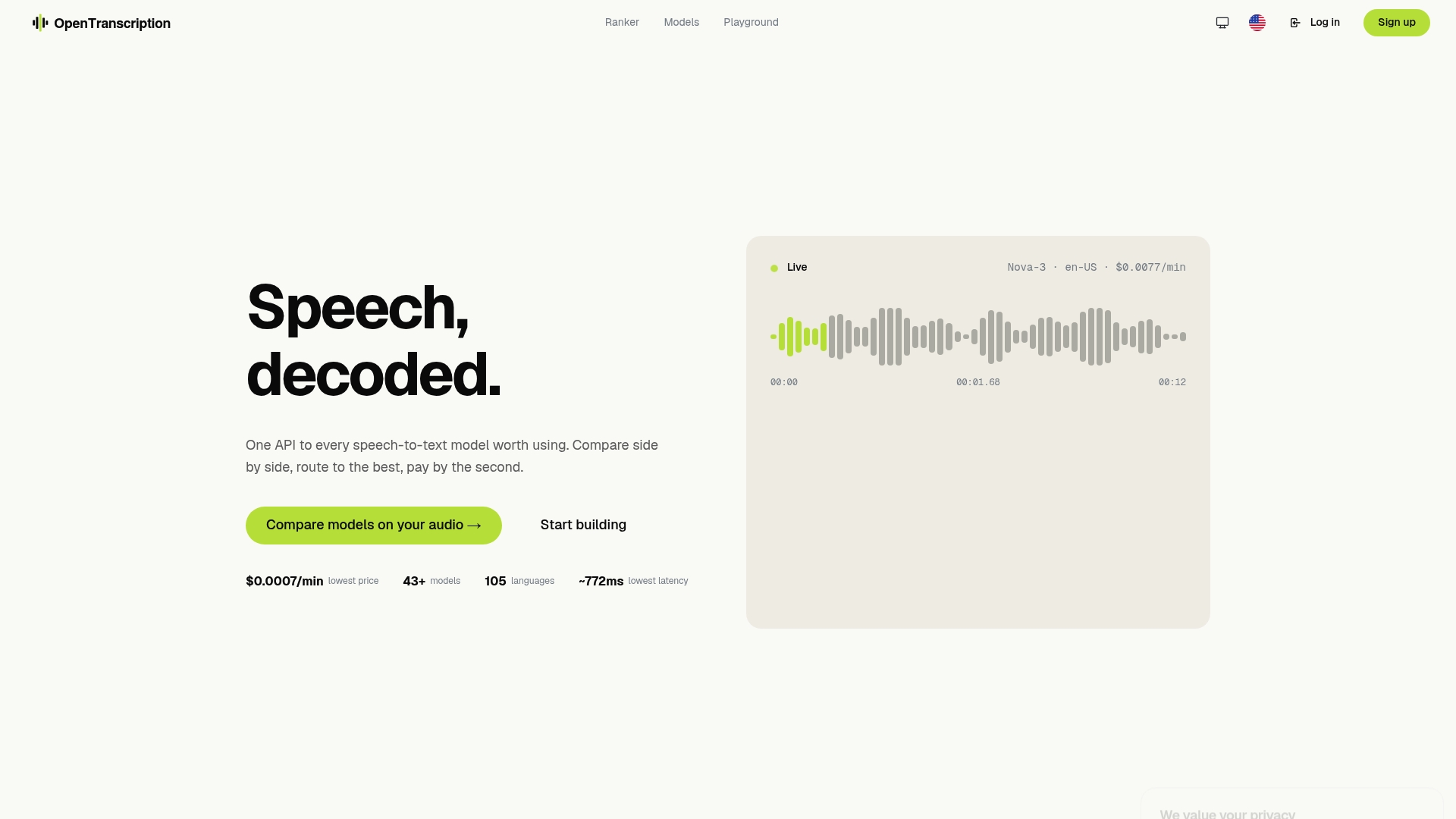
Evaluating ten open-source ASR models against your own audio, across accuracy, latency, language coverage, and cost, is a multi-week engineering project if you build the comparison infrastructure yourself. OpenTranscription’s benchmarking and model catalog gives you that comparison pre-built, covering 40+ models with live metrics on real audio.
Three concrete advantages for developers working through the selection process this guide describes:
- Side-by-side accuracy and latency benchmarks across models, so you can validate published WER claims against a consistent test methodology before writing a line of integration code.
- Real-time streaming and speaker diarization available through a single API, eliminating the need to chain separate models for transcription, diarization, and timestamps.
- Pay-as-you-go pricing with no subscription lock-in, billed per second of audio, which fits the variable volume of a proof-of-concept or a production system with uneven load.
Upload a short test set or call the OpenTranscription API directly to run a live benchmark against your audio before committing to a model.
Sources
Canonical repositories and tooling referenced throughout this guide:
- microsoft/VibeVoice
- Omnilingual ASR: Open-Source Multilingual SpeechRecognition for 1600+ Languages
- PyTorch
FAQ
What is the best open source speech recognition model?
There is no single best model. For English real-time use, NVIDIA Parakeet or whisper.cpp with a quantized model leads on latency; for multilingual long-form work, Qwen3-ASR or VibeVoice-ASR leads on structured output quality. Match the model to your primary constraint.
Is OpenAI Whisper open source?
Yes. Whisper’s code and model weights are both published under the MIT License, which permits commercial use, modification, and redistribution without royalty obligations.
Is OpenAI Whisper free to use?
The open-source Whisper weights and code are free to download and self-host. Running inference incurs your own compute costs. Managed API access to Whisper through third-party platforms, including OpenTranscription, is billed per second of audio processed.
What is the best open source text-to-speech option?
This guide covers ASR (speech-to-text), not TTS. For open-source TTS, Coqui TTS and the VITS family are the most widely used starting points, but they are separate projects from the ASR models described here.
How do I evaluate open source ASR models for my use case?
Build a 30-sample stratified test set from your actual audio (clean, noisy, accented, domain-specific), run each candidate model with consistent preprocessing (16 kHz mono via FFmpeg), and compute WER with jiwer. Measure real-time factor on your target hardware. OpenTranscription’s model catalog provides pre-computed benchmarks across 40+ models as a starting reference.