

Can You Use HIPAA Speech-to-Text for Clinical Notes?
Yes. Clinicians can use speech-to-text for clinical documentation in a HIPAA-compliant way, but only when a signed Business Associate Agreement (BAA) is in place with the vendor and specific technical safeguards are active before any patient audio reaches the service.
The non-negotiables are consistent across every credible implementation:
- A signed BAA with the transcription vendor before any protected health information (PHI) is transmitted
- Encryption in transit and at rest using TLS 1.2 or higher and AES-256 or equivalent
- Access controls and audit logs tied to unique user IDs, not shared logins
- Minimum-necessary handling, especially for psychotherapy notes, which carry stricter protections than the general medical record
Pro Tip: Never dictate PHI into your phone’s default voice-to-text keyboard or a free consumer transcription app. Neither typically offers a BAA, which makes the disclosure unauthorized under HIPAA regardless of how accurate the transcript turns out to be.
Key Takeaways
HIPAA-compliant speech-to-text is achievable when a signed BAA, encryption in transit and at rest, access controls, and minimum-necessary handling are all verified in writing before PHI moves.
| Point | Details |
|---|---|
| BAA comes first | No PHI should reach a vendor’s servers until a signed BAA names your organization specifically. |
| Consumer apps are off-limits | Phone dictation keyboards and free transcription tools generally lack BAAs and should never touch clinical notes. |
| Psychotherapy notes need separation | Keep therapy session content out of the standard medical record unless a clinician deliberately transfers it. |
| Verify, don’t trust marketing | Require TLS/AES encryption, audit logs, and a SOC 2 or HITRUST report in writing, not just a vendor’s compliance claim. |
| OpenTranscription offers model flexibility | Its benchmarking across 40+ models and per-second billing let clinical teams adjust for accuracy and cost without contract lock-in. |
Table of Contents
- What “HIPAA-Compliant Speech-to-Text” Actually Requires
- Vendor Verification Checklist: What to Require in Writing
- Cloud APIs, EHR Dictation, or On-Prem: Choosing a Deployment Model
- Why a Model-Agnostic, BAA-Ready API Fits Clinical Workflows
- Step-by-Step Implementation Checklist
- Where Clinical Speech-to-Text Deployments Go Wrong
- What Clinical Speech-to-Text Actually Costs
- Deploy HIPAA-Ready Speech-to-Text Without Vendor Lock-In
- Sources
- FAQ
What “HIPAA-Compliant Speech-to-Text” Actually Requires
The moment a patient’s voice recording or its transcript contains identifiers such as name, date of birth, or diagnosis details tied to a specific person, it becomes electronic protected health information (ePHI), and it falls under the full weight of HIPAA’s Privacy and Security Rules. That reclassification happens automatically. It doesn’t matter whether the audio sits on a server for three seconds or three years.
Any vendor that creates, receives, maintains, or transmits that audio on your behalf becomes a business associate under federal law, and HHS guidance is explicit that a signed BAA must exist before that data moves. There’s no grace period and no exception for “just a quick test.” A vendor’s marketing page claiming the platform is “HIPAA-compliant” means nothing without a countersigned agreement naming your organization.
Beyond the contract, the Security Rule expects a defined set of technical safeguards, treated as addressable but effectively mandatory for any serious clinical deployment:
- End-to-end encryption for streaming audio and stored transcripts
- Role-based access controls limiting who can view or export a session
- Audit logging that records every access event, not just logins
- Documented breach notification procedures
- A minimum-necessary policy that restricts PHI exposure to what a given workflow genuinely requires
There’s no HHS-run certification stamp for “HIPAA-compliant” software. Compliance is demonstrated through contracts and documented controls, not a badge on a vendor’s homepage, which is why OCR enforcement actions tend to focus on missing BAAs and undocumented safeguards rather than technology choice itself. A practice that skips the paperwork faces the same exposure whether it used a $20-a-month app or an enterprise API.
Vendor Verification Checklist: What to Require in Writing
Vetting a speech-to-text vendor for clinical use is a contract exercise first and a technical exercise second. Skipping either half leaves gaps that surface during an audit or, worse, a breach investigation.
Require these items in writing before any audio moves:
- A signed BAA naming your organization specifically, not a generic terms-of-service reference to HIPAA
- A subcontractor flow-down clause disclosing every subprocessor that touches the audio or transcript
- Breach notification timelines that meet or beat HIPAA’s own reporting windows
- Data location and retention limits, including where servers physically sit and how long transcripts persist after processing
- A right-to-audit clause allowing your compliance team to review vendor practices
On the technical side, ask pointed questions rather than accepting vague assurances. Does the vendor use TLS 1.2 or TLS 1.3 for transport? Is data at rest protected with AES-256 or an equivalent cipher, managed through a proper key management system or hardware security module rather than a static key baked into the API? Does the platform support single sign-on and multi-factor authentication, and are audit logs immutable, meaning no admin can quietly edit the trail after the fact?
Operationally, look for a SOC 2 or HITRUST report, or an equivalent independent attestation, along with documented incident response service-level agreements and a defined process for vetting new subprocessors before they’re added.
Pro Tip: Insist on contract language that explicitly forbids the vendor from using identifiable PHI to train or fine-tune its models without separate, written consent. Many general-purpose AI vendors reserve broad rights to use submitted data by default, and a BAA alone doesn’t automatically close that door.
Cloud APIs, EHR Dictation, or On-Prem: Choosing a Deployment Model
Three deployment patterns dominate clinical speech-to-text, and each fits a different risk tolerance and operational budget.
Cloud HIPAA-eligible APIs offer the widest model selection, real-time streaming, and the ability to scale from a solo therapist’s laptop to a hospital system’s intake desk without new hardware. The tradeoff is a larger vendor and subprocessor surface, which means more contract diligence up front and ongoing monitoring of who touches the data downstream.

EHR-integrated dictation apps plug directly into systems like Epic or a smaller practice-management platform, producing a single audit trail that lives inside the record you already maintain. That tight integration comes at the cost of flexibility. Switching vendors later often means renegotiating the integration from scratch, and you’re locked into whatever accuracy the embedded model delivers.
On-premise or offline models give the tightest control over PHI because audio never leaves your network. Few small practices have the IT staff to maintain that infrastructure, and the hardware and maintenance costs can outweigh the security benefit for anyone below hospital-system scale.
The right choice comes down to matching your risk profile, staff capacity, and budget to the deployment type, then documenting that decision in your organization’s risk register so an auditor can see the reasoning, not just the outcome.
Why a Model-Agnostic, BAA-Ready API Fits Clinical Workflows
A single transcription model rarely performs equally well across a full patient population. Accents, background noise in a shared clinic space, overlapping speech during a family session, and specialty vocabulary in psychiatry versus orthopedics all shift accuracy in ways that a locked-in vendor can’t easily address. A model-agnostic API lets a practice benchmark options for accuracy, latency, and cost, then route different session types to whichever model performs best, without re-engineering the intake workflow every time.
OpenTranscription approaches this by benchmarking more than 40 transcription models side by side, giving clinical teams a way to compare performance on their own representative audio rather than relying on a vendor’s self-reported numbers. Real-time streaming and speaker diarization support live scribing during a session, while structured transcripts carry word-level timestamps and confidence scores that let a supervising clinician spot-check anything the model flagged as uncertain.
| Platform Signal | Detail |
|---|---|
| Models benchmarked | 40+ transcription models compared side by side |
| Language support | more than 40 languages |
| Realtime capability | Live streaming transcription with speaker diarization |
| Billing structure | Per-second, pay-as-you-go, no subscription lock-in |
| Output format | Structured transcripts with timestamps and confidence scores |
Pro Tip: Route any transcript segment with a confidence score below your chosen threshold into a manual reviewer queue rather than letting it auto-file into the chart. That single workflow step catches most transcription errors before they become part of the permanent record.
Step-by-Step Implementation Checklist
Rolling out speech-to-text across a practice or clinical team goes smoother when the legal work happens before the technical work, not alongside it.
- Map the data flow. Trace the path from microphone to device to API to EHR, and mark every point where PHI is created, transmitted, or stored.
- Classify content types. Separate standard clinical notes from psychotherapy notes, since the latter require stricter handling and shouldn’t merge into the general record without deliberate clinician action.
- Sign the BAA and map subprocessors before a single test audio file gets transmitted, not after the pilot starts.
- Lock down technical controls, including TLS/AES encryption, SSO or MFA, role-based access, and audit log configuration, verified rather than assumed.
- Train staff and set policy on retention and destruction timelines, recording consent language, and a testing cadence for ongoing quality assurance.
A behavioral-health-specific implementation guide adds one more layer worth flagging: state recording-consent laws vary, and a practice operating in a two-party consent state needs a documented notice process before any session gets recorded, HIPAA compliance aside.
Pro Tip: Build the data flow diagram before you shop for vendors, not after. Knowing exactly where PHI touches your systems tells you which contract clauses and technical controls actually matter for your specific setup.
Where Clinical Speech-to-Text Deployments Go Wrong
The failures that show up in audits are rarely exotic. They’re the predictable result of convenience winning over process.
- Dictating patient details into a phone’s built-in voice-to-text keyboard or a free transcription app that never signs a BAA
- Letting psychotherapy notes auto-merge into the standard medical record instead of requiring a deliberate clinician step to transfer content
- Pasting session notes into a general consumer AI chatbot that doesn’t prohibit training on submitted data
- Skipping a subprocessor inventory, so nobody in the organization actually knows where transcripts are stored or for how long
The recurring theme across enforcement guidance isn’t exotic hacking or sophisticated breaches. It’s organizations that never confirmed, in writing, what their vendor was actually doing with patient audio.
Each of these mistakes traces back to the same root cause: treating a transcription tool as a convenience feature rather than a system that handles regulated data.
What Clinical Speech-to-Text Actually Costs
Pricing in this category generally follows one of three shapes: per-second or per-minute usage billing, tiered enterprise plans with volume discounts, or a managed markup layered on top of raw model access for added features like diarization or EHR connectors.
Accuracy varies more than most vendors advertise. Specialty medical vocabulary, background noise in a busy clinic, and overlapping speakers in a family or group session all push word-error rates higher, which translates directly into clinician time spent correcting transcripts.
- Test with your own representative audio, not a vendor’s polished demo clip
- Measure word-error rate specifically on clinical terminology, not general conversation
- Time how long a clinician spends correcting each transcript type
- Audit confidence scores against actual errors to calibrate your reviewer threshold
- Factor integration work, EHR mapping, reviewer time, and retention costs into total cost of ownership, not just the per-minute rate
A Publisher’s Note on Rolling This Out
The practices that get this right treat vendor flexibility as a compliance asset, not a technical luxury. A model-agnostic, BAA-ready API lets a clinical team adjust for accuracy and cost as needs change, without renegotiating a locked-in contract or rebuilding a workflow from scratch every time a better model ships.
Deploy HIPAA-Ready Speech-to-Text Without Vendor Lock-In
OpenTranscription gives clinical teams something most single-model vendors can’t: the ability to benchmark accuracy, latency, and cost across 40+ transcription models before committing to one, with per-second billing that means paying for what you actually process instead of a flat subscription regardless of volume.
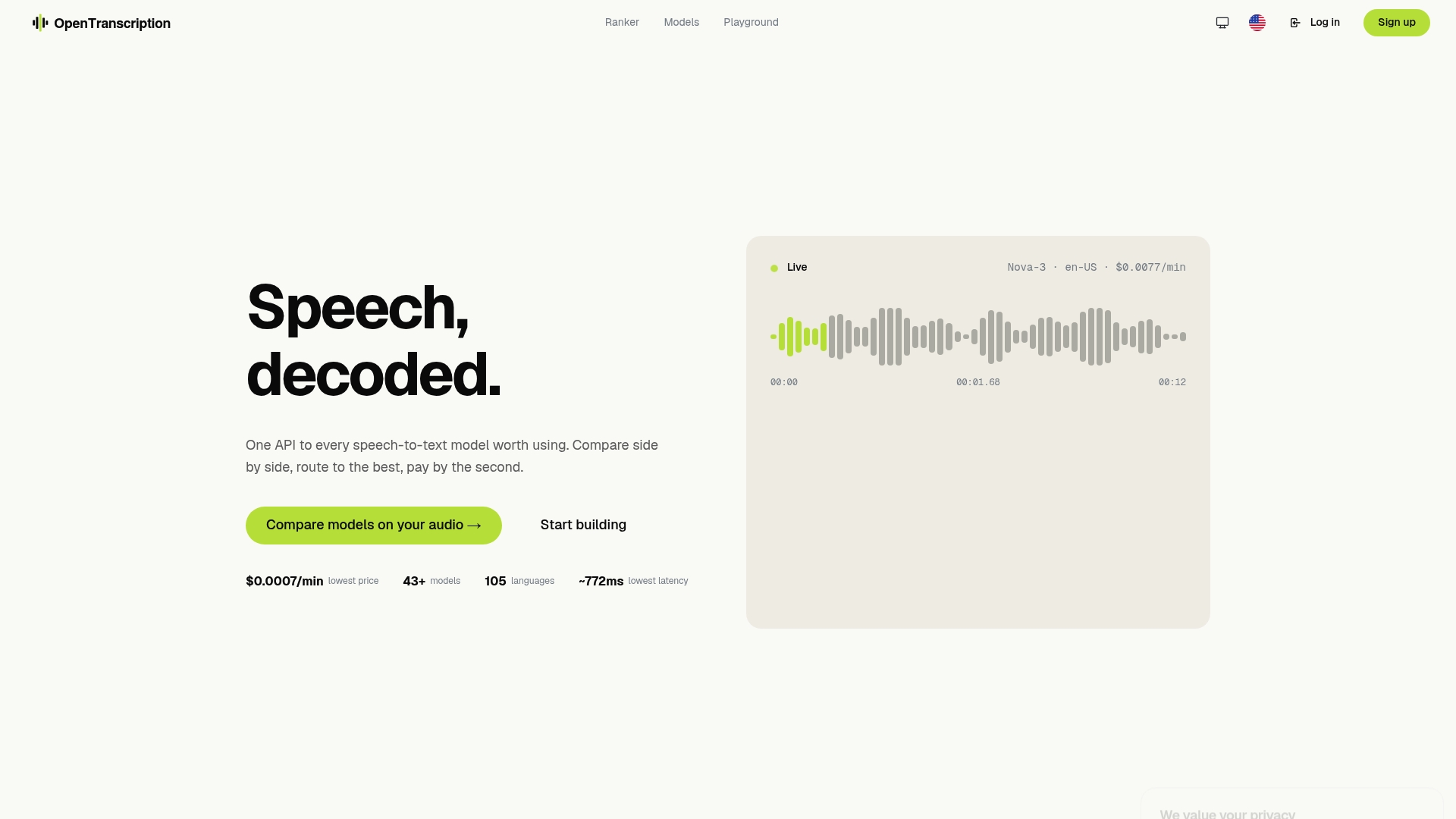
For a practice or health system evaluating options, that flexibility matters more than it sounds. A model that performs well on general dictation might struggle with a psychiatric intake full of specialty terminology, and switching providers under a traditional locked contract usually means months of renegotiation. With OpenTranscription’s model catalog, that switch is a routing decision, not a procurement project. Real-time streaming and speaker diarization support live scribing, and structured transcripts with confidence scores give supervising clinicians a clear signal for what needs a second look before it enters the chart.
Teams ready to move forward can compare model benchmarks directly, request a signed BAA, and run a secure test using sample clinical audio before committing to a workflow change.
Sources
- Business associates and HIPAA | HHS
- HIPAA-Compliant Speech-to-Text Implementation Guide for Behavioral Health Settings — ForwardCare Blog
This article is general information, not a substitute for advice from a qualified lawyer. Consult a qualified legal professional about your own circumstances before acting on anything here.
FAQ
Is Voice-to-Text HIPAA-Compliant?
Voice-to-text can be HIPAA-compliant only when the vendor signs a BAA and implements required safeguards like encryption and audit logging; general consumer dictation tools typically don’t meet either bar.
Is Google Voice HIPAA-Compliant?
Google Voice is a consumer communications product, not a vendor offering a healthcare-specific BAA for clinical documentation, so it shouldn’t be used to capture or transcribe PHI.
Is Google Speech-to-Text HIPAA-Compliant?
Google’s cloud speech services can be used in a HIPAA-compliant way only under Google Cloud’s enterprise BAA terms and with the required technical safeguards configured; the free consumer-facing version doesn’t offer this coverage.
What Should Change in How Practices Handle HIPAA Speech-to-Text?
Regulatory guidance continues to emphasize signed BAAs, documented technical safeguards, and strict separation of psychotherapy notes rather than any single new technology mandate, so practices should focus on verifying vendor contracts and controls rather than waiting for a specific new speech-to-text rule.
Can OpenTranscription Support HIPAA-Compliant Clinical Transcription?
OpenTranscription’s model-agnostic API, real-time streaming, and structured transcripts with confidence scores fit clinical workflows that require flexibility, and organizations should confirm a signed BAA is in place before transmitting any PHI through the platform.