

ASR Bias: A Research and Engineering Field Guide
ASR bias refers to systematic performance disparities across speaker groups in automatic speech recognition systems — disparities that produce harms beyond raw accuracy, including temporal taxation, disrupted conversational flow, and downstream exclusion from automated services. Before designing any mitigation, researchers and engineers should run three operations first: compute subgroup word error rate (WER) and character error rate (CER) stratified by speaker attributes, measure the subgroup delta with bootstrapped confidence intervals, and test statistical significance using permutation tests or Poisson regression. The operational priority is unambiguous: measure first, then mitigate, then monitor continuously.
- Compute WER and CER per subgroup (accent, dialect, gender, age, race/ethnicity).
- Calculate absolute and relative subgroup deltas; report bootstrapped 95% confidence intervals.
- Test significance with permutation tests or Poisson regression; log confidence scores and word-level timestamps for every inference.
Pro Tip: Pre-register your evaluation plan, including subgroup definitions and minimum sample sizes, before running any model comparison. Post-hoc subgroup selection is one of the most common sources of inflated fairness claims in the ASR literature.
Key Takeaways
ASR bias is a systematic, measurable phenomenon that requires subgroup WER evaluation with bootstrapped confidence intervals and significance testing before any mitigation is designed or claimed.
| Point | Details |
|---|---|
| Measure before mitigating | Compute subgroup WER/CER with bootstrapped 95% CIs and permutation tests; pre-register subgroup definitions before evaluation. |
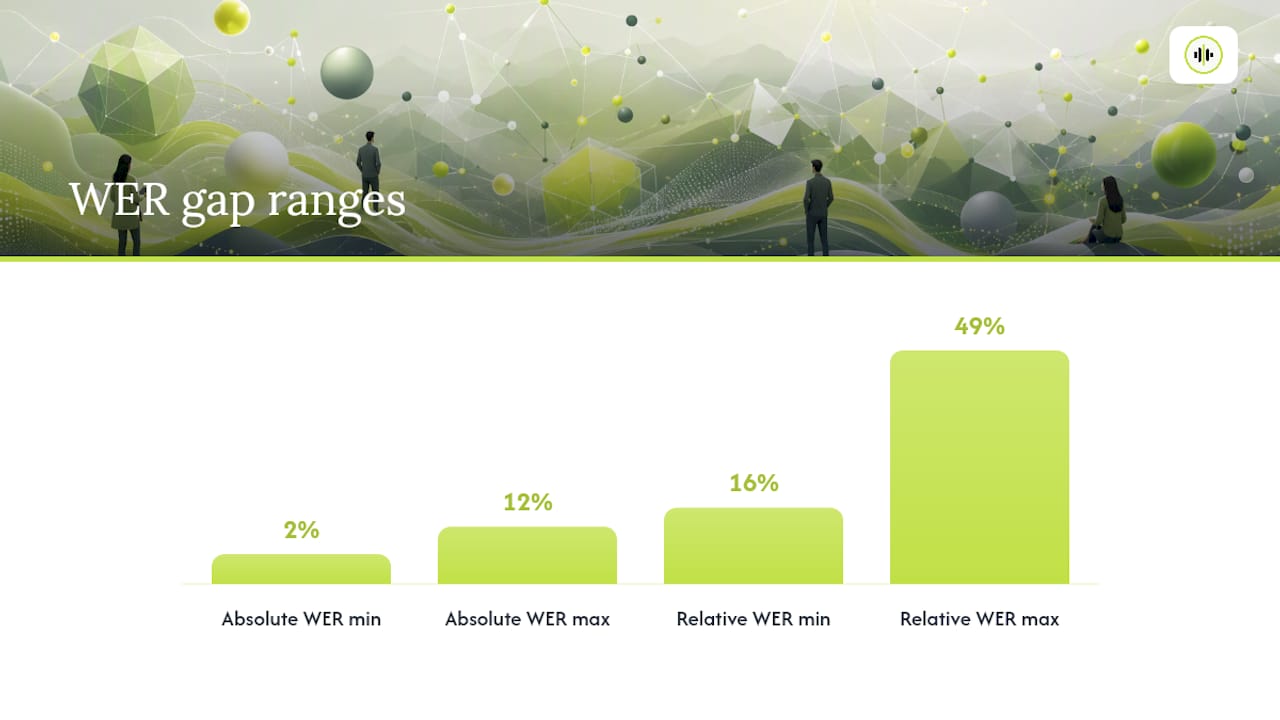
| Non-American accents face documented gaps | Absolute WER gaps of roughly 2%–12% (relative 16%–49%) have been found across multiple ASR systems and accent categories. |
| Combine mitigation strategies | Data-centric methods alone are insufficient; model-centric approaches like DARe address inductive biases without requiring demographic labels at inference time. |
| Monitor continuously in production | Deploy stratified dashboards, confidence-distribution alerts, and timestamp alignment checks; schedule periodic re-evaluation after any upstream model update. |
| OpenTranscription for multi-model audits | OpenTranscription’s API provides access to 40+ models with word-level timestamps and confidence scores, supporting reproducible multi-system bias evaluations in a single pipeline. |
Datasets
- L2-Arctic: Psi — non-native English speech from 24 L1 backgrounds.
- Speech Accent Archive: Accent — controlled read speech from 2,800+ speakers across 214 native languages.
- CORAAL: Oraal — sociolinguistically annotated AAVE recordings.
- SBCSAE: Linguistics — conversational American English across regional varieties.
- FaiST: Fairness-focused ASR test set for dialect and demographic disparity evaluation.
- VoxCeleb: Robots — large-scale speaker corpus from celebrity interviews.
- Common Voice: https://commonvoice.mozilla.org/ — crowd-sourced multilingual corpus with self-reported demographic labels.
Papers and resources
- Fairness of Automatic Speech Recognition: Looking Through a Philosophical Lens — philosophical framing of ASR fairness and temporal taxation.
- Towards Fair Speech Recognition: Mitigating Demographic Bias in End-to-End ASR Systems — DARe mitigation paper with Poisson-regression evaluation.
- A Systematic Literature Review on Bias Evaluation and Mitigation in ASR for Low-Resource African Languages — ACM survey covering data-centric and model-centric methods.
- Unveiling Performance Bias in ASR Systems — multi-system empirical study reporting 2%–12% absolute WER gaps.
- Towards Inclusive Automatic Speech Recognition — cross-lingual survey of bias dimensions and architecture effects.
- REDDIT: Replay-based Distribution eDITing to fix timestamp drift — timestamp drift correction with catastrophic forgetting avoidance.
- Dialect and gender intersection evaluation on podcast data (EMNLP 2024) — intersectional AAVE/Chicano English/Spanglish findings.
Practical tooling
- OpenTranscription model rankings — multi-model benchmarking interface for reproducible ASR comparisons.
- OpenTranscription Signal blog — in-depth model profiles and research summaries.
Table of Contents
- What does ASR bias actually mean, and why does it matter?
- How do you measure ASR bias rigorously?
- Which datasets should you use for ASR bias evaluation?
- What does the empirical literature actually show?
- Why do ASR systems develop systematic disparities?
- What mitigation strategies have demonstrated results?
- How do you manage ASR bias in production systems?
- What ethical and social harms does ASR bias produce?
- What are the highest-priority open problems in ASR bias research?
- How do you run a fast multi-model bias evaluation?
- What belongs in a reproducible bias evaluation report?
- An honest assessment of what bias audits actually cost
- OpenTranscription gives you multi-model bias benchmarking in one pipeline
- Sources
- FAQ
What does ASR bias actually mean, and why does it matter?
ASR bias is not simply a synonym for high error rates. The formal distinction matters: bias exists when performance differences systematically map to socially salient speaker groups or speech varieties and produce differential burdens on those groups.
Philosophical analysis of ASR fairness frames repeated misrecognition as a form of disrespect: when a system consistently fails to recognize a speaker’s variety, it imposes a temporal tax (the time spent correcting, re-speaking, or abandoning the interaction) and disrupts the conversational flow in ways that compound historical marginalization. This framing shifts the evaluation target from “how accurate is the model on average” to “who bears the cost of inaccuracy and what does that cost them.”
Common bias dimensions and intersectionality
The primary dimensions along which ASR bias has been documented include:
- Accent and dialect: Regional and social varieties of English (AAVE, Chicano English, Appalachian English, Southern American English) consistently show higher WER than General American English across most commercial and research systems.
- Non-native speech: L2 speakers of English face compounded challenges from phonological transfer, prosodic differences, and reduced representation in training corpora.
- Gender: Effects are inconsistent across studies and architectures; some systems favor male voices, others show no significant gap, and a few show female-speaker advantages in narrow domains.
- Age: Older speakers and children both show elevated error rates, driven by acoustic differences in fundamental frequency, articulation rate, and vocal tract characteristics.
- Race and ethnicity: Racial disparities in ASR performance are partially but not entirely explained by dialect — cross-lingual phoneme-error analysis confirms that pronunciation differences account for only a fraction of observed bias.
- Sociolect: Class-correlated speech patterns (vocabulary, prosody, code-switching) introduce additional performance variation that standard benchmarks rarely capture.
Intersectionality compounds these effects. An AAVE-speaking woman may face a different error profile than an AAVE-speaking man, and neither profile is predictable from single-axis evaluations alone. Treating bias dimensions as independent is a methodological error that understates real-world disparities.
The nine canonical datasets and models in this space
Every researcher entering ASR fairness work needs to know these nine resources:
- wav2vec 2.0 (wav2vec2): Meta AI’s self-supervised speech encoder; widely used as a fine-tuning base for accent and dialect studies; tested in the DARe mitigation paper.
- OpenAI Whisper: Large-scale multilingual ASR model trained on 680,000 hours of web audio; frequently benchmarked for accent and language coverage; also tested in DARe experiments.
- FaiST: A fairness-focused ASR test set designed to surface dialect and demographic disparities in conversational English.
- L2-Arctic: A corpus of non-native English speech from speakers of 24 L1 backgrounds; standard for accent-robustness evaluation.
- Speech Accent Archive: George Mason University’s collection of speakers reading a common paragraph across hundreds of native languages; useful for controlled accent comparisons.
- CORAAL: Corpus of Regional African American Language; the primary resource for AAVE-specific ASR evaluation with sociolinguistically annotated recordings.
- SBCSAE: Santa Barbara Corpus of Spoken American English; conversational, unscripted audio covering multiple regional varieties.
- VoxCeleb: Large-scale speaker-verification corpus derived from celebrity interviews; broad speaker diversity but limited demographic metadata.
- Common Voice: Mozilla’s crowd-sourced multilingual corpus; wide language coverage with self-reported demographic labels, though label quality varies.
How do you measure ASR bias rigorously?
Measurement is where most fairness claims fail. Aggregate WER obscures subgroup disparities; reporting it alone is insufficient for any fairness-oriented publication or audit.
Primary metrics
- Subgroup WER and CER: Compute independently per speaker group. WER counts word-level substitutions, deletions, and insertions; CER operates at the character level and is more sensitive to morphologically rich languages and code-switching.
- Absolute subgroup delta: The raw WER difference between the highest- and lowest-performing subgroups. This is the most interpretable metric for communicating harm magnitude.
- Relative subgroup delta: The absolute delta divided by the reference-group WER, expressed as a percentage. Multi-system evaluation found non-American accents often show absolute WER gaps of roughly 2%–12%, with relative differences of approximately 16%–49% depending on the recognizer and accent category.
- Confidence-score distributions: Per-subgroup calibration curves reveal whether a model’s confidence scores are systematically miscalibrated for certain speaker groups, which matters for downstream decision thresholds.
Evaluation protocol checklist
- Define subgroups before data collection; use self-identified demographic labels where possible.
- Stratify speaker splits so no speaker appears in both training and evaluation sets.
- Set minimum per-subgroup sample sizes (at least 50 speakers and 500 utterances per subgroup is a reasonable floor for detecting medium-effect-size gaps).
- Normalize transcripts consistently: decide on punctuation handling, case folding, and number normalization before scoring, and apply the same rules to hypotheses and references.
- Compute bootstrapped 95% confidence intervals (1,000+ resamples) for each subgroup WER.
- Run permutation tests or Poisson regression to test whether observed deltas exceed chance.
- Report drop-in-deviance statistics when comparing nested models.
Pro Tip: Evaluation frameworks that omit subgroup sample sizes, confidence intervals, and significance tests routinely overstate fairness gains. Poisson regression and drop-in-deviance testing are practical, well-calibrated options for WER-based fairness tests — prefer them over simple t-tests, which assume normality that WER distributions rarely satisfy.
Reporting requirements
Every published evaluation should include: speaker count per subgroup, total utterance count, mean utterance duration, recording device and channel type, background noise conditions, tokenization rules, and the exact software version and random seed used for scoring. Without this metadata, results cannot be reproduced or compared across studies.
Which datasets should you use for ASR bias evaluation?
Choosing the right corpus is as consequential as choosing the right model. Each dataset below has specific strengths and documented caveats.
Data caveats researchers must document
- Label quality: Common Voice’s self-reported demographic labels are inconsistently applied; VoxCeleb’s demographic metadata is inferred, not self-identified.
- Scripted vs. conversational audio: L2-Arctic and Speech Accent Archive use read speech, which underestimates real-world error rates for spontaneous, disfluent, or code-switched speech. CORAAL and SBCSAE are conversational and therefore more ecologically valid for deployment-oriented evaluations.
- Confounded recording conditions: Telephone-quality audio correlates with certain speaker demographics in naturalistic corpora, making it difficult to separate acoustic-channel effects from dialect effects.
- Over-representation of scripted speech: Most large ASR training corpora skew toward read speech, which means models trained on them may underperform on spontaneous conversational audio for all speakers, but the penalty is not distributed equally.
When combining datasets, preserve speaker IDs, recording device metadata, channel type, and annotation notes in a single manifest file. Losing provenance information makes it impossible to control for confounds in downstream analyses. For privacy considerations around demographic metadata, the on-device vs. cloud transcription trade-offs discussion at Obsidian Ridge Labs offers a useful operational perspective.
Practical recommendation: Start with a balanced held-out conversational sample drawn from CORAAL and SBCSAE, then augment with controlled accent subsets from L2-Arctic and Speech Accent Archive. This combination gives you both ecological validity and phonetic control.
What does the empirical literature actually show?
The evidence base is now large enough to support several reliable generalizations, though effect magnitudes vary substantially across systems and evaluation conditions.
Multi-system evaluation across L2-Arctic, Speech Accent Archive, CORAAL, and SBCSAE found that non-American accents suffer absolute WER gaps of roughly 2%–12%, with relative differences of approximately 16%–49%, depending on the recognizer and accent category. These are not edge-case failures; they represent systematic performance stratification across the speaker population.
Dialect-centered evaluation on annotated podcast data found that AAVE, Chicano English, and Spanglish all perform significantly worse than Standard American English, and that gender effects interact with dialect in ways that single-axis analyses miss. EMNLP 2024 findings on this intersectional data confirm that the gap is not uniform across model families — some architectures show larger dialect penalties than others, which has direct implications for model selection in fairness-sensitive deployments.
Key patterns across the literature:
- AAVE shows some of the largest documented WER gaps relative to General American English, across both hybrid DNN-HMM and end-to-end architectures.
- Chicano English and Spanglish exhibit elevated error rates driven by code-switching, phonological transfer, and prosodic differences that standard language models handle poorly.
- Nigerian English and Xhosa appear in low-resource African language evaluations, where the ACM systematic review documents that mitigation work has been almost entirely data-centric.
- Gender effects are inconsistent: some studies find male-speaker advantages, others find no significant gap, and the direction of the effect often depends on the domain and model architecture.
- Age effects are more consistent: both older adults and children show elevated WER, though the acoustic drivers differ between these groups.
Why do ASR systems develop systematic disparities?
Understanding root causes is prerequisite to designing mitigations that actually work. The causes operate at multiple levels simultaneously.
Data-level causes
- Under-sampling of speaker varieties: Most large ASR training corpora are dominated by General American English, broadcast speech, and read text. Speakers of minority dialects, non-native accents, and low-resource languages are structurally underrepresented.
- Biased metadata collection: When demographic metadata is collected at all, it is often inferred rather than self-identified, introducing systematic labeling errors that propagate into evaluation and mitigation.
- Scripted corpus dominance: Read-speech corpora produce models that generalize poorly to spontaneous, disfluent, or conversational audio — and the generalization gap is larger for non-standard varieties.
Annotation and transcription convention causes
Transcribers unfamiliar with a speaker’s dialect tend to normalize non-standard phonological and morphosyntactic features toward Standard American English, producing reference transcripts that penalize the model for correctly transcribing the speaker’s actual speech. This is a subtle but well-documented source of measurement bias that inflates apparent WER for dialect speakers.

Pro Tip: When commissioning transcription for dialect corpora, recruit annotators who are native or highly proficient speakers of the target variety, and provide explicit annotation guidelines that preserve dialectal features rather than normalizing them.
Acoustic and channel causes
Telephone-quality audio (8 kHz, narrowband) correlates with certain demographic groups in naturalistic datasets. When a model trained predominantly on wideband studio audio encounters narrowband telephone speech, the acoustic mismatch degrades performance — and if that mismatch is correlated with speaker demographics, the result looks like demographic bias even when the proximate cause is channel type.
Model-level causes
Cross-lingual phoneme-error analysis shows that pronunciation differences explain only a fraction of observed bias, which means model architecture and pretraining data skew are independent contributors. End-to-end architectures like Whisper and wav2vec2 absorb language model priors from their pretraining data; if that data skews toward Standard American English text, the decoder will systematically prefer standard-variety hypotheses even when the acoustic evidence supports a dialectal form. Decoding strategies compound this: beam search with a strong language model prior can suppress phonologically plausible but lexically unusual hypotheses that correspond to dialectal pronunciations.
Timestamp drift is a related but underappreciated failure mode. Transcript text may remain accurate while timestamps drift across long non-speech gaps, producing alignment errors that affect downstream applications like captioning and speaker diarization. Replay-based distribution editing (REDDIT) addresses this with minimal parameter updates and without triggering catastrophic forgetting.
What mitigation strategies have demonstrated results?
Mitigation approaches divide into data-centric, model-centric, and evaluation-aware categories. The research consensus, supported by inclusive ASR survey findings, is that data-centric methods are necessary but not sufficient — architecture-specific solutions are required when the bias source is a model inductive bias rather than a data gap.
Data-centric approaches
- Targeted collection: Systematically recruit speakers from underrepresented varieties using community partnerships. Document self-identified demographic labels, recording conditions, and consent terms.
- Reweighting: Upweight underrepresented speaker groups in the training loss without collecting new data. Effective for mild imbalances; can overfit when the minority group is very small.
- Synthetic augmentation: Use text-to-speech systems trained on target varieties to generate additional training audio. Quality varies; augmented data should supplement, not replace, real speaker recordings.
- Stratified fine-tuning: Fine-tune on a class-balanced batch constructed from per-subgroup sampling. Requires careful learning-rate scheduling to avoid catastrophic forgetting of majority-group performance.
Model-centric approaches
- DARe (Demographic label-Agnostic disentanglement and adversarial Reweighting): A plug-and-play module that disentangles content and group embeddings using clustering-derived pseudo-group labels, then applies adversarial reweighting. DARe experiments on wav2vec2, SEW-tiny, and Whisper small showed improved fairness metrics while maintaining similar or lower WER — and critically, it requires no demographic labels at inference time.
- Adversarial debiasing: Train a secondary network to predict speaker group from encoder representations; penalize the encoder for making group prediction easy. Effective but sensitive to hyperparameter choices.
- Bias-aware loss functions: Modify the training objective to penalize disproportionate errors on minority subgroups. Requires per-sample group labels during training.
- Speaker-adaptive layers: Add speaker-specific normalization layers (e.g., speaker-conditioned batch norm) that adapt to individual acoustic profiles at inference time.
Evaluation-aware strategies
- Maintain a held-out subgroup test set that is never used for model selection or hyperparameter tuning.
- Run continuous A/B monitoring in production to detect performance drift across subgroups over time.
- Apply counterfactual augmentation checks: generate minimally different utterances that differ only in dialect-specific features and verify that model outputs are consistent.
Pro Tip: The cluster-based pseudo-label pipeline in DARe is reproducible without demographic labels: cluster encoder representations, assign pseudo-group IDs, then apply adversarial reweighting. This makes it deployable in production settings where collecting self-identified demographics is impractical or legally constrained.
Known failure modes to document: overfitting to pseudo-group clusters that do not correspond to real demographic boundaries; catastrophic forgetting of majority-group performance during aggressive fine-tuning; and fairness gerrymandering, where a model appears fair on measured subgroups while concentrating errors on unmeasured intersectional groups.
How do you manage ASR bias in production systems?
Lab mitigations do not automatically translate to operational controls. Production deployments require monitoring infrastructure, fallback patterns, and governance policies that can detect and respond to performance drift before it causes user harm.
Monitoring checklist
- Deploy stratified WER/CER dashboards segmented by speaker demographic proxies (language, region, device type) where direct demographic data is unavailable.
- Set confidence-distribution alerts: flag inference batches where mean confidence drops below a calibrated threshold for any speaker segment.
- Monitor word-level timestamp alignment metrics to detect timestamp drift across long non-speech gaps, which can silently degrade captioning and diarization quality.
- Log per-channel audio metadata (sample rate, codec, SNR estimate) alongside transcripts to enable post-hoc acoustic confound analysis.
- Schedule periodic re-evaluation on held-out subgroup test sets; model drift from upstream provider updates can reintroduce disparities that were previously mitigated.
Fallback and UX patterns
- Human-in-the-loop verification: Route low-confidence transcriptions to human review queues, with priority weighting for high-stakes applications (medical, legal, emergency services).
- Clarification UI: Surface a reask prompt when confidence falls below threshold, rather than silently passing a potentially incorrect transcript to downstream systems.
- Escalation rules: Define explicit confidence thresholds and subgroup-specific error-rate thresholds that trigger escalation to a higher-accuracy model or human reviewer.
- Graceful degradation: For real-time applications, prefer partial transcripts with explicit uncertainty markers over silent failure or hallucinated text.
For teams evaluating on-device versus cloud transcription trade-offs in privacy-sensitive deployments, privacy and accuracy comparisons between different transcription approaches offer a useful operational reference.
Privacy and data governance
- Obtain explicit consent before collecting demographic metadata for monitoring purposes.
- Provide opt-out mechanisms for speakers who do not wish their audio used for model improvement.
- Define retention policies for sensitive speech data; audio containing identifiable speech is personal data under most US state privacy frameworks.
- Document the provenance of any demographic labels used in monitoring dashboards, distinguishing self-identified from inferred labels.
What ethical and social harms does ASR bias produce?
Accuracy metrics capture only part of the harm. Philosophical analysis of ASR fairness argues that when repeated misrecognition constitutes disrespect, the appropriate response is not merely technical correction but a reorientation of the evaluation framework toward social harms.
The documented social harms include:
- Increased friction and exclusion: Speakers whose varieties are poorly recognized face higher rates of failed transactions, misrouted calls, and inaccessible automated services.
- Downstream automation bias: ASR errors propagate into captioning, content moderation, and search indexing systems, amplifying the original disparity at scale.
- Labor shifts: When ASR fails, the burden of correction falls on the speaker — a form of unpaid labor that is not distributed equally across the population.
- Identity and disrespect: Persistent misrecognition of a speaker’s name, dialect, or language variety communicates, at scale, that the system was not designed for them.
Stakeholder engagement recommendations
- Conduct community-governed data collection: partner with affected language communities to design collection protocols, annotation guidelines, and usage policies.
- Co-design evaluation criteria with community representatives before finalizing benchmarks.
- Publish transparent reports that include subgroup performance breakdowns, not just aggregate metrics.
- Submit to independent audits and make evaluation scripts and datasets available for third-party reproduction.
What are the highest-priority open problems in ASR bias research?
The field has made measurable progress on accent and dialect disparities in English, but several critical gaps remain.
High-priority research gaps
- Low-resource language coverage: The ACM systematic review documents that mitigation work for low-resource African languages has been almost entirely data-centric; fairness-aware model-centric methods are rare, and evaluation benchmarks are sparse.
- Intersectional studies: Most published evaluations treat bias dimensions as independent. Studies that jointly analyze race, gender, dialect, and age are needed to characterize the compounding effects that single-axis analyses miss.
- Fairness-aware model architectures: Current architectures are not designed with fairness constraints; integrating fairness objectives at the architecture level (rather than as post-hoc fine-tuning) is an open research problem.
- Conversational and unscripted benchmarks: Most existing benchmarks use read speech. Conversational, spontaneous audio benchmarks with rich demographic metadata are needed for ecologically valid evaluation.
- Temporal and distributional metrics: Standard WER does not capture the time burden imposed by repeated correction cycles. New metrics that quantify temporal taxation and conversational disruption are needed.
Methodological needs
- Demographic label-agnostic evaluation techniques that do not require self-identified labels at test time.
- Standard reporting templates that journals and conferences can require for fairness-related submissions.
- Shared datasets with privacy-preserving governance (federated evaluation, differential privacy) that enable cross-institutional benchmarking without centralizing sensitive speech data.
Collaboration and funding priorities
- Interdisciplinary teams combining linguists, ethicists, engineers, and community representatives produce more durable findings than single-discipline groups.
- Shared infrastructure for privacy-preserving dataset governance would reduce the barrier to cross-institutional collaboration on sensitive corpora.
- Funding agencies should prioritize intersectional studies and low-resource language work, where the empirical gaps are largest and the potential harms most severe.
How do you run a fast multi-model bias evaluation?
This checklist gives engineers a reproducible path from raw audio to statistically defensible subgroup comparisons across multiple ASR systems.
Step-by-step evaluation protocol
- Prepare a balanced test set. Select audio from at least two conversational corpora (e.g., CORAAL for AAVE, SBCSAE for regional varieties). Target at least 50 speakers and 500 utterances per subgroup. Preserve speaker IDs, recording metadata, and reference transcripts in a manifest file.
- Normalize references. Apply consistent tokenization: lowercase, strip punctuation, expand numerals, and handle contractions uniformly. Apply the same normalization to all model hypotheses before scoring.
- Call 3+ models via API. Submit identical audio files to each model endpoint. Record model name, version, inference timestamp, raw hypothesis, word-level confidence scores, and word-level timestamps for every utterance.
- Compute subgroup WER/CER. Use a standard scoring library (e.g.,
jiwerin Python) to compute WER and CER per subgroup. Calculate absolute and relative subgroup deltas. - Bootstrap confidence intervals. Resample utterances within each subgroup 1,000+ times; compute WER for each resample; report the 2.5th and 97.5th percentiles as the 95% CI.
- Run significance tests. Apply Poisson regression with subgroup as a predictor and utterance-level word count as an offset; report the subgroup coefficient, its standard error, and the drop-in-deviance p-value. Alternatively, run a permutation test by randomly shuffling subgroup labels 10,000 times and comparing the observed delta to the null distribution.
- Log and archive. Store raw hypotheses, aligned references, scoring scripts, random seeds, and model version strings in a versioned repository. This is the minimum artifact set for reproducibility.
Example result schema
Note: The figures above are illustrative schema examples showing the required reporting format; they are not sourced empirical results. Use your own evaluation outputs in this schema.
Pro Tip: To avoid catastrophic forgetting during model-targeted fine-tuning, use elastic weight consolidation (EWC) or the replay-based approach described in REDDIT: maintain a small replay buffer of majority-group utterances and interleave them with minority-group fine-tuning batches. For timestamp drift specifically, REDDIT corrects long-gap alignment with minimal parameter updates, preserving text accuracy while fixing alignment metrics.
The OpenTranscription model rankings interface provides a structured environment for multi-model comparisons, with access to 40+ transcription models through a single API endpoint. For bias evaluation workflows, this means you can submit the same test set to multiple model families in a single pipeline, retrieve word-level timestamps and confidence scores for each, and compare subgroup performance across architectures without managing separate API credentials and response schemas.
For deeper model-level analyses, the OpenTranscription Signal blog publishes in-depth model profiles that document architecture-specific failure modes — useful context when interpreting subgroup WER gaps across model families.
What belongs in a reproducible bias evaluation report?
Reproducibility in ASR fairness work requires a minimum artifact set that allows independent researchers to verify, extend, or challenge published findings.
Minimum reporting checklist
- Dataset name, version, and access URL or DOI.
- Sampling strategy: how speakers were selected, how utterances were drawn, and whether the sample was stratified.
- Per-subgroup speaker count and utterance count.
- Mean utterance duration and total audio hours per subgroup.
- Recording conditions: device type, channel (telephone/studio/in-the-wild), sample rate, and estimated SNR.
- Tokenization and normalization rules applied to both references and hypotheses.
- Model name, version string, and inference configuration (beam width, language model weight, decoding strategy).
- Random seeds for all stochastic components.
- Statistical test used, test statistic, degrees of freedom, p-value, and effect size (absolute delta and 95% CI).
Evaluation artifacts
- Raw hypothesis transcripts aligned to reference transcripts (in a standard format such as CTM or JSON with word-level timestamps).
- Scoring scripts with pinned dependency versions (requirements.txt or conda environment file).
- Docker container or reproducible environment specification.
- Subgroup manifest file linking utterance IDs to speaker metadata.
- Pre-registration document (if applicable) timestamped before evaluation.
Suggested metadata header for papers and vendor reports
Dataset: [name, version, DOI]
Subgroups evaluated: [list with self-identified vs. inferred label note]
Speaker counts: [per subgroup]
Utterance counts: [per subgroup]
Audio conditions: [device, channel, sample rate, SNR]
Normalization: [rules applied]
Model: [name, version, config]
Significance test: [test name, statistic, p-value, CI]
Code: [repository URL, commit hash]
An honest assessment of what bias audits actually cost
The measure-mitigate-monitor cycle sounds clean on paper. In practice, the first measurement pass almost always surfaces more subgroups than the team budgeted for, and the statistical significance requirements mean that small subgroups require disproportionately large sample sizes to produce defensible results.
The most common surprise in field experiments is that data-centric mitigations produce measurable WER improvements for the targeted subgroup but simultaneously degrade performance for a different, unmeasured subgroup — a form of fairness gerrymandering that only becomes visible when the evaluation scope expands. This is why pre-registering the full subgroup list before any mitigation is applied is not a bureaucratic formality; it is the only way to detect this failure mode.
Model-centric approaches like DARe are promising precisely because they do not require demographic labels at inference time, which removes a significant practical barrier. But they introduce their own trade-offs: the clustering step that generates pseudo-group labels can produce groups that do not correspond to meaningful demographic boundaries, and the adversarial reweighting can overfit to those artificial clusters. The practical advice is to validate pseudo-group assignments against any available demographic metadata before trusting the fairness metrics.
The teams that make the most durable progress are those that engage affected communities before finalizing evaluation criteria — not after. Community input changes which subgroups get measured, which error types get weighted, and which downstream harms get tracked. That upstream investment consistently reduces the number of expensive post-hoc corrections.
OpenTranscription gives you multi-model bias benchmarking in one pipeline
Bias evaluation at the scale this article describes — multiple model families, multiple subgroups, word-level timestamps, confidence scores, and bootstrapped significance tests — requires infrastructure that most research teams build from scratch and maintain indefinitely. OpenTranscription’s API platform eliminates that overhead by providing access to 40+ transcription models through a single endpoint, with structured outputs that include word-level timestamps, confidence scores, and speaker diarization labels ready for subgroup WER computation.
For bias evaluation workflows specifically, the platform’s model catalog lets you select model families by architecture (wav2vec2-based, Whisper-based, hybrid) and submit identical audio batches to each, returning normalized JSON responses that feed directly into scoring pipelines. The ranking interface surfaces per-model accuracy and speed metrics, giving teams a starting point for model selection before running full subgroup evaluations. Pay-as-you-go billing with no subscription commitment means you can run a one-time audit without a long-term contract. To start a multi-model benchmark on your own test set, access the platform at Opentranscription.
Sources
- Unveiling Performance Bias in ASR Systems: A Study on Gender, Age, Accent, and More
FAQ
What is ASR bias?
ASR bias is a systematic performance disparity across speaker groups in automatic speech recognition systems — specifically when accuracy gaps map to socially salient attributes like dialect, accent, gender, age, or race, and produce differential burdens such as temporal taxation or service exclusion.
What does ASR stand for in speech recognition?
ASR stands for Automatic Speech Recognition, the technology that converts spoken audio into text. Bias in ASR refers to unequal error rates across speaker groups rather than random or uniform inaccuracies.
What is an ASR hypothesis?
An ASR hypothesis is the text sequence a speech recognition system outputs as its best guess for a given audio input. In bias evaluation, hypotheses are compared to reference transcripts per subgroup to compute WER and CER.
What is ASR confidence?
ASR confidence is a score, typically between 0 and 1, that a model assigns to each word or segment in its hypothesis, reflecting the model’s estimated probability that the transcription is correct. Per-subgroup confidence calibration analysis can reveal whether a model is systematically overconfident or underconfident for specific speaker groups.
How do you reduce ASR bias in practice?
Combine data-centric approaches (targeted collection, reweighting, stratified fine-tuning) with model-centric methods such as DARe, which uses clustering-derived pseudo-group labels and adversarial reweighting to improve fairness metrics without requiring demographic labels at inference time, while maintaining similar or lower WER.
Recommended
- Universal-3 Pro: what AssemblyAI shipped, and what it still won’t say · Signal
- AssemblyAI Universal-3 Pro: model profile · Signal
- Deepgram Nova-3: the enterprise ASR workhorse you can buy but not inspect · Signal
- Amazon Transcribe Medical: what AWS actually ships, and what it won’t tell you · Signal